
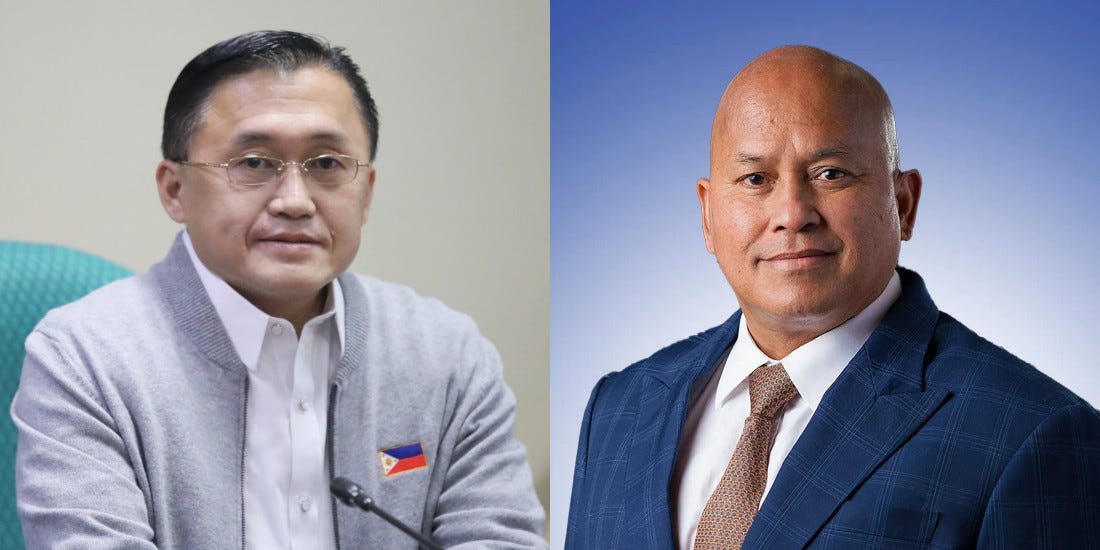
The International Criminal Court in The Hague in the Netherlands has named eight onetime members of the top leadership of the Philippines’ national police as accomplices of former President Rodrigo Duterte who helped to prosecute the murderous drug war carried out during Duterte’s six-year reign from 2016 to 2022. The eight include Duterte’s former special assistant Christopher Lawrence “Bong” Go, and Ronald “Bato” dela Rosa, the former chief of the Philippine National Police, both of whom have since been elected to the Philippine Senate.
Prosecutors described a “national network” that comprised essentially what became known as the Davao Death Squad during Duterte’s mayoral reign in Mindanao’s Davao City, scaled to a nationwide operation during his presidency. Officers allegedly operated under the assumption that they were invulnerable as long as they served a government-sanctioned campaign. The international panel, in an amended indictment issued on February 13, indicated there are other unnamed co-conspirators as well in the 80-year-old Duterte’s drug campaign.
The other six named are Vicente Danao, Oscar Albayalde, Dante Gierran, Camilo Cascolan, Vitaliano Aguirre II and Isidro S. Lapeña, all of whom ascended from positions in Davao City law enforcement and formed the nucleus of Duterte’s national law enforcement group, prosecuting what the ICC’s amended charge describes as a “Common Plan to ‘neutralize’ alleged criminals through violent crimes including murder across the Philippines.”
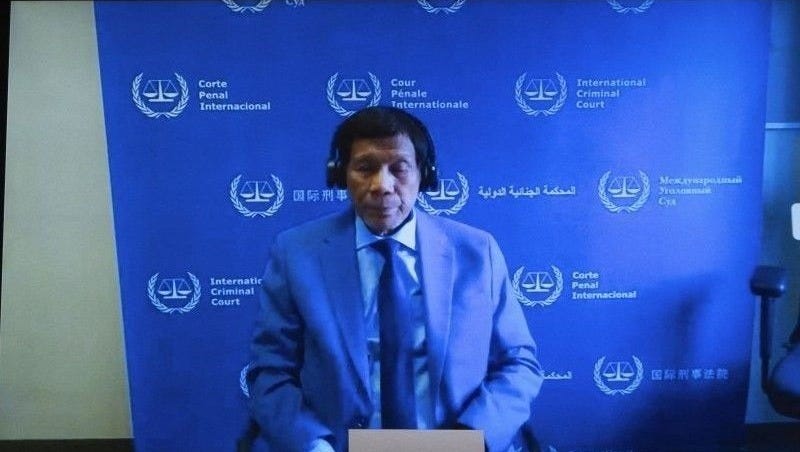
Duterte was arrested on March 11, 2025, by the Philippine National Police and Interpol under an ICC warrant charging him with crimes against humanity related to his drug war and has been in custody in The Hague for the past 11 months. The charges extend back to Duterte’s period as mayor, when he won national fame as a roughshod reformer, with an estimated 1,500 suspected drug dealers and other criminals killed by death squads and police. In his presidential campaign, he promised to fatten the fish of Manila Bay with the bodies of drug dealers although many of the dead were believed to be merely petty criminals the police wanted to get rid of.
Hundreds of new complainants
An additional 500 victims have been included in the list of complainants cited by the ICC, bringing to 539 the number of victims or representatives from their families who are directly involved in the investigation, a fraction of the thousands claimed by human rights organizations. The Philippine National Police, however, claim only 6,252 deaths during what they describe as “legitimate anti-drug operations.” The Armed Conflict Location & Event Data Project (ACLED) puts the figure at 7,843, while Human Rights Watch and the ICC estimate the toll to be between 12,000 and 30,000. This higher range includes “deaths under investigation” and killings by unidentified vigilante groups. The amended 16-page ICC document can be found here.
It is uncertain what effect the naming of the officials by the international tribunal is likely to have, beyond making it inconvenient for them to travel internationally for fear of arrest. They are unlikely to be arrested domestically and turned over to the ICC. Some 58 percent of Filipinos expressed opposition to Duterte’s own arrest, with his regional stronghold in Mindanao objecting most. Many consider President Ferdinand Marcos Jr to have improperly arranged the Interpol arrest to rid himself of the head of a rival political clan. It has cost him dearly in popularity and he isn’t likely to make that mistake again.
The imprisoned former president remains relatively popular and his daughter Sara, who has vowed to continue his drug war, is outperforming Marcos in opinion polls despite a looming impeachment charge over her performance as vice president, considered by many to be a political ploy to scupper her chances to run for the presidency in 2028.
Sara Duterte has capitalized on the arrest, accusing Marcos of having her father ‘kidnapped.’ Public outrage over the extradition is said to contributed to what was called a “midterm massacre” in June 2025 polls for the Philippine legislature.
“The case against Duterte in The Hague is a stark reminder of the importance of the International Criminal Court as a court of last resort, standing for equality before the law, with the potential to reach even those thought to be untouchable,” wrote Carlos Conde, who heads the Manila-based Rights Reports Philippines NGO. “But it is precisely because the court is pursuing its global mandate that it is currently under attack. In February, President Donald Trump issued an executive order authorizing sanctions against its officials and others supporting the court’s work, in a bid to shield U.S. and Israeli officials from facing charges of war crimes and crimes against humanity. The court can overcome these challenges, but only with the support of the international community and its member countries. This is true when it comes to confronting the sanctions and to securing more arrests across the court’s docket. International Criminal Court member countries should step up their efforts to protect the court that they created to ensure that the victims of the most serious crimes have access to justice.”
War against the unwanted
Part of the problem in generating outrage is that Duterte’s war on drugs turned out to be a war on the poorest of the Philippines’ poor, particularly in Manila’s teeming slums. The murders were almost all committed either by police officers or death squads against poverty-stricken users of crystal methamphetamine, known as shabu in the Philippines, and didn’t touch the higher-placed individuals bringing drugs into the country. The current issue of the US-based Harper’s Magazine carries a 7,500-word description of how desperate their plight is.
They were virtually nameless victims, powerless and unknown to anyone in the power structure with enough clout to stir outrage, even including the shabu ‘dealers,’ who were likely to be little better off than the users. Police officers were incentivized to target victims through cash rewards and promotions. Payments for eliminating any of the alleged “high-value targets,” the ICC document said, ranged from P50,000 (US$863) to P1 million. The ICC documented evidence that police routinely planted firearms, ammunition, and drugs on victims to fabricate justifications for killings, directly contradicting the official narrative that suspects died resisting arrest.
The drug policy was formulated during Duterte’s reign as Davao City mayor and included “at least hundreds of other murders during the mayoral period, thousands of other murders in the Presidential period, and other violent crimes…carried out pursuant to a State policy to ‘neutralize’ through violent crimes, including murder, alleged criminals in the Philippines who were perceived or alleged to be involved in drug-related and other crimes such as theft and murder,” the complaint states.
The attack “was widespread [and] carried out on a large scale and frequent basis, victimizing a significant number of civilians over a broad geographic area and a prolonged period of time. During the mayoral period, it occurred in Davao City for a period of more than four years. During the presidential period, the attack expanded to locations across the Philippines for a period of almost three years. The attack included thousands of killings, which were perpetrated consistently throughout the charged period.
It was systematic “in that it was planned, organized and executed in a coordinated fashion, with the acts perpetrated in a clear pattern of violence directed at the targeted population.”