
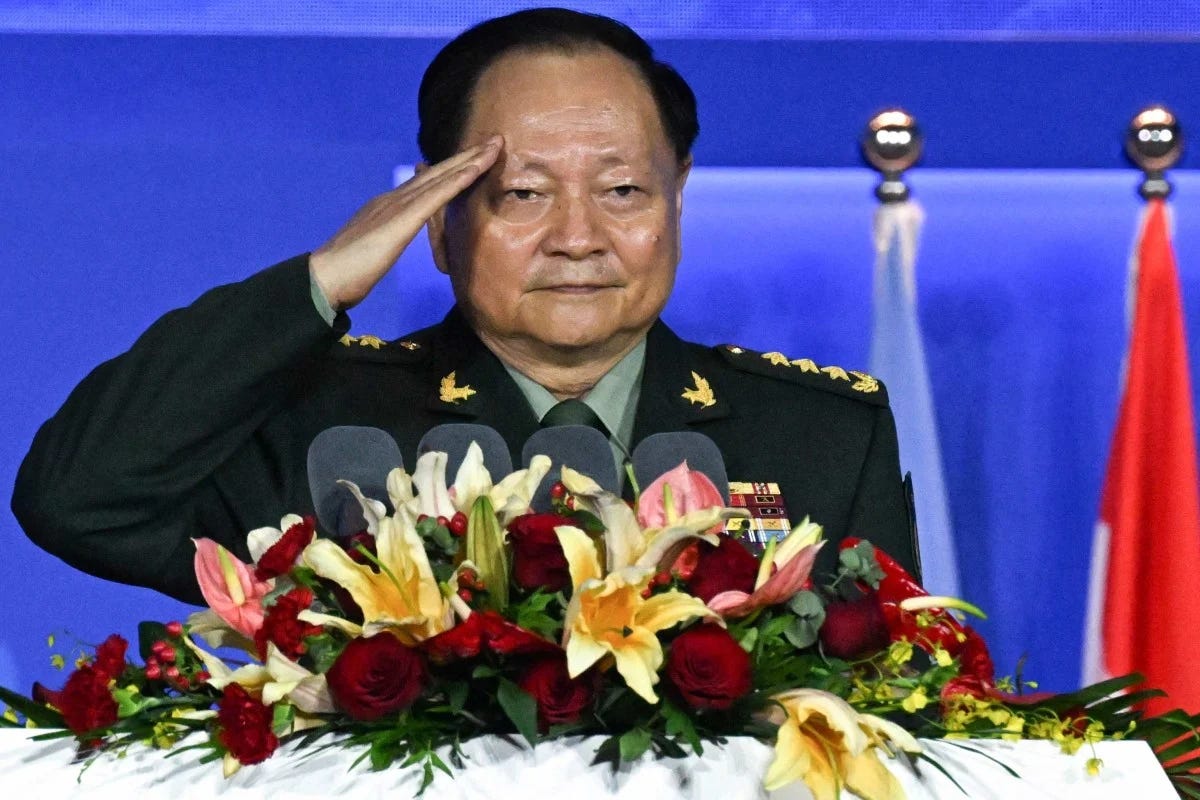
The Saturday sacking of China’s second-most-powerful military leader, General Zhang Youxia, and another top Chinese general, Liu Zhenli, has awakened speculation that the two had sought to pull off a coup against Chinese President Xi Jinping and comes at the expense of a weakened and unsettled People’s Liberation Army (PLA), possibly narrowing the prospect of an invasion of the recalcitrant island of Taiwan.
It is the latest in a series of purges of Chinese military officers since 2023 that has wracked the Chinese military, with at least 70 arrested over a corruption scandal in the elite rocket force. On June 29, 2024, Asia Sentinel reported that two former defense ministers, General Li Shangfu and General Wei Fenghe, were prosecuted and expelled from the Chinese Communist Party.
At 3 PM Beijing time on January 24, China’s Ministry of Defense announced that Zhang and Liu were being investigated for “serious violations of party discipline and the law.” Although scores of senior Chinese officers have been taken down since 2023, Zhang is the most powerful military chief to be purged since the 1971 falling out between Mao Zedong and Marshal Lin Biao, a defense minister and heir to Mao. The charges are not only about corruption but also disloyalty to Xi, according to an editorial in the PLA Daily published around 11 PM Beijing on January 24. The editorial said, “The resolute investigation of Zhang Youxia and Liu Zhenli is a major victory of the struggle against corruption of the party and military.”
“As senior officers of the party and military, Zhang Youxia and Liu Zhenli seriously betrayed the trust of the party center and the Central Military Commission, seriously trampled upon their responsibilities in the Central Military Commission, severely affected the party’s control of the military, damaged the party on political and corruption issues,” the editorial disclosed.
The Central Military Commission (CMC) is the small group of China’s most powerful military leaders. Xi is the CMC chairman, with Zhang until recently vice chairman, and Liu a member.
“Seems Xi has removed all hindrances to remaining emperor, but at the expense of unity and normalcy,” Willy Lam, a senior fellow of the Jamestown Foundation, a US think tank, told Asia Sentinel. “He can only depend on rising stars who know how to flatter him, but whose military efficacy is dubious. Most generals with experience have been removed. Taiwan is safe for the moment.”
“Xi sees Zhang Youxia as a real threat. He must have gotten enough support to get rid of [him]. Xi will have a greater mandate and confidence facing Trump,” said a source who asked not to be named.
The PLA Daily editorial hinted more heads will roll, saying the elimination of the “ice” of corruption in the PLA “is not a day’s work” and the digging into corruption is getting deeper.
More arrests are likely, agreed David Tsai, a US-based China watcher, in a January 24 tweet: “The arrests were carried out like a shocking military mutiny. Next, a large number of lieutenant generals, major generals, and even division-level officers will be arrested as well.”
Just a year ago, the CMC had six members including General He Weidong, Admiral Miao Hua, Zhang and Liu. The current purge means only Xi and General Zhang Shengmin areleft, leaving a significantly thinned and unsettled high command. Zhang Shengmin oversees anti-corruption investigations within the PLA, so he was probably Xi’s tool to take down Zhang Youxia and Liu.
He Weidong and Miao Hua, two former Xi allies, were purged last year, Asia Sentinel reported last June 5, in a downfall that bears the hallmarks of a power struggle between Xi and Zhang Youxia – leaving Zhang, after the removal of He and Miao, to be purged in turn. Zhang and Liu Zhenli were the only members of the CMC with significant combat experience. Removing them leaves the PLA high command with less seasoned leadership, a level of disruption that could cause confusion and dysfunction in decision-making, particularly in a potential wartime scenario. The need to purge top-ranking loyalists suggests a deep trust deficit within the PLA, with political loyalty prioritized over operational readiness.
Dennis Wilder, a professor at Georgetown University, tweeted on January 24, “This is definitely the CCP equivalent of the Nazi ‘night of the long knives.’ Zhang’s real crime. Becoming all powerful in the military after destroying the He Weidong network…. Xi wants his fourth term, and nothing will stand in his way.”
Xi is currently serving a third term, breaking the rule laid down by the late Chinese leader Deng Xiaoping that limited the tenure of China’s leaders to two five-year terms.
Ironically, Xi and Zhang were childhood friends. Zhang Youxia’s father, Zhang Zongxun, was a founding member of the PLA and served alongside Xi’s father, Xi Zhongxun, in the Chinese Civil War. The Xis and Zhangs hailed from the same province of Shaanxi.
“How do you convince Xi that his childhood bestie is threat to him? Who would dare to do it? What would be their incentives?,” tweeted Victor Shih, Director of the 21st Century China Center of the University of California at San Diego, on January 24. “This is shocking to me. I had thought that He Weidong was the Lin Biao figure, but it turns out to be Zhang Youxia, one of Xi’s oldest friends who helped him consolidate power. I just can’t believe that corruption alone did this.”
Trump’s National Defense Strategy
Hours before the Chinese Defense Ministry announced the investigation of Liu and Zhang, the US Department of War released its National Defense Strategy, which doesn’t even mention Taiwan. The report said the US will “deter China in the Indo-Pacific through strength, not confrontation.” President Trump, it said, “seeks a stable peace, fair trade, and respectful relations with China, and he has shown that he is willing to engage President Xi Jinping directly to achieve those goals. But President Trump has also shown how important it is to negotiate from a position of strength.”
The de-escalation also demonstrates the Trump administration’s worldview of the planet as divided into distinct spheres of interest dominated by Russia, China and the United States, each of which allows the other to live and let live. The US will support “strategic stability with Beijing as well as deconfliction and de-escalation, more generally. But we will also be clear-eyed and realistic about the speed, scale, and quality of China’s historic military buildup. Our goal in doing so is not to dominate China; nor is it to strangle or humiliate them. Rather, our goal is simple: To prevent anyone, including China, from being able to dominate us or our allies,” it added.
He will soon be sleeping with the fishes.