
By: John Elliot
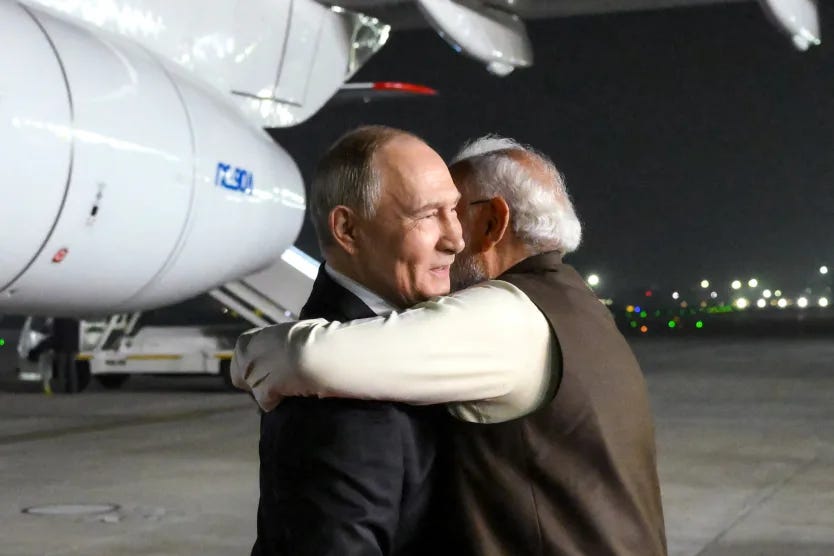
It could have been a tightrope walk, but President Vladimir Putin’s state visit to India during the past two days was so well stage-managed that it was a success both for him and Prime Minister Narendra Modi. Putin was showing the world that he could still be treated as a global stateman by a significant world power despite the invasion of Ukraine, and Modi was showing Donald Trump that he had alternative powerful friends to the US president. Together, they were giving a signal to the West of a significant play in global politics.
The display of personal bonhomie began the moment Putin landed in Delhi on Thursday evening and shared Modi’s car to a private dinner. That led on Friday to the best pageantry and hospitality that India could provide, along with joint public statements and a mass of well-meaning agreements with a target set last year of US$100 billion trade by 2030.
While the visit only lasted just over 24 hours, it was one of the most significant and high profile of the two countries’ 23 annual summits and it gave much-needed fresh impetus to the relationship. But it was knocked off what would have been wall-to-wall television news coverage by pandemonium at India’s airports when over 1,000 airline flights were cancelled due to operational problems.
The agreements didn’t go so far as Putin might have hoped. They didn’t commit India to continue buying controversial Russian oil, which is being significantly reduced having mushroomed after the Ukraine invasion when it caused a rift between India and the US. Nor did they include major new orders for Russia’s S-400 missile defense system, which India is already using, nor joint production in India of Sukhoi Su-57 fifth generation jet fighters. That has given Trump less to complain about at a time when India is trying to finalize a US trade deal.
The annual summit is usually a bilateral event of only modest international significance. If Trump hadn’t upset 25 years of work by successive US leaders coaxing India gradually to move away from its historic Soviet and Russian allegiances, it would probably not have hit the world headlines this week, apart from the focus on Ukraine. But Trump’s imposition of 50 percent tariffs in July, coupled with criticisms of the Modi regime for buying Russian oil, upset that and led to Modi showing that he could be as close to Putin as he was to Trump in the past.
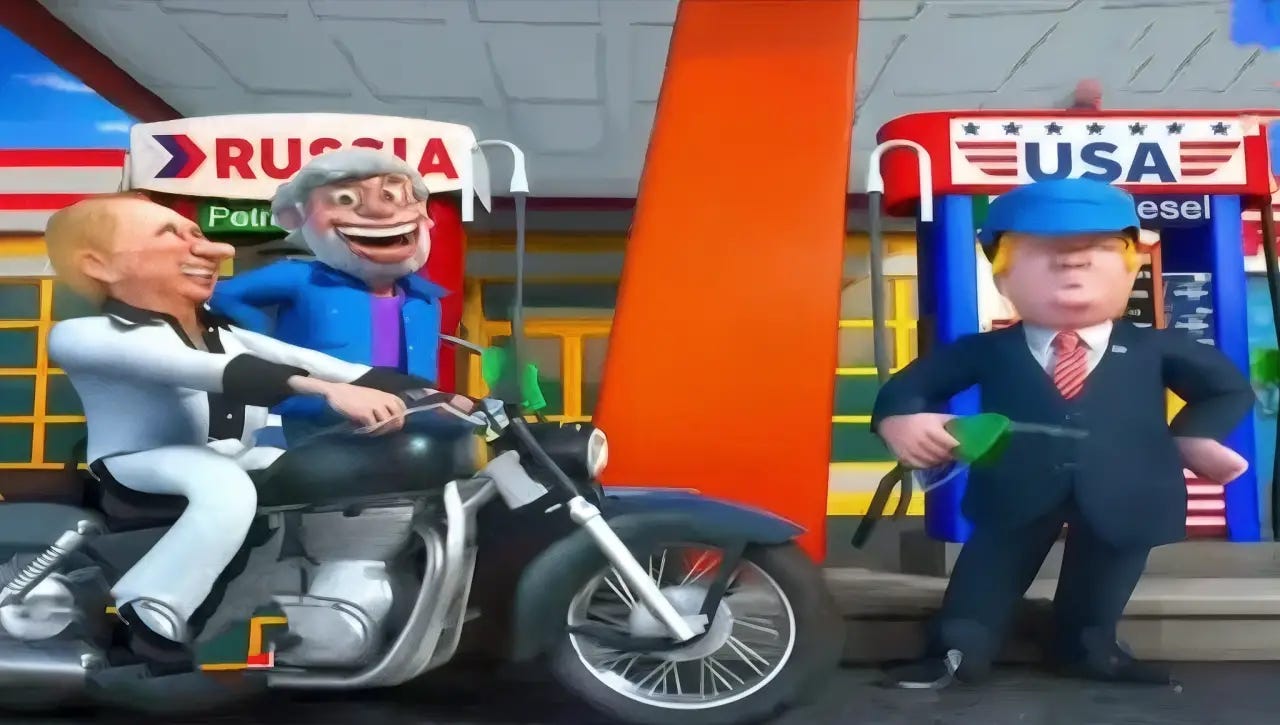
The visit could have turned into a trilateral with Trump interrupting from the US as a social media interloper, but he has – so far – remained uncharacteristically silent. (He spent part of yesterday receiving FIFA’s first peace prize). That has led to speculation that he knows he cannot now object to Modi being close to Putin when he is trying to negotiate a Ukraine peace settlement with business overtones.
Also in Modi’s and Putin’s minds would have been Xi Jinping, China’s president, who has been developing close links with Russia and is also patching up relationships with India after years of tense and sometimes hostile engagements on its undefined border. Modi has to be suspicious of Putin’s relationship with Xi, especially since China provides India’s hostile neighbor Pakistan with aircraft, missiles and other support.
Putin’s last visit to Delhi was four years ago this week during the Covid crisis, two months before he launched the invasion of Ukraine. The visit lasted just five hours. Since then, he and Modi have had a total of 16 conversations, 11 between 2022 and 2024 five this year.
At a regional summit in China on September 1, Putin ostentatiously invited Modi into his limousine for an hour’s private conversation. Modi said that “even in the most difficult circumstances India and Russia have walked together, shoulder to shoulder. Our close co-operation is important not just to our two countries but for global peace, stability and prosperity”.
Continuing the upbeat emphasis on the relationship, a detailed Indian government statement issued on December 4 described Russia as a “longstanding and time-tested partner” and said the countries had a “Special and Privileged Bond.”
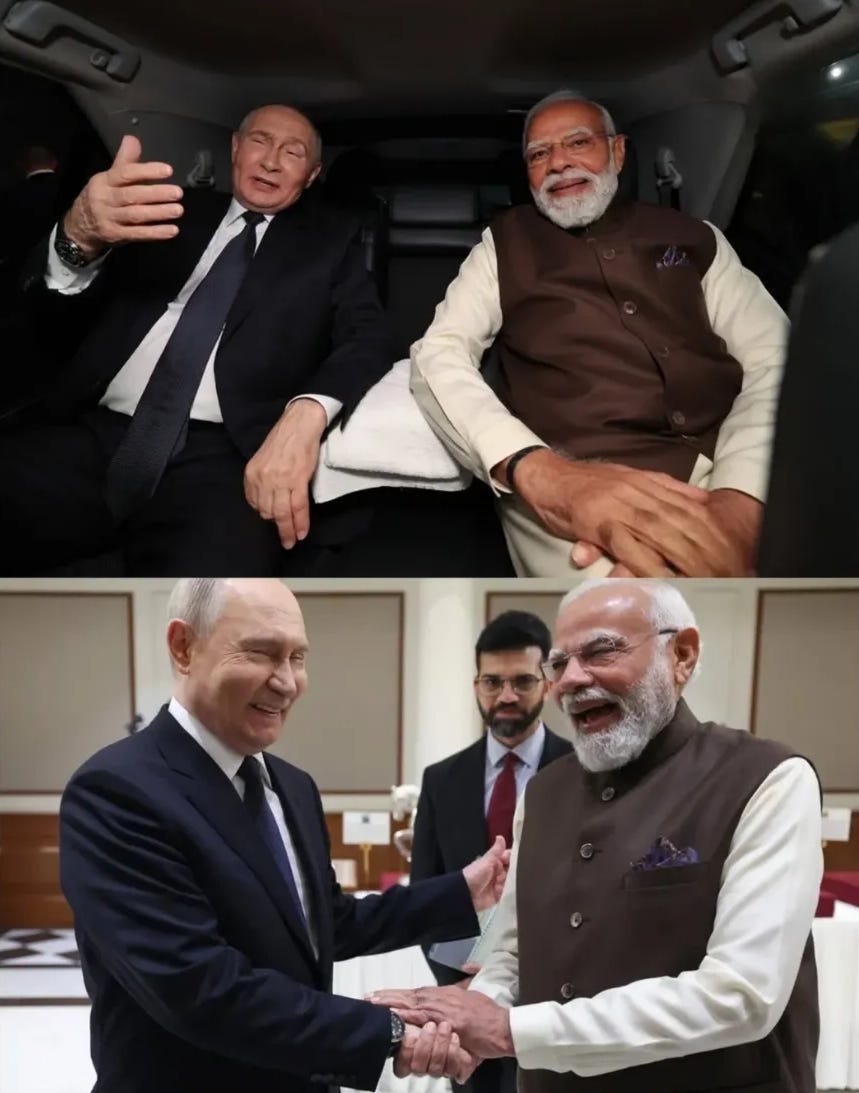
Putin said in a long 100-minute interview with India Today tv before he left Moscow that Modi was “a person of integrity” who was “very sincere” about “strengthening Indian Russian ties across the whole range of areas, especially crucial issues of economy and defense and humanitarian cooperation, development of hi-tech”.
“It is very interesting to meet with him,” Putin added. “He travelled here, and we sat with him at my residence and we drank tea for the whole evening, and we discussed different topics. We simply had an interesting conversation purely like humans…. The Indian people can certainly take pride in their leader.”
Putin also said Russia was “a reliable supplier of oil” to India and was “ready to provide uninterrupted fuel supplies.” The US had continued to buy nuclear fuel from Russia so “why shouldn’t India have the same privilege!”
At a joint media conference, however, Modi said energy security had been a “strong and vital pillar of the India-Russia partnership,” but avoided the oil purchases and defense deals. Instead, he mentioned the value of the two countries’ long-standing “win-win” co-operation in civil nuclear energy which they would continue to take forward.”
A major focus was on bilateral trade, which rose sharply if lopsidedly with the oil purchases to a record high of US$68.7 billion in 2024-25. That was made up by Russia’s (mainly oil) exports of US$63.8 billion while India’s totaled just US$4.9 billion. Putin was accompanied by a large business delegation, partly aimed to boosting what Russia buys from India. An Indian pharmaceutical factory in Russia plus investments in shipbuilding and critical minerals are among the plans.
Perhaps the most unconventional and controversial diplomatic incident was an article written jointly by the British high commissioner in Delhi and the French and German ambassadors that was published on December 1 in the Times of India. Titled “Russia doesn’t seem serious about peace,” it said: “Every day sees new indiscriminate Russian attacks in this illegal war, targeting civilian infrastructure, destroying homes, hospitals, and schools. These are not the actions of someone that is serious about peace.”
It is far from clear what the three countries’ ambassadors hoped to achieve, nor who they were trying to influence. They were rebuked by India’s foreign ministry for breaching “acceptable diplomatic practice,” and the Russian ambassador wrote a reply titled “Europe’s Four Treacheries are Impeding Peace in Ukraine.”
The high commissioner’s and ambassadors’ article presumably reflected the view in Europe that it was unacceptable for Modi to lay on such an unconditionally splendid welcome when Russia is not only failing to negotiate a Ukraine peace deal but is also provoking European countries with military and cyberspace maneuvers. Coincidentally, as he flew into Delhi, Putin was personally blamed by a UK inquiry for the death in 2018 of a Salisbury resident accidentally infected by the Novichok nerve agent intended to kill a former Russian spy and UK double agent. There were also reports of the UK unfreezing £8 billion of frozen Russian assets to aid Ukraine.
Viewed however from Asia, which broadly regards Russia’s war with Ukraine as a distant problem for the West to deal with, Modi properly called for a peaceful solution, while Putin in his India Today tv interview mixed support for seeking resolution to the war with a hard line on winning the bitterly disputed Donbas region.
“We will finish it when we achieve the goals set at the beginning of the special military operation – when we free these territories,” Putin said, having just mentioned the Donbas when asked for his red lines. “Either we take back these territories by force, or eventually Ukrainian troops withdraw and stop killing people there.”
John Elliott is Asia Sentinel’s South Asia correspondent. He blogs at Riding the Elephant.
Pair of disgusting scumbags.
Two heads of government of shithole countries with no real allies make a big show of being friends. So what. Trump is right to stop wasting resources trying to persuade India to be an ally of the West.