
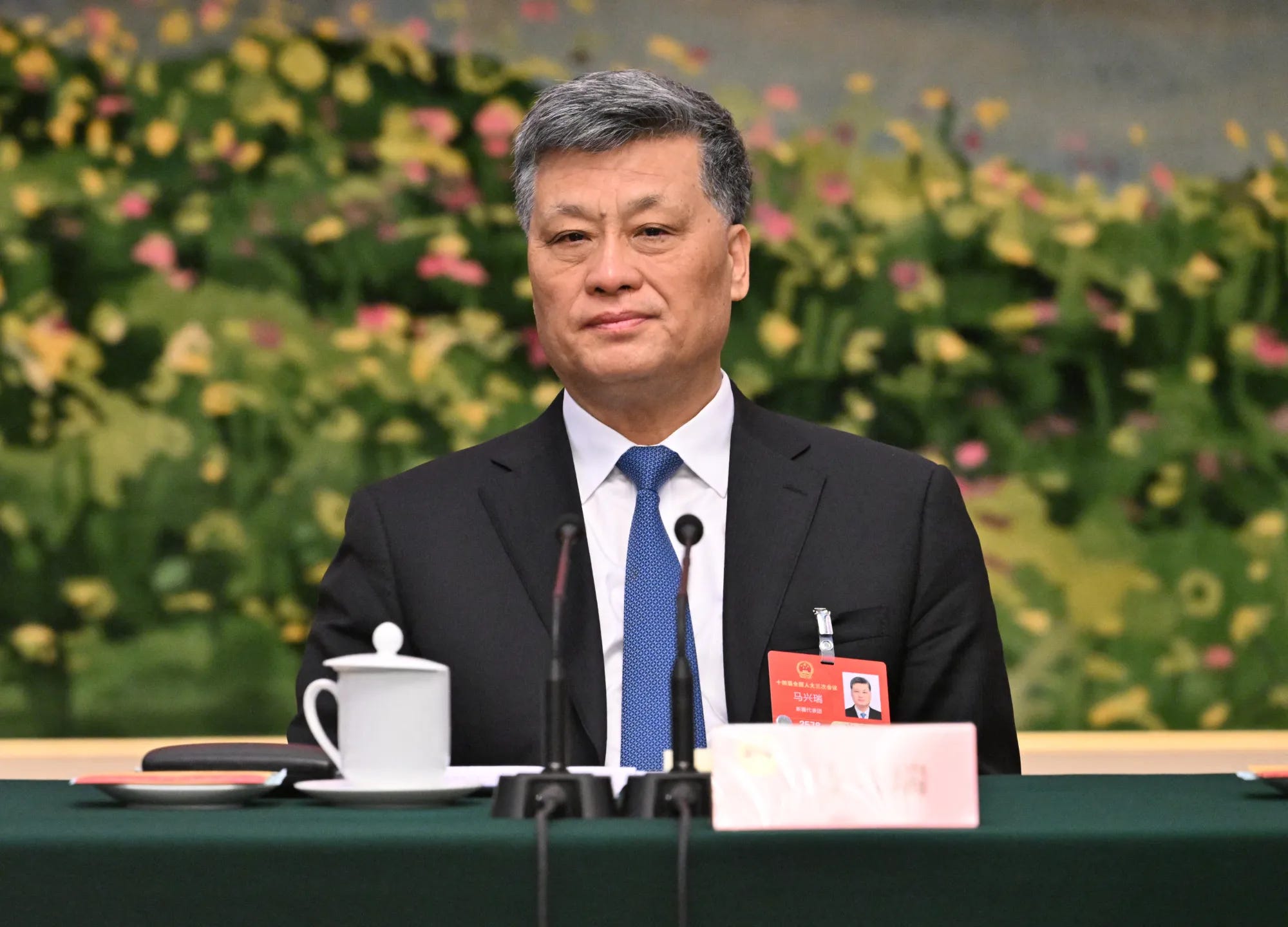
Since Chinese President Xi Jinping launched his anti-corruption campaign in late 2012, millions of Chinese officials have been taken down, including “flies” (minor officials) and “tigers” (senior officials). Recently, complications have emerged in Xi’s crusade, involving a tiger who got caught and the apparent disappearance of a general in charge of fighting corruption in the People’s Liberation Army (PLA).
After a decade and a half in power, with waves of sweeping purges to protect his position, there’s little evidence that Xi faces any genuine rival, but internal power struggles nevertheless remain fierce. It is also an indication, however, of the difficulty of eradicating corruption that continues to pervade the Chinese political establishment. The recent snared tiger, Ma Xingrui, is a former head of the Xinjiang Uygur Autonomous Region and a former member of China’s Politburo, the country’s highest policy-making body– and an acquaintance of President Xi’s wife.
On June 30, the state-owned People’s Daily announced that Ma had been expelled from the Chinese Communist Party and dismissed as a member of the National People’s Congress. Ma’s ill-gotten gains were confiscated and he faces trial, People’s Daily added. He is the first civilian Politburo member to be taken down for corruption since July 2017.
“Politburo members typically enjoy an informal layer of political immunity and are rarely ever removed while in office,” said a report of SinoInsider, a China-focused political risk consultancy based in New York, on July 16. “Since the end of the Cultural Revolution, very few sitting Politburo members have been publicly expelled and criminally prosecuted solely for conventional corruption or personal misconduct. Ma Xingrui’s downfall suggests that he was deemed guilty of serious transgressions.”
What makes Ma’s case unusual is his long association with Xi’s wife, Peng Liyuan, growing up together in Yuncheng County, Shandong Province. When she was a child, Peng frequently spent time in the Ma family home, according to media reports. Ma’s wife, Rong Li, is reportedly close to Peng. Despite Peng’s associations with Ma and his wife, there is no evidence of wrongdoing by China’s first lady.
“The case is significant as it marks the first visible crack in the implicit social contract between Xi and his top lieutenants,” tweeted Henry Gao, a law professor at Singapore Management University, on July 15.
Some overseas Chinese media outlets and commentators have argued that the purge of Xi “confidant” Ma is a sign that Xi is “losing power,” said the SinoInsider report. “A closer examination of Ma’s career, however, shows no special connection between Ma and Xi,” adding that Ma didn’t receive special promotion or treatment while being elevated in the officialdom, “unlike those who were actually longtime Xi allies such as Cai Qi or Li Qiang.”
“Ma Xingrui turned his back on the party’s principles, seriously violated the party leadership’s political requirements for senior officials…. The nature of his case is extremely severe, creating an extremely bad influence,” said the People’s Daily. He was also accused of trading power and money for sex. He was charged with accepting gifts and money and was accused of helping relatives buy property at below-market prices, helping relatives obtain huge benefits and “committing rampant family corruption.”
Ma’s “rampant family corruption” largely involved his wife Rong Li and younger brother Ma Xingquan, reported the Hong Kong-based Chinese-language daily Ming Pao. Rong distributed Hong Kong-registered insurance policies to families of senior Chinese officials, alleged several media reports.
A July 17 report by the Chinese financial publication Caixin on Ma “has uncovered a sprawling political-business syndicate that extracted billions of yuan from real estate deals and dumped toxic assets onto property giant China Vanke Co. Ltd. (which is listed in Hong Kong and Shenzhen).”
Ma was close to Hui Ka Yan, a former chairman of the now-defunct China Evergrande Group, once China’s biggest property developer, which collapsed last year in a sea of red ink. In April, Hui pleaded guilty in a Chinese court to fraud, embezzlement and bribery in relation to his formerly Hong Kong-listed company.
Disappearing generals
Although Ma has been expelled from the NPC, two generals, Zhang Youxia and Liu Zhenli, remain members, five months after the announcement of corruption investigations against them in January. Zhang Youxia and Liu were formerly members of the Central Military Commission (CMC), China’s most powerful military body, headed by Xi. After their removal from the CMC, the commission shrank from four members to two –Xi and General Zhang Shengmin, the PLA’s top anti-graft official. Strangely, Zhang Youxia and Liu Zhenli remain listed on the CMC, although the weblinks to their names are no longer there.
“Zhang Youxia’s fall represents far more than another corruption case. It marks the culmination of a multi-year power struggle between competing princeling factions for control of China’s military,” said a report of the Institute of Security Development & Policy based in Stockholm, Sweden, on January 30, 2026.
In another unusual development, a few weeks after two other Chinese generals were appointed to important posts, all mention of them was deleted from the Chinese Ministry of Defense website and the People’s Daily Chinese-language website.
According to an announcement on China’s Ministry of Defense on July 3, at a ceremony in Beijing on that day, Xi promoted Zhang Shuguang to full general and appointed him as head of the CMC anti-corruption department. At that ceremony, Xi promoted Wang Gang to full general and appointed him the chief of China’s air force, said the defense ministry announcement.
“That means Zhang Shengmin will retire soon and Zhang Shuguang will likely become new Vice Chair of CMC. Wang will likely be part of new CMC lineup in 2027,” tweeted Lyle Morris, a senior fellow of the Asia Society Policy Institute’s Center for China Analysis.
Subsequently, the announcement on the defense ministry website has been shortened such that the names of Zhang Shuguang and Wang Gang were obliterated, only stating Xi promoted unnamed generals. The names of Zhang and Wang can no longer be found on the defense ministry website at this time of writing. The latest mentions of Zhang Shuguang and Wang on other Chinese state media websites like China Daily and the English version of People’s Daily occurred on July 3 and 4
On July 11, Morris tweeted, “Interesting. News of this has been scrubbed from the PRC MND website and the PLA Daily. It’s like it didn’t happen. Are they purged already?”
“The strange goings-on around Zhang Shuguang and Wang Gang further illustrates the fact that while Xi remains top dog overall, his influence on PLA high-level personnel developments is less than total, in fact, subject to disruptions by generals who do not see eye to eye with Xi, but who publicly dare not openly contradict Xi,” Willy Lam, a senior fellow of the US think tank Jamestown Foundation told Asia Sentinel.
The photograph of the promotion ceremony showed an unsmiling Xi, who looked unhappy, standing with Generals Zhang Shengmin, Zhang Shuguang, and Wang Gang.
A possible clue to why references to Zhang Shuguang and Wang were deleted from the defense ministry’s website lies in the identity of their ultimate backers. Wang is believed to be a protégé of former Chinese President Hu Jintao, who was unceremoniously escorted from a meeting by Xi in October 2022. Wang’s major promotions came while Hu was China’s leader. Zhang Shuguang spent years as a PLA anti-corruption investigator under Zhang Shengmin and is therefore considered his protégé. He also served for a time in the northern Chinese command under Zhang Youxia.
Zhang Shengmin is believed to be an ally of Zhang Youxia (they are not related), Asia Sentinel reported on June 5, 2025. Both men belong to the “Shaanxi gang,” since Zhang Shengmin was born in Shaanxi province while Zhang Youxia was born in Beijing, but his ancestors hailed from Shaanxi, raising the likelihood that Zhang Shuguang is possibly an ally of Zhang Youxia.
The great benefit to the U.S. from these constant purges is that it likely reduces the possibility of China making a military move against Taiwan. Hard to see a surviving general acting with sufficient initiative in a conflict knowing one false move gets them arrested. Unless there is somebody who is a) HIGHLY capable and b) was not taking any money. Given the price of a first star was $150,000 ten years ago, that sounds like a unicorn.
i guess he should have just stuck with profiting from state-backed uygur slave labor.