
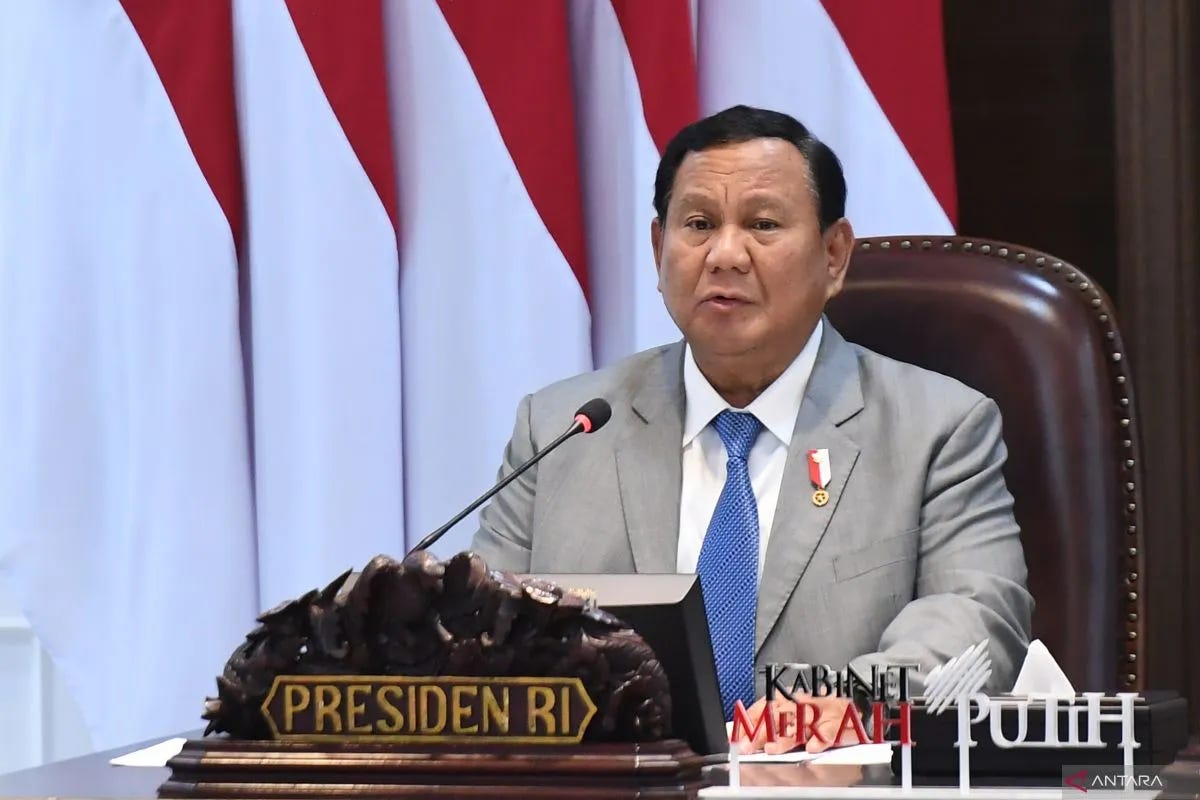
A wide range of media sources in Jakarta are reporting that President Prabowo Subianto is growing frustrated with the massive sovereign investment fund he established a year ago on the expectation it could transform an agglomeration of corruption-riddled state-owned enterprises into a global wealth fund similar to Singapore’s Temasek. He is demanding to see results and warning government officials not to submit reports that misrepresent facts simply to please him.
Prabowo originally projected that Daya Anagata Nusantara, or Danantara, as it is known, could eventually manage assets worth up to $1 trillion with a minimum annual return on investment of 7 percent, later raised to 10 percent in an economic climate in which the World Bank reported national GDP growth at 5.11 percent for 2025, moderating to a projected 5.0 percent for 2026.
“Do not play games with me by providing false reports just to make me happy. I give this as a serious warning,” the president said during a speech marking the fund’s first anniversary.
Prabowo’s warning came after both Moody’s and Fitch international rating agencies have recently expressed concerns over the governance, funding and investment priorities of the fund. Fitch noted that Danantara’s role could increase debt-financed investments, which might lead to higher budgetary risk amid declining fiscal transparency. It revised Indonesia’s sovereign outlook to negative from stable, while affirming its ‘BBB’ rating. Moody’s has also revised Indonesia’s credit rating outlook to negative from stable, largely over Danantara’s governance concerns.
Danantara is also raising concern that Prabowo’s economic policies center on a shift toward state-led, nationalistic strategies redolent of his onetime father-in-law Suharto, that threaten to strain public finances and reduce investor confidence as well as his proclivity, as a former general, to turn to the military in other areas to seek to accomplish national goals.
Local media reported last week that Prabowo set a target for Danantara to contribute at least US$50 billion annually to the state, based on an estimated minimum return on assets of 5 percent from the state assets it manages.
“We understand that in the first years we may not achieve the higher targets. If we only require a 5 percent return on assets, that means Danantara must return US$50 billion to the state each year,” Prabowo said, adding that Danantara must establish long-term targets for managing state assets and eventually aim for an annual ROA of between 10 percent and 15 percent.
It is too early for financial reports for the fund, which has been gobbling up not only SOEs but investing in a wide range of so-called National Strategic Projects, including in energy and mineral processing sectors that have long been fraught with controversy. It has taken over up to 2 million hectares of seized illegal oil palm forest, handing them over to a state-owned enterprise which specializes in palm oil management.
Danantara at the outset took over management of the affairs of 70-odd SOEs which hold assets equivalent to 52 percent of GDP. They include the country’s three biggest banks and the national energy, national electricity, national telecommunications and national mining companies, as well as dozens of others that are money-losing and riddled with inefficiency and corruption and have been a long-term drag on the economy. In 2018, the country’s audit board (BPK) noted that procurement issues accounted for 49 percent of total state losses. Between 2016 and 2021, 119 corruption cases were reported within SOEs involving 340 suspects. Notable cases include the 2024 PT Timah Tbk scandal, which led to an estimated Rp300 trillion in losses. Other high-profile corruption cases have involved Garuda Indonesia, Jiwasraya, and Krakatau Steel.
It is difficult to see how the SOEs can be reformed without a revolutionary housecleaning. That hasn’t occurred. From its inception, Danantara’s governance structure has drawn criticism. Prabowo’s constitutional role as chairman of the supervisory board, combined with a management lineup populated by figures with close political and business ties to him, has raised red flags. Indonesia Corruption Watch has identified at least 24 of the 31 individuals in its organizational structure as Politically Exposed Persons—current or former holders of public office or individuals with significant power or influence—considered more vulnerable to involvement in illicit activities such as bribery, corruption or money laundering. At least seven of those 31 are said to maintain active political affiliations.
Civil society groups also have pointed out that a number of projects promoted, ranging from coal downstreaming and energy development to natural-resource-based ventures, involve individuals or companies with close political ties to the president or to Danantara’s leadership itself. One project frequently cited is the Kayan Hydropower Plant in North Kalimantan, billed as one of Southeast Asia’s largest energy projects and a cornerstone of Indonesia’s green industrial ecosystem and mineral downstreaming agenda. Behind the narrative of energy transition and sustainable development, multiple sources suggest that companies linked to Hashim Djojohadikusumo, Prabowo’s brother, may be involved, whether as developers, strategic partners, or suppliers.
Coal downstreaming is under scrutiny, particularly the development of gasification technology to produce dimethyl ether, or DME. Planned for three sites across Sumatra and Kalimantan, the project has long been promoted as a substitute for imported liquefied petroleum gas. Civil society studies, however, have highlighted that the mining areas and supporting zones for the project are located on land associated with companies that have historical ties to Prabowo.
Yet in the renewable energy sector, several prominent business figures active in the field also maintain close political connections to Prabowo or to Danantara’s leadership. Among them is Aburizal Bakrie, a central figure in the Bakrie Group and a member of the Prabowo–Gibran campaign advisory board. There is also Boy Thohir, the chief executive of Adaro Energy, who has publicly declared his political support and is related to Erick Thohir, Indonesia’s minister of state-owned enterprises and a member of Danantara’s supervisory board. To many analysts, this web of positions and relationships signals the potential for conflicts of interest in the management and financing of renewable energy projects designated as nationally strategic.
From the beginning, critics have pointed to the limited transparency in institutional design, particularly the absence of adequate public disclosure regarding investment decision-making mechanisms, project selection criteria and conflict-of-interest mitigation. Civil society organizations including Yayasan Indonesia Cerah, Indonesia Corruption Watch, Trend Asia and Climate Rangers have launched an independent platform known as Danantara Monitor to track and report on the institution’s activities.
The consequences of this opacity are becoming increasingly apparent. A number of projects have sparked public controversy because they appeared abruptly, without clear explanations of how they were selected or why they were prioritized. In some cases, the names of companies and individuals involved became known only after projects were announced as part of the national strategic agenda, rather than during the planning stage. As a result, space for public and parliamentary oversight has narrowed, while perceptions of conflicts of interest have hardened in the absence of timely official clarification.
Perhaps most significantly, the situation has begun to erode confidence both domestically and internationally as the Moody’s and Fitch downgrades have shown. Governance experts warn that without strong transparency safeguards, Danantara risks being perceived not merely as a state investment instrument but as an extension of political power and particular business networks. Even if such perceptions do not culminate in legal violations, they could undermine its credibility as a long-term investment partner, ironically contradicting the very purpose for which the institution was created.