
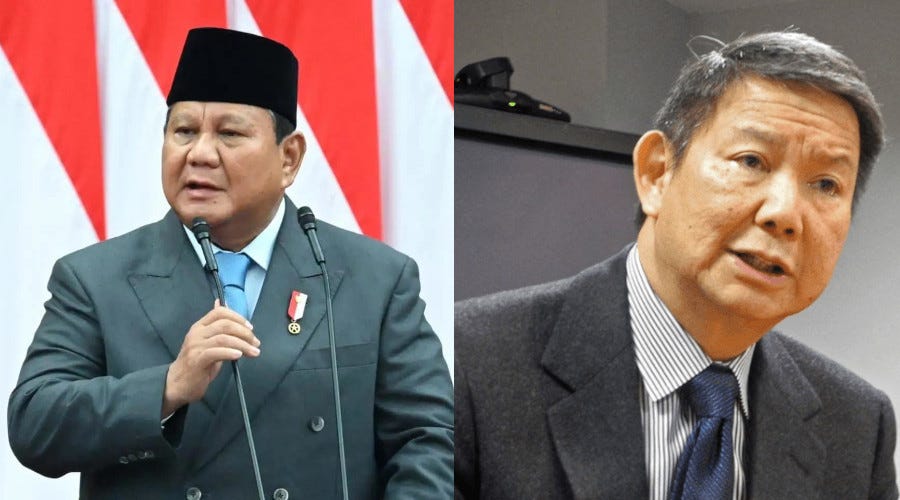
After years of electoral defeat and the enormous financial toll of repeated presidential bids, the brothers Prabowo Subianto and Hashim Djojohadikusumo are now enjoying what appears to be a golden era — not only in politics, but also in business. As Indonesia’s newly elected president consolidates power, pushing through dozens of regulations that distribute power among party elites, political volunteers, retired generals and the president’s immediate family, his younger brother has moved aggressively to expand a sprawling commercial empire, raising growing concerns over conflicts of interest at the intersection of state authority and private capital.
Hashim, through his holding company Arsari Group, has in recent years accelerated investments across a wide range of sectors from digital infrastructure and telecommunications to renewable energy, mining, property development and digital assets. The pace and scale of this expansion, coming amid Prabowo’s ascent to the presidency, have prompted warnings from civil society groups that Indonesia may be entering a period in which political power and commercial influence are becoming dangerously intertwined within the president’s own family, an ominous replay of the decades when Prabowo’s own father-in-law Suharto, who was driven from power by public outrage in 1998, treated Indonesia as an enormously corrupt family enterprise that resulted in the alleged theft of anywhere from US$15 billion to US$35 billion, making him one of the world’s most corrupt leaders.
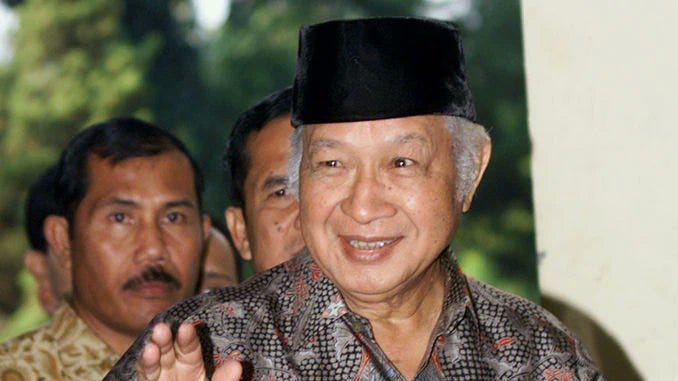
Prabowo finally secured the presidency in 2024 on his fifth attempt, after four previous failures in which he either lost the race outright or failed to advance as a viable contender. Those repeated campaigns exacted a heavy financial price. Based on official campaign finance disclosures submitted to Indonesia’s General Elections Commission, Prabowo and his running mates spent nearly Rp500 billion (US$2.98 million) during just two presidential elections, in 2009 and 2014. That figure represents only a fraction of the total cost of mounting a national presidential campaign in Indonesia.
While no definitive figure exists, estimates from political researchers and policy institutes suggest that a presidential and vice-presidential ticket typically requires trillions of rupiah to compete effectively. By the 2019 election, rumors circulated widely that Prabowo was running out of money. Several political figures were quoted in local media making remarks that suggested he had become increasingly cautious — even frugal — in his spending.
At the same time, one of his companies, the paper manufacturer Kertas Nusantara, was reported to have fallen behind on wage payments and severance pay to thousands of workers after operations were halted. The reports reinforced a growing perception that Prabowo’s long-held ambition to become president had strained not only his political capital, but also his personal finances.
Prabowo was not alone in bearing the cost. For years, his younger brother Hashim, now 70, served as the principal financial backer of both Prabowo’s political ambitions and business ventures. Hashim himself became entangled in a tax arrears case in Switzerland beginning in the mid-2000s. For years afterward, his lawyers sought to persuade Swiss authorities that he was effectively bankrupt — a condition he attributed in part to having spent roughly Rp5.5 trillion (US$297.95 million) to bail out Prabowo’s businesses and bankroll his election campaigns.
Hashim had faded from public view after his name surfaced in a 2002 scandal involving Indonesia’s Bank Indonesia Liquidity Assistance (BLBI) program. Yet by 2020, Forbes listed him as one of Indonesia’s richest individuals, estimating his wealth at around Rp10 trillion (US$595.8 million). He is now widely known as the owner of Arsari Group, a conglomerate active in mining, agribusiness and renewable energy.
Prabowo Consolidates Power
Two decades on, Prabowo’s own reported wealth has rebounded significantly. According to his official asset disclosures, his net worth now exceeds Rp2 trillion, the bulk of it held in the form of securities — typically corporate shareholdings — valued at approximately Rp1.7 trillion. Media investigations have linked him to or alleged ownership of roughly 20 companies operating across sectors including fisheries, palm oil, timber and forestry, pulp and paper, and coal mining.
Speaking at a consolidation meeting of his campaign volunteers in January 2024, Prabowo stated that the land area under his control now approached 500,000 hectares. One of those holdings, located in Central Aceh, has recently drawn intense scrutiny after being accused of exacerbating deadly floods and landslides across Sumatra that have killed more than 1,150 people.
An analysis based on concession maps by the civil society group Mining Advocacy Network (Jatam) concluded that the disasters were not caused solely by extreme rainfall. They were also driven, the group said, by widespread deforestation in upstream river areas — including industrial plantation forest concessions owned by President Prabowo Subianto through PT Tusam Hutani Lestari (THL).
PT Tusam Hutani Lestari controls roughly 97,000 hectares of forest across Central Aceh, Bener Meriah, Bireuen, and North Aceh. The concession areas sit alongside dozens of other large-scale land leases, collectively eroding mountainous forest cover, damaging watershed catchment areas, and weakening the natural capacity of the landscape to absorb heavy rainfall.
Indonesia Corruption Watch (ICW), in a review of the first year of the Prabowo–Gibran administration, warned that Prabowo appeared intent on consolidating power in a manner reminiscent of Indonesia’s authoritarian New Order era under President Suharto. In a report published in October 2025, ICW noted that the New Order regime relied on three main pillars: the armed forces (ABRI), the bureaucracy, and the Golkar party.
According to ICW, Prabowo has revived what it called the “spirit of the New Order” in a new configuration: the military (TNI), the National Nutrition Agency (BGN) and his Gerindra Party. The military has once again expanded its role in civilian affairs, the BGN — bolstered by vast budgetary authority and staffed heavily by retired generals — has become a central bureaucratic engine, and Gerindra has emerged as a dominant political force reaching deep into regional governments. Added to this, ICW said, is a new financing vehicle known as Danantara, designed to underwrite Prabowo’s ambition to fully exploit Indonesia’s extractive resources.
The Resurgence of Hashim’s Business Empire
Since Prabowo assumed the presidency in 2024, Hashim Djojohadikusumo’s business interests have expanded with striking speed. Through Arsari Group, which he founded in 2006, Hashim has invested in sectors widely viewed as lucrative in the years ahead: digital infrastructure (FiberCo), telecommunications (WIFI/Surge), renewable energy, mining (Arsari Tambang), property development (via TRIN) and digital assets (COIN).
In partnership with the private equity firm Northstar and the telecommunications company PT Indosat Tbk., Arsari established a joint venture focused on fiber-optic connectivity. To create the new company, valued at 14.6 trillion rupiah, Indosat transferred ownership of its fiber-optic assets. The transaction allowed Indosat to monetize those assets in exchange for a 45 percent stake in the new entity, while Arsari Group also acquired a 45 percent stake.
Launched in late December, the joint venture — operating under the name FiberCo — is set to manage an integrated fiber-optic network spanning more than 86,000 kilometers, including national backbone infrastructure, domestic subsea cables and access networks serving telecommunications towers and business districts.
“Through this collaboration, Arsari Group is committed to building the physical backbone of Indonesia’s digital economy, which will boost productivity, expand digital inclusion and open new AI-based economic opportunities,” said Aryo P.S. Djojohadikusumo, Arsari Group’s deputy chief executive and Hashim’s son.
Hashim has also broadened his reach by establishing PT Arsari Sentra Data, which has become the controlling shareholder of PT Solusi Sinergi Digital Tbk., known as Surge. Surge recently won a tender for the 1.4 GHz frequency band, clearing the way for the launch of a low-cost internet service branded as Internet Rakyat (IRA).
Industry analysts say IRA could prove disruptive in Indonesia’s telecommunications market. The service, offering unlimited 100 Mbps internet for 100,000 rupiah per month, is expected to attract consumers while intensifying competition among internet service providers.
Through another subsidiary, PT Arsari Nusa Investama, Arsari Group has also entered the digital asset sector by acquiring shares in PT Indokripto Koin Semesta Tbk. (COIN), a publicly listed digital asset trading platform. The size of the stake was not disclosed. Observers say the move is strategically significant, given Hashim’s position as the president’s younger brother — a status that leads markets to interpret his business decisions as signals of future economic policy direction.
In mining, Arsari Tambang is studying the acquisition of mining assets in Canada valued at approximately Rp7 trillion, with the transaction targeted for completion by June 2026. Aryo Djojohadikusumo said the plan gained momentum after Indonesia and Canada signed the Indonesia–Canada Comprehensive Economic Partnership Agreement in September 2025.
Hashim, now serving as the president’s special envoy for climate and energy, has also set his sights on the electricity and renewable energy sectors. In May 2024, during a visit to the Kayan Hydro Energy hydropower project in North Kalimantan, he expressed interest in investing in the project. The hydropower plant has since been designated as one of 29 National Strategic Projects, a status that provides government guarantees ranging from financing support to legal protections.
The family’s business maneuvers have also reached the real economy. Arsari Group is reported to be finalizing plans to acquire a 20 percent stake in PT Perintis Triniti Properti Tbk. (TRIN), a property development company. Market speculation suggests the move is not merely a portfolio investment, but could signal long-term synergies between TRIN and Arsari’s land bank and infrastructure ecosystem.
In its report, Indonesia Corruption Watch concluded that since the start of the Prabowo administration, political cronies have benefited more quickly than others, reinforcing Prabowo’s consolidation of political and economic power.
The report, titled “Only One Year In, Already Repressive and Authoritarian,” cited several government decisions that it said directly benefited Hashim, including the designation of the Kayan hydropower project as a National Strategic Project, the formalization of Nusantara as Indonesia’s political capital — where Hashim’s companies are set to supply clean water — and advantages arising from the Indonesia–Canada Comprehensive Economic Partnership Agreement.
“Companies linked to the Prabowo family are enjoying direct benefits from government policies, making this a clear and tangible conflict of interest,” ICW said in its report.
The author asked to remain nameless out of a concern for personal safety.
what's the difference with every president in indonesia since suharto?
every new president does the same thing as this article points out