

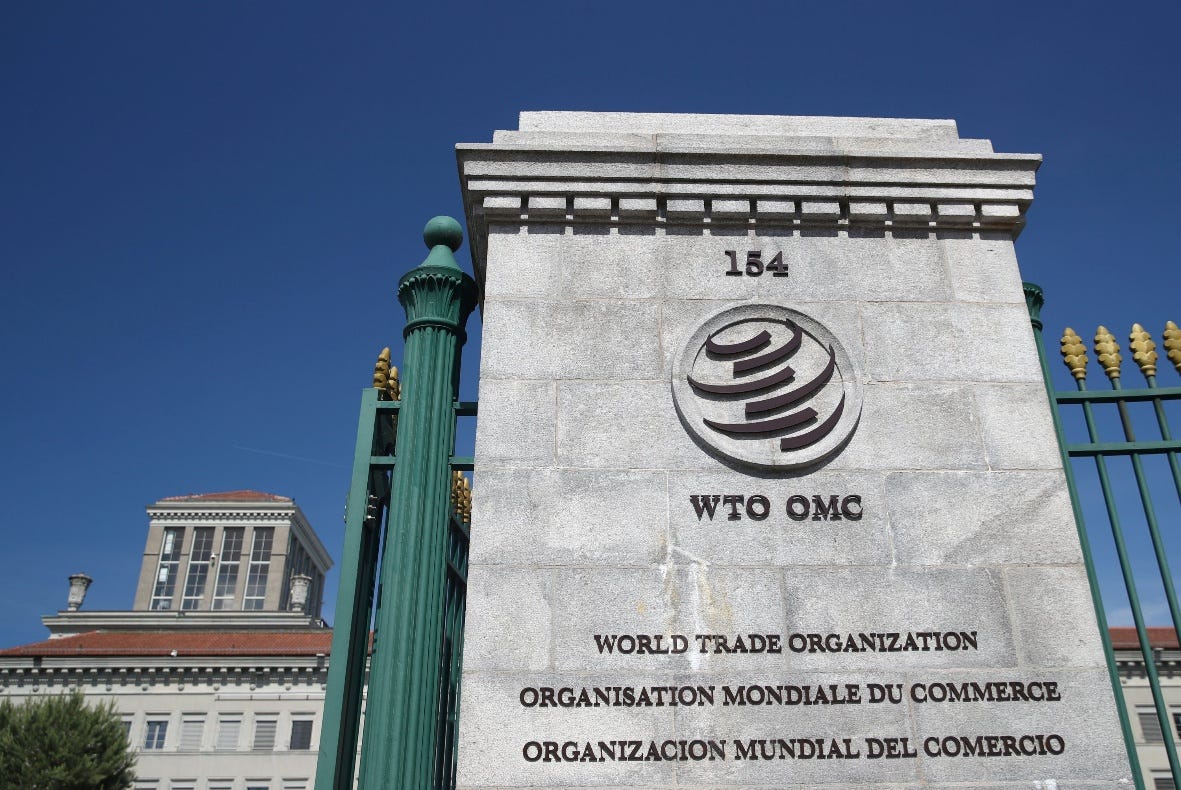
The World Trade Organization, born in 1947 as the General Agreement on Tariffs and Trade (GATT) and reconstituted in 1995 as one of the three major pillars of global economic governance, along with the International Monetary Fund and the World Bank, is little heard from today beyond the odd press release, for instance, one recently announcing discussions of professional qualification recognition.
The organization has faced setbacks including difficulty negotiating new rules for modern trade including agriculture, IT and climate, but the main obstacle is the United States and particularly the Trump administration, which now sees the world in a very different way, with the WTO reduced almost to a talking-shop in its Geneva headquarters.
The first Trump administration began to undermine the WTO by blocking appointment to its appellate system to settle disputes and determine breaches of WTO rules. The second has trashed the whole system by imposing new tariffs almost at random and then making agreements with specific countries based on individual deals, a direct contravention of any system of rules. Whether or not these tariffs are deemed legal by the US Supreme Court is irrelevant to the fact that the US no longer believes in rules-based international trade. Instead, it is the law of the jungle, with bedraggled old Trump as proclaiming himself King of the Beasts.
Long gone is the time when, for example, the US led the world in seeing freer trade as an opportunity for its great corporations and used its muscle to, in practice, informally align the WTO with the World Bank and the IMF, over which the US exercised major influence. US moves to make it possible for China to join and abide by its rules were a major issue – realized in 2001 and seen as a major achievement of the Clinton administration.
Gone too are the days when trade liberalization negotiations were seen as an important spur to global economic growth, at least among developed and upper middle-income countries. The Kennedy Round, the Tokyo Round, the Uruguay Round and the Doha Development Round, which has never been completed, were markers of progress and the extension of rules and an appeal system to services trade and intellectual property.
Assessing the disaster
The extent to which this is a disaster for world trade has yet to be seen. Much depends on whether other countries reject the WTO’s principles of fair, open, and predictable global trade through non-discrimination, binding commitments, lowering barriers, fostering fair competition and supporting development and economic reform. So far, global trade volume overall does not appear to have been badly impacted by Trump’s twists and turns and use of tariffs or threats thereof for narrow, often short-term political purposes. Trade has responded by shifting. Thus, while China’s exports to the US have stalled, those to Europe and ASEAN have boomed. The US trade deficit has been reduced but its overall current account deficit remains around 3 percent of its GDP.
So far, other countries haven’t followed suit on the beggar-thy-neighbor principle that crashed trade in the 1930s. Some countries, such as Mexico, have raised barriers to Chinese goods, partly to appease the US and partly to protect their own industries. There has been no direct retaliation by the EU against the US and China has used specific issues, notably rare earths, as its bargaining tool. This is of course against WTO rules but doesn’t impact trade more generally.
North America is another matter. Trump has already trashed the principles of the US-Mexico-Canada (formerly NAFTA) trade agreement with tariffs on steel and cars. The question now is whether the USMCA can survive at all. It is up for review this year and Trump has expressed skepticism, though Mexico’s Sheinbaum has so far proved an effective negotiator.
Pressure from Chinese exports
The EU has talked China into putting the brakes on exports of cheap vehicles by manufacturers with massive surplus capacity. Some ASEAN countries face domestic pressure to stem the flow of goods from a China suffering from over-investment and weak domestic demand. China has used global irritation over US behavior to enhance its own reputation as a believer in the rules system. Hypocritical, though that may be, concern with US behavior has seen Canada’s prime minister Carney resetting relations with Beijing and Germany’s Merz and UK’s Starmer are due there soon.
Overall, the negative impact on the world trade system has so far been small – and certainly much less than feared last April. In some ways, Trump’s actions have spurred cooperation elsewhere. The EU in January 2026 finally signed a long-negotiated free trade deal with Mercosur (Brazil, Argentina, Uruguay, Paraguay) after years of opposition from its farmers. In July 2025, the UK and India finally agreed an economic partnership deal including freer trade.
Thus far in Southeast Asia there has been no sign of backtracking on existing agreements and Japan and South Korea remain solid in defense of the WTO system, while having to concede to higher US tariffs. Some ASEAN countries, notably Malaysia, have accepted a degree of US resources hegemony with concessions on principles to a visiting Trump. These are likely to be disavowed, certainly after he leaves office if not before.
New free trade deals elsewhere and still-flourishing global trade are hopeful signs but whether they do much good for the WTO itself is another matter. Global progress has been halted for many years and while the Geneva-based body still does useful technical work including dispute resolution, it carries limited weight as an institution even though it broke new ground with the appointment of Ngozi Okonjo-Iweala, its first woman and first African as Director General in 2021. Although intellectual property is within the WTO’s remit, it has no role in contentious trade issues surrounding, for example, monopolistic or socially undesirable practices by search engines, websites and other key aspects of the digital age.
Nonetheless, insofar as the US is leading the way to undermine the WTO, much of the rest of the world may better recognize its merits. That may particularly be the case for lower-income countries that once saw it as favoring the developed world. Now the Global South may look to it, or at least the principles it represents, as being a defense for weaker countries from being picked off one by one by the big beasts. The US is the most obvious of those, but the other – China – is at least as dangerous for both open trade and industrial development in the poorer world.
China’s giant trade surplus is produced by an inbuilt economic bias to investment at the expense of consumption. It also faces accusations of violating WTO rules through state-led policies like subsidies, forced technology transfer, IP theft, market access restrictions and domination by state-owned enterprises. But a Global South political backlash against China’s nationalist economics might have already begun. Only by investing in offshore production can it avoid the backlash, but that is difficult while overcapacity at home is entrenched in the system – in housing, cars and, next maybe, robots. Meanwhile, it continues to churn out lower-tech stuff at prices with which many middle-income countries cannot compete.
maybe it all began when china was trusted and admitted, but that was based on info at the time.
just like the dollar itself, expect a slow decline in global trade organizations.
americans have proven they are simply not to be trusted with important durable institutions, and are just opportunistic traders qualifying for the BRICs club.
Trump’s "puerile iconoclasm" regarding the WTO is a "squalid betrayal" of the very Enlightenment principles that made American hegemony possible. To watch a "slovenly demagogue" dismantle the GATT’s legacy is to witness a "vandal defecating in a cathedral" simply because he cannot "comprehend the architecture".
The Dysfunctional Appellate Body: By "strangling the dispute mechanism" in its crib, the administration hasn't "freed" American trade; it has merely "legalized international mugging".
The Law of the Jungle: This is not "sovereignty," but a "regression into the tribal," where "contracts are treated as ransom notes" and "allies as marks".
The Hypocrisy of Hegemony: The irony is "leaden and inescapable": by "trashing the rules-based order," Trump has provided the "perfect moral camouflage" for the very Chinese mercantilism he "claims to abhor".
Ultimately, this "twisted image" being forced upon the world is not a new order, but a "monument to narcissism," where the "ruins of global cooperation" serve as the pedestal for a "man whose only talent is the bonfire".