
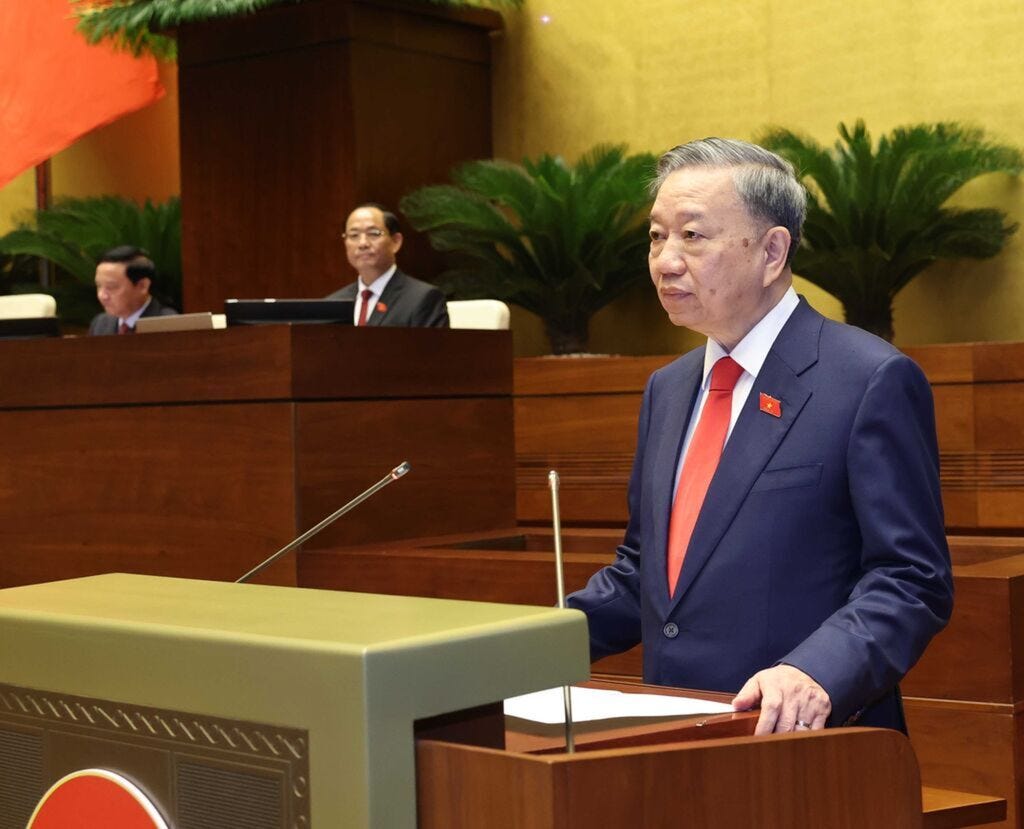
On February 26, in a demonstration of the Vietnam Communist Party’s support of citizens’ rights, the government set up early voting areas for 4,000 voters including those on ships, oil rigs, other offshore facilities and specialized environments to vote in advance of national elections, well before the actual March 15 start date. Domestic media have extolled the state and party’s commitment to free and fair polls to elect deputies to the 16th National Assembly and the 11th City Council of Ho Chi Minh City.
It is an election in name only, however, critics say. Only party members are effectively allowed to run, with party General Secretary Tô Lâm, a former security chief and the country’s most powerful political figure, significantly tightening security, consolidating power across the board and intensifying control over dissent, media, and the political establishment itself.
Across the country, 218 early polling stations have been opened. Some 73.4 million voters from 34 newly rearranged administrative units are expected to cast ballots. As a general rule, local community leaders compete for the highest turnout, mostly by pressuring citizens to vote and permitting proxy voting.
First year under sweeping changes
This year marks the first election that claims to be in an era characterized by sweeping reforms: provincial mergers, transition to a two-tier administrative model, digitization of public services, etc. Yet, amid the fanfare of media and the ongoing lawfare that prevents voters from exercising their freedom of expression, this 2026 edition remains a secure sham.
Domestic media have also gone to great lengths to emphasize the diversity of the pool of candidates that are to compete for 500 slots in the legislative body. Among the 864 candidates across 182 electoral units nationwide are 392 female candidates (accounting for 45.37 percent); 188 candidates from ethnic minorities (21.76 percent), surpassing minimum criteria set by the 2025 amended Law on elections that women and members of ethnic minorities account for 35 percent and 18 percent respectively. Only 65 of the 846 candidates are not members of the Communist Party, compared to 74 candidates in 2021. Only four are approved independent candidates, compared to nine previously.
The list of nominees for the National Assembly elections published on the information portal of the government is in a new order, not alphabetical, with Tô Lâm, the re-elected Secretary General, the first person listed. He is reportedly seeking dual roles as party chief and president, copying China’s Xi Jinping. On the list, date of entry to membership is also indicated to show seniority, though the law says that party membership is not compulsory.
In 2021, prior to the election, two self-nominated and non-Party member candidates were arrested for propagating information, documents and items aimed at “opposing the Socialist State,” although there was little evidence to prove their charges. State-controlled outlets accused the self-nomination as a “theatrical play” of self-styled democrats conspiring to overthrow the state.
Dissent crushed
Vietnam, now sitting on the UN Human Rights Council for the second term, has shown progress in crushing dissent over the past five years. As usual, the party is warning the public to be cautious of “distorted information” regarding self-nomination. Now, in addition to posting comments deemed detrimental to the reputation of the police or the party, sharing social media posts by overseas dissidents is also subject to fines, commonly VND 7.5 million (US$288. 25).
This year, there are no outstanding independent candidates. Lương Thế Huy, a Vietnamese jurist who became the first openly gay selfnominated candidate for the National Assembly in 2021, is no longer seeking candidacy. According to a 2024 report by the US-registered NGO Legal Initiatives for Vietnam, statebacked cybertroopers allegedly ran a smear campaign against him in 2021 with messages accusing him of tax evasion and of being a USfunded antistate actor although he is a prominent civil society figure.
Huy had been actively using social media to explain what he would do if elected, something other candidates at the time didn’t do. His failure to gain a seat in the legislature was disappointing but not surprising.
The “yes men” legislative body
The amended Law on Promulgation of Legal Documents, enacted by the National Assembly last year, significantly shortened the time for soliciting public comment when drafting laws to one third for ordinary procedures and to one sixth for fast-tracked ones, and even allows public consultation to be waived entirely for documents in “special” cases, though what it means to be special is cloaked in secrecy.
That facilitated the Ministry of Public Security (MPS), which produced most of the legislation in 2025, to announce a draft proposal to rate “digital citizens” last December, a few days after the conclusion of the 15th National Assembly. Citizens would be categorized into three groups: positive, basic, and unranked, depending on their engagement with the MPS-managed Vietnam Electronic Identification platform (VNeID).
In another move that parallels China, the MPS also proposed national regulation for DNA Biometrics for the national Identity System. Although the MPS has since the beginning of the year proposed 20 draft laws and proposals online for public consultation, the time frame for input coincides with the lunar new year. They include a draft decree detailing certain provisions of the Cybersecurity Law, one on regulations to prevent and combat fake news and misinformation, a draft circular on the implementation of the task of court protection by the People’s Police force, etc.
The police also occupy a major role in the electoral process, having helped to identify eligible voters based on national population data collected since 2021. For the first time, voters can also access information about elections via mobile application (VNeID). The police are committed to proactively and promptly “preventing, detecting, stopping, and neutralizing any plots to sabotage the election early and from a distance.” The MPS has produced 36 nominees including the Minister Lương Tam Quang, now also Politburo member.
Shortened term
The 2021-2026 parliamentary term has been shortened by three months, with election day also two months earlier than previously, supposedly because of alleged shortcomings of the transitional model in previous years. The early date is designed to smooth the rapid consolidation of the political apparatus and personnel of State agencies in alignment with Lâm’s plan to ensure new leadership is in place quickly.
“There are ministers and leaders who are not re-elected but still continue to manage because their terms are not over,” explains an article in state-affiliated media. “Similarly, at the local level, some individuals may not be re-elected as provincial party secretaries but continue to serve as chairpersons of the People’s Council until the new council is elected. This reality shows that while the old apparatus remains in place due to their ongoing terms, the new personnel and structure cannot commence because they lack legitimacy.”
Top leadership positions such as the President, Prime Minister, and Chairperson of the National Assembly are usually decided at the first session of the newly elected National Assembly in July 2026. However, these three must be members of the Politburo.
International actors, having condemned elections elsewhere, have so far been silent on Vietnam’s polls despite its consistent failure to adhere to human rights commitments. The EU upgraded its ties to comprehensive strategic partnership just a few days after the Party Congress concluded.
Trần Thanh Mẫn, who became chairman of the National Assembly following the “forced resignation” of his predecessor Vương Đình Huệ and was reelected to the Politburo last January, states that election results will be announced no later than March 25. Another all-time high turnout and broad unanimity are a foregone conclusion.