
By: Cameron Magusic
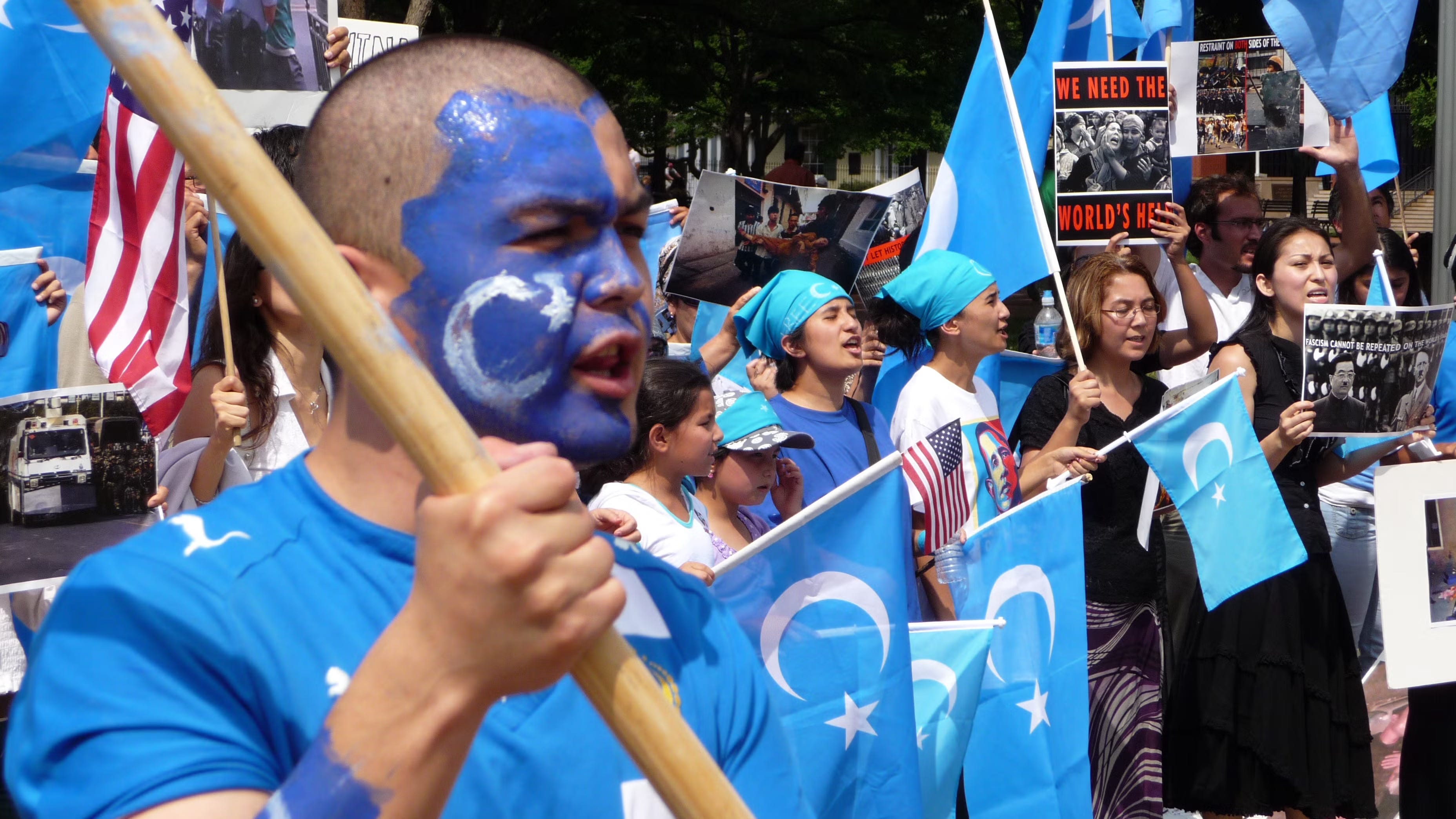
Acclaimed Uyghur poet and human rights advocate Abduweli Ayup has been invited to give a presentation at the Sorbonne University in Paris on Oct. 24, documenting linguicide and family separation in Xinjiang.
Speaking from his home in Norway, Ayup said he plans to use the occasion –which he will fund using his own resources – to reveal that 47,000 Uyghur children in Kashgar county have been separated from their parents.
He also plans to share videos and photos from so-called boarding kindergartens, an established concept in China that critics allege are used to instill national culture and result in Uyghur kids who “forget” their first language.
A translation of the invitation, written by the European Uyghur Academy, said that Ayup has been invited to give a lecture about his research as part of a “scientific symposium” that “will bring together Uyghur academics, engineers, artists, writers and young entrepreneurs working across different parts of Europe.”
The meeting “aims to exchange views on preserving the Uyghur language and cultural heritage, how the Uyghur diaspora – especially youth – can approach opportunities in modern science, technology, and business, as well as the future of the Uyghur diaspora and strengthening mutual cooperation.”
Linguicide by school
Ayup said one part of his presentation will focus on linguicide – the forced death of a language through policies, violence, or other ways.
“According to my documentation, Uyghur kids under 13 don’t speak Uyghur. The boarding kindergartens are the most dangerous [places] which [are] killing the Uyghur language. Uyghur language was eliminated from public life, like street signs, tables and even the menus at the restaurants. The kids have to report every morning at the school what language they spoke at home – if the schools found that kids speak[Uyghur] at home, their parents would be punished [by losing] their security scores,” Ayup said.
Kids, whom Ayup described as “prisoners,” “have to speak Chinese when they meet with their family members once a month.” Ayup also said these residential schools are “killing” the Uyghur language by keeping children there up to 270 days a year.
“If their kids speak Chinese well, their score will rise. If they don’t speak Chinese to their family members, they will lose their scores. The complete surveillance mechanism makes linguicide possible in the Uyghur homeland.”
The other part of Ayup’s presentation will focus on the Chinese ethnic unity law, which he says is his “main focus” because “we need to tell the world how dangerous it is.” The Law on Promoting Ethnic Unity and Progress, which took effect on July 1 this year, aims to protect minority rights and strengthen ethnic groups.
When the law took effect, the World Uyghur Congress said the legislation “seeks to forcibly assimilate ethnic groups” such as Uyghurs “into a single ‘Chinese nation’ by discouraging the expression of distinct ethnic identities while promoting a state-imposed concept of ‘ethnic unity’ that elevates Han Chinese identity as the national norm.”
Ayup, who has co-authored a new book about Uyghur exiles fighting in Syria, said the law has “criminalized freedom of expressions in diaspora, like expressing your opinion, send[ing] your kids to Uyghur schools in diaspora [and] participating in Uyghur gatherings outside of China.”
The law also “legalized demolishing Uyghur mosques, replacing place names, changing Uyghur culture [and] banning [the] Uyghur language,” Ayup said.
“We will publish a report about [kids aged between three and six years old who are in] the Chinese boarding kindergarten system because of their parents [being] in prison or because of their parents being transferred to other provinces.”
He said that while he is documenting testimonies of both crimes, he and his team of volunteers at Uyghur Hjelp, a not-for-profit he co-founded in Norway, are not pursuing legal action.
“I just document and publish reports. But legal action? That’s not my job,” Ayup said. ”We are focusing on documenting and explaining.”
However, Ayup said a legal case has been initiated by international human rights lawyer Rayhan Asat in the United States, “but the case is really slow.”
Verifying, documenting, exposing
Ayup, who is the only linguist in his group, said his process of documenting involves verifying claims by confirming identities and reports through open-source data and other ways.
Ayup said this open-source research extends to cultural artefacts: “We use Google Earth. For example, if you say that the mosque in your neighborhood is being destroyed, we use Google Earth to check if it happened or not.”
“We don’t publish anything if we are not sure it happened, but we hide some parts of the facts if it will put someone in danger, and we will not share that. So we never share the source.”
One challenge is corroborating claims. For example, in speaking with Uyghurs who have witnessed mass graves, he said, “The problem is people only can share with us that they have seen it and their family members are being buried there.
“It is really hard to prove it because we need to have solid evidence” such as photos, Ayup said.
“People can tell us what happened, but they can’t share the names and they can’t share the exact location” because they worry that the Chinese government will find out and family members will be persecuted.
Ayup also said that Uyghur Hjelp now focuses on telling detailed stories of Uyghur people who are arrested in China, rather than simply counting how many have been arrested.
“We did something like that in 2021 or 2020. At the time, we investigated 5,000 people being arrested. But since then, we focused on how many people were being arrested, then we focused on who they are.
“Now we are publishing their story. We published books of the people in jail, and we are going to publish an anthology of Uyghur writers who have been arrested,” Ayup said.
More broadly, while Ayup and others continue to raise awareness, he said the “crucial part” is stopping the genocide of Uyghur people and holding accountable those responsible.
While he noted the US government’s passage of the Uyghur Forced Labor Prevention Act in 2021, which prevents goods made with forced labor throughout Xinjiang from being imported into the US, he said other countries and international organizations like the United Nations haven’t played their part.
A recent Human Rights Watch report, for example, concluded “that what’s happening in the Uyghur homeland may constitute crimes against humanity,” Ayup said, but there weren’t any real accusations or action.
“Unfortunately, people are still being arrested,” Ayup said. “I am concerned that those people who were arrested in 2017 and 2018 … are dying. That’s the sad part.”
Cameron Magusic is an Australian journalist who has contributed to academic and public discussions regarding the human rights situation of China’s Uyghur Muslim minority.