

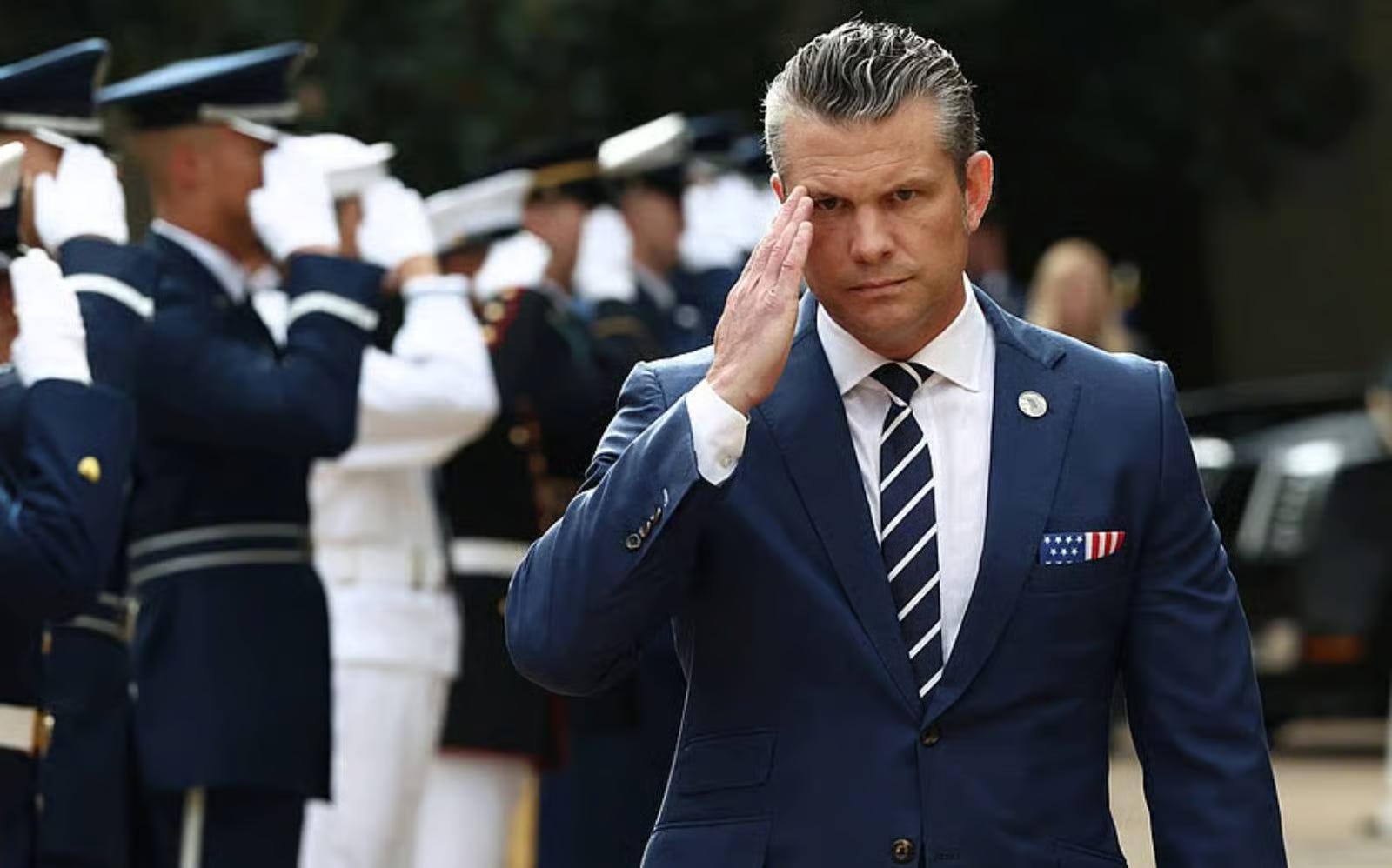
The Trump administration has revived relations with Phnom Penh over recent months, lifting an arms embargo implemented by Trump’s predecessor Joe Biden, and restarting joint military exercises ended in 2017 by Phnom Penh as Cambodia more closely aligned with Beijing, seemingly ignoring its standing as the world cybercrime capital and a pro-China obstacle to ASEAN and US efforts to slow China’s continuing claims to virtually all of the South China Sea.
Last October, Secretary of War Pete Hegseth met with Cambodian Deputy Prime Minister Tea Seiha in Kuala Lumpur to revive defense cooperation, which had been suspended following the near-complete breakdown in ties when Cambodia aligned itself more closely with China and accused Washington of plotting a “color revolution” to overturn the CPP government.
“Perhaps the brightest spot in Trump’s Southeast Asia policy is Cambodia,” Derek Grossman, a visiting Senior Fellow at ISEAS - Yusof Ishak Institute at the National University of Singapore, recently wrote describing the administration’s efforts at rapprochement.
Events as much as US wooing have begun to force a change in the rapport between Phnom Penh and Beijing, a recognition that the status quo ante is untenable. The economy is flailing from escalating tariffs, renewed Thai border tensions and a prolonged downturn in real estate. There has been a slump in tourism and Chinese investment, partly due to the reputational damage caused by the cyberscam industry, in which as many as 100,000 people have been lured by false promises to be forced to carry out online scams, The now-dormant confrontation with Thailand has also decimated cross-border trade and seen the return of almost a million migrant workers from Thailand.
Tariffs reduced
Trump’s first tariff announcement last April called for a crippling 49 percent rate on Cambodian goods, one of the highest in the world before dropping it to 19 percent in line with other ASEAN nations. The US is Cambodia’s biggest export destination, especially for apparel, footwear, and travel goods. China remains Cambodia’s largest overall trading partner and chief source of imports as well as its main economic collaborator – albeit with an overwhelming trade deficit – and a close geopolitical ally.
Hegseth later announced the military exercise resumption and the lifting of the arms embargo, a move intended to reduce Phnom Penh’s reliance on Chinese military technology. The secretary is expected to later join a future US naval ship visit to the Ream Naval Base, a strategically vital facility due to its location, offering access to South China Sea shipping lanes and a key potential trade chokepoint. The base has been upgraded with support from China, with Chinese forces believed to have special access.
“I’m sure that Trump values regional strategic balance above all else, especially in preventing China from breaking out of the first island chain, and the Cambodian port is an important part of this strategic consideration,” said a Kuala Lumpur-based military analyst. “The US realizes it has lost footage or influence in Vietnam, Laos and Cambodia due to a policy of strategic negligence. The US wants to return to Cambodia to deter China and Russia from exercising greater influence in the region, especially in the Gulf of Thailand. Washington is worried that it will lose access to the Strait of Malacca if China constructs the proposed land bridge spanning the Kra Isthmus. Phnom Penh is likely to allow China to make use of the Naval Base at Riem once completed which would put Washington at a disadvantage.”
The 48-year-old Cambodian Prime Minister Hun Manet, a graduate of the US’s prestigious West Point military academy, told reporters last November that US-Cambodian relations are improving, with both countries moving toward deeper cooperation in trade and other sectors. Hun Manet Sen is the son of Hun Sen, now president of the Senate, the longest serving prime minister in Cambodia’s history, an authoritarian strongman who ruled for 38 years through violence, intimidation, and the systematic dismantling of democratic institutions.
Hun Manet said his meeting on November 4 with US Assistant Secretary of State for East Asian and Pacific Affairs, Michael George DeSombre, focused on expanding bilateral ties in areas including fighting transnational crime. Earlier in January, DeSombre announced the US would provide US$45 million in assistance to Cambodia and Thailand to ensure peace between the two Southeast Asian neighbors, who recently clashed, and help both countries combat scam operations and drug trafficking.
Although Hun Manet has been linked by Human Rights Watch and other sources to large-scale online scam networks, particularly “pig butchering” scams and other alleged high-level corruption and involvement in illicit activities within Cambodia’s ruling elite, the Tokyo-based current-affairs magazine The Diplomat recently reported that “Cambodia’s top foreign policy objective is a concerted whitewashing of the new PM’s international image as some sort of heroic reformer,” allowing him to be welcomed at last year’s World Economic Forum in Davos.
Despite that, the country is widely described by analysts, journalists, and human rights groups as governed by a deeply corrupt ruling elite, particularly the Hun family and associated business figures, who have enriched themselves through illegal cyberscams and control of logging and land concessions and brutal suppression of opposition to maintain power. An explosive report partly funded by USAID last June directly implicated Hun Manet and his deputy premier, Vongsey Vissoth along with 28 other top government and business leaders, as well as officials of the Chinese Communist Party in Beijing, in a panoply of cyber crimes.
In October, the US seized assets including US$15 billion in bitcoin belonging to Prince Holding Group, and its chairman, Vincent Chen Zhi, called the largest forfeiture action in the history of the US Department of Justice. Last week, Chen, a close Hun Sen family associate, was extradited to China, where he is to go on trial.
“If the US was serious about building relations up with Cambodia, they would have appointed an ambassador by now,” said a Bangkok-based analyst. “But the ambassador designate, Robert Forden – who is career foreign service and was nominated by Biden, is still in Senate confirmation purgatory, going back to June 2022. It would be the easiest thing in the world for Rubio or Trump to withdraw his nomination and put some MAGA loyalist in there, but they have not done so.”
Partners will remain uncertain about the depth of commitment on issues like the South China Sea and Taiwan, wrote Japhet Quitzon, an Associate Fellow for the Southeast Asia Program at the Center for Strategic and International Studies in Washington, and Gregory B. Poling, a senior fellow and director for the Southeast Asia Program and the Asia Maritime Transparency Initiative at CSIS. “Ultimately, those anxieties trace to President Trump’s unclear position on competition with China and so cannot be assuaged by the secretary of defense or anyone else. But the overall effect of this trip, following on the heels of President Trump’s generally positive engagements in the region, was to reassure nervous allies and partners that a U.S. strategic retreat from the Indo-Pacific is not imminent.”