

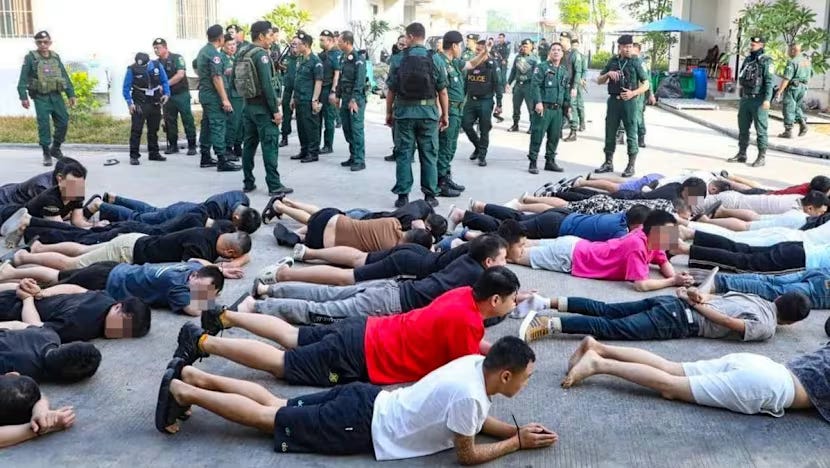
Under pressure from China, the United States and South Korea, Cambodia has begun clearing out the cyberscam operations that have employed tens of thousands of kidnapped victims to defraud the gullible across the globe through lovelorn, crypto currency investment, pig butchering and other rip-offs. Beijing, apparently fed up by the repercussions of mainland mafia gangs and their activities, has been putting the operators on trial and executing them as fast as they are returned to the country.
Videos have shown a mass exodus of Chinese nationals in Sihanoukville, Kandal, Battambang, Kampot and other Cambodian border towns. The UN Office on Drugs and Crime (UNODC) estimates at least 100,000 people worked in the industry. Last week, officials announced they had arrested 2,044 foreigners during a raid on a 22-building compound in southeastern Svay Rieng Province’s Bavet City, which shares a border with Vietnam. In previous raids, the kingdom said it had arrested another 5,106 online scam suspects in 23 nationalities over the past seven months, with 4,534 of them deported to their birth countries.
How sincere the government might be is debatable. Agence France reported many people had fled earlier, apparently after being tipped off to the raids, quoting a source who called the departures “anti-crime theater.” The 2025 US State Department’s Trafficking in Persons Report described senior Cambodian government officials and business elites as reportedly involved in and benefiting from scam operations, helping to explain their continued proliferation despite growing international scrutiny. In 2020, Chen Zhi, head of the notorious Prince Group, secured a minister-level advisory role to Hun Sen, having donated upwards of US$18 million to the government.

Last June, Jacob Sims, a Visiting Fellow at Harvard University’s Asia Center and an adviser to a variety of government agencies and NGOs and which was supported at least partly by the United States Agency for International Development (USAID), in a 73-page report directly implicated Hun Manet and his deputy premier, Vongsey Vissoth along with 28 other top Cambodian government and business leaders as well as officials of the Chinese Communist Party in Beijing in the scams.
Deja vu?
Mass expulsions have happened before. In 2019, Hun Sen, then Cambodia’s prime minister, announced, under apparent pressure from Beijing, an online gambling ban that emptied the seaside town of Sihanoukville, with an estimated 450,000 Chinese leaving the kingdom by 2020. But it wasn’t long before the country was once again teeming with huge compounds run by Chinese cyber-gangsters, risking becoming a major Cambodian economic pillar. Revenue generated by the scam compounds is estimated at US$12.5 billion to US$19 billion annually, equivalent to as much as 60 percent of Cambodia’s formal GDP according to a January 25 report by the Washington, DC-based Center for Strategic & International Studies, ahead of industry at 41.8 percent of the formal economy. Illicit revenue is not currently included in the country’s official economic reports.
In October, the Trump administration began reviving relations with Phnom Penh with a meeting between US Secretary of War Pete Hegseth and Cambodian Deputy Prime Minister Tea Seiha in Kuala Lumpur to reopen defense cooperation that had been suspended following a near-complete breakdown in ties when Cambodia aligned itself more closely with China. Whether that meeting included a demand for action on the scam compounds is unknown. But later that month, the US Justice Department announced the seizure of US$15 billion of bitcoin linked to multiple jurisdictions including Singapore, Hong Kong and Taiwan from online scams allegedly operated by Prince Holding Group, and Chen Zhi.
Cambodia initially responded defensively to sanctions against Prince Group, according to the Geneva-based Global Initiative Against Transnational Organized Crime. “However, pressure mounted on the country after Singapore, Thailand, Hong Kong, Taiwan and South Korea all moved to seize Chen Zhi’s assets, and impose sanctions and travel bans. Growing international outrage over the Prince Group’s transnational fraud empire seems to have forced China to ramp up pressure on Cambodia to cooperate in the deportation.”
Chen Zhi was arrested and, on January 7, was extradited to China, where it is likely he will be executed. Last week, China executed 11 members of the notorious Ming family criminal gang, who ran similar mafia-like scam centers in Myanmar. More than 20 additional family members received prison sentences ranging from five years to life, while the clan’s patriarch, Ming Xuechang, died by suicide in 2023 while evading arrest. Officials executed another four earlier this week, members of the Bai family mafia, a powerful clan that also operated large-scale scam centers in Myanmar. It is the latest development in Beijing’s intensified crackdown on cross-border telecom fraud and related crimes.

Hun Sen, now president of the Cambodia Senate, on January 29 told South Korea’s newly appointed ambassador to Cambodia, Kim Changyong, that “Cambodia will not tolerate telecommunications fraud or allow criminal groups to use the country as a safe haven, as authorities intensified a nationwide crackdown. In January, Hun Manet, a graduate of the prestigious West Point military academy in upstate New York, issued a public appeal for national unity, calling cyber fraud a serious transnational crime that threatened the country’s social security and reputation as well as the stability of the region.
Hun Manet said the ongoing operations reflect the Cambodian government’s “firm and uncompromising stance against transnational crime.” Cambodia, his father stressed, will not permit any criminal organization to use its territory as a hiding place or as a base for illegal activities, particularly those linked to telecommunications fraud.
While the scams have been an embarrassment to Cambodia, they have been an equally significant, high-level embarrassment to China, with mafia gangs operating cyber operations across Southeast Asia and far afield. Beijing has stepped up its own crackdown, initially targeting the networks operating along the border in northern Myanmar. Once those local syndicates were largely dismantled or relocated, the focus shifted to Cambodia. The scams have cut into Chinese tourism numbers in Thailand and Cambodia out of fears they will be kidnapped and forced into working in the scam compounds.
UNODC called Southeast Asia “the ground zero for the global scamming industry,” with transnational organized criminal groups based in the region “masterminding these operations and profiting most from them.” Despite the crackdown, the networks are often left intact, and the syndicates have proven resilient, often just moving from one area to another. Having been rooted out of the Philippines, and now Cambodia, they have moved to new locations as far away as locations in the United Arab Emirates, Montenegro and elsewhere to better target Western markets. It’s doubtful they will be put out of business entirely.
It would be interesting to explore the potential relations between the crackdown on these illegal operations and the current conflict between Cambodia and Thailand.
The Chinese government has executed members of the Bai family by firing squad.