

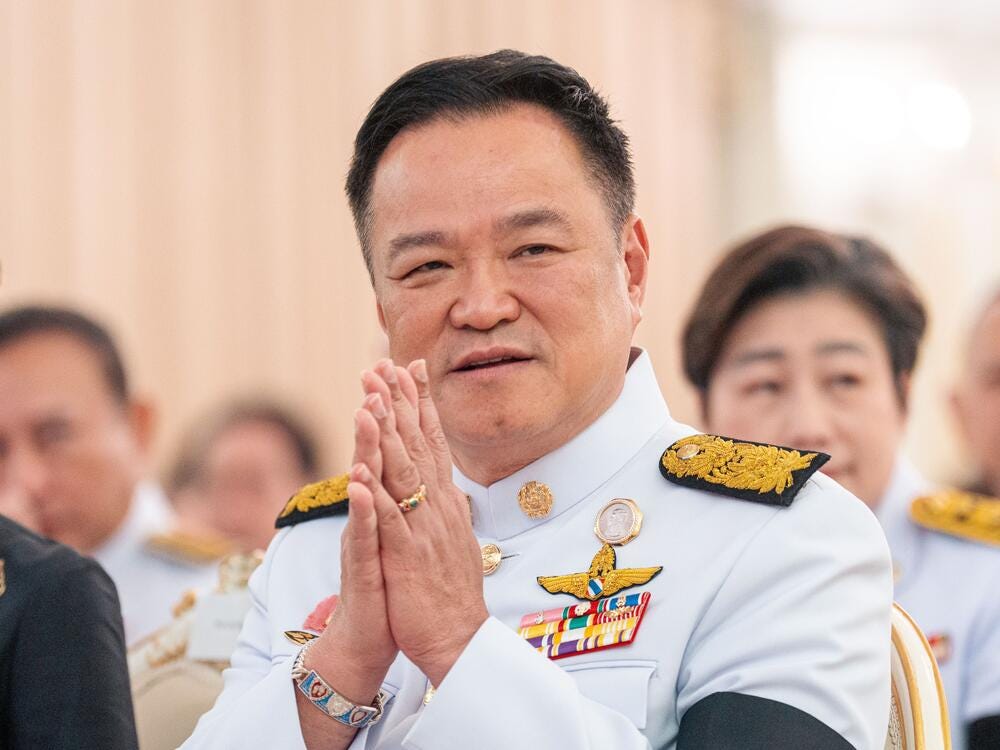
Thai Prime Minister Anutin Charnvirakul’s December 11 decision to dissolve Parliament, precipitating early polls, is widely regarded as a tactical strike while he is riding high on nationalist sentiment, said to be at “football match fever” from the renewed border clash with Cambodia, while trying to preempt his lackluster execution on southern flooding and his macroeconomic underperformance, given falling tourism and industrial output. He is also banking on the dire straits of the jailed Thaksin Shinawatra’s Pheu Thai party, whose “cobra” MPs are flocking over to Anutin’s Bhumjaithai Party, analysts say.
Thailand has been in political turmoil since 2023 elections that were followed by months of negotiations and court actions designed to keep what was then the youth-oriernted pro-democracy Move Forward Party, which took a plurality of seats, out of power. Eventually, Pheu Thai formed an unwieldy coalition only to see its first prime minister disqualified by the courts, after which political kingmaker Thaksin’s daughter Paetongtarn took over, to be ousted this July by the courts as well.
With a snap general election required within 45 to 60 days, polls are now expected in February, with Anutin, an adroit political veteran, and his cabinet serving as a caretaker government. But in the meantime, the prime minister faces a basket of problems that threaten to flare up and consume his government, including a huge scandal that has ensnared top officials and attracted the attention of the Financial Action Task Force and US authorities, courtesy of the US-based investigative website Whale Hunting.
The website has published five months of voluminous articles giving chapter and verse, which can be found here. While Thailand politics has been musical-comedy corrupt going back to the 1980s days of “buffet democracy,” (I’ll have some of this, some of that”) this is on another level. The constant drip of allegations is hurting Anutin’s Bhumjaithai Party leadership, analysts say.
Under Anutin, the government has shifted aggressively to shift to pre-emptive military engagement, striking Cambodian casinos and hotels it said were used as hubs for transnational cyberscams. Foreign Minister Sihasak Phuangketkeow has led an assertive diplomatic campaign, briefing foreign missions to frame Cambodia as the sole aggressor. Murray Hunter, an Australian blogger and former Asia Sentinel contributor living in the flood-stricken southern Thai city of Hatyai, said that with the renewed fighting, “there is now a realization that there is no longer any mutually trusted mechanism by both sides to attempt to bring fighting back under control and broker a ceasefire once again. The conflict is effectively a forest fire burning out of control.” A call by US President Donald Trump for a ceasefire has been ignored by both sides.
Escaping no-confidence motion
By dissolving parliament now, Anutin avoids the scrutiny of a no-confidence vote and simultaneously discredits the opposition People’s Party, which joined Bhumjaithai in a coalition in September on dissolution of parliament within four months and promise of reforming the 2017 constitution, drafted and adopted under the military-backed government. The attempt by the People’s Party, which succeeded Move Forward, to censure the government looks politically opportunistic during a national security crisis and the referendum is out the window with People Power’s young, democratically-oriented supporters voicing deep dissatisfaction that the party “should have known better” than to trust Bhumjaithai.
The People’s Party, the biggest in Parliament, must also watch its step with the military and other elitist institutions as it seeks to mobilize its progressive base to again turn out in numbers. Some 44 of the party’s 142 MPs, parliament’s biggest bloc, face potential political bans for signing a 2021 motion to amend the country’s draconian lèse-majesté law, which makes it a crime to defame, insult, or threaten members of the royalty.
“No one got what they wanted,” said a longtime western observer in Bangkok. “Anutin and Bhumjaithai betrayed the People’s Party by effectively thwarting Constitutional reform, and the opposition reformers returned the favor by kicking off efforts to gather signatures for a no-confidence vote, forcing Anutin to fall on his sword and dissolve the parliament. The MOU between the two parties (creating the coalition) arguably damaged both with their core base supporters, but there is plenty of campaigning ahead in what will be a massive face-off between the conservative “big house” party coalition vs. the activists and leftists, between older voters and impatient youth, and between the status quo and political reformers.”
Problems piling up
Thailand now enters a perilous phase under a caretaker government with severely restricted powers at a time of critical trade negotiations with the US regarding reciprocal tariffs, currently stalled at 19 percent, now on hold. “The freeze is interpreted as a direct consequence of the breakdown of the Trump-brokered Kuala Lumpur Peace Accord, with Washington signalling subtle pressure by withholding further talks,” said Ben Kiatkwankul, a partner at MCG Consulting in Bangkok. “Should the border war escalate further or economic pressure from Washington intensify, the administration lacks the legal authority to sign treaties, shift strategic policy, or approve emergency budgets, leaving the nation dangerously exposed until the February polls.
Bhumjaithai’s Khon La Khrueng (Let’s Go Halves) co-payment stimulus scheme, in which the state subsidizes 50 percent of daily expenses for food, beverages, and essential goods, encouraging consumer spending and supporting small businesses, with users paying their half via the Pao Tang app at participating merchants and boosting the grassroots economy is now at a standstill, with the potential to disappoint if not outright incensing voters.
There are longstanding socioeconomic problems. Thailand’s Gini coefficient, a measure of wealth inequality, is highest in Southeast Asia, with the top 10 percent holding 70 percent of the country’s wealth. Household debt is among the world’s highest, its large agricultural sector is vulnerable to global competition,its manufacturing industry is struggling to transition to high-tech industries, and there are distressing urban-rural regional disparities once capitalized upon by the now-eclipsed Thaksin, a stultified royalist and elitist class fighting against democratic progress, and an overwhelming and corrupt military, all worsened by the Covid-19 pandemic and government inability to recover from it.
Now photos have appeared of Anutin and other top government officials in company with a notorious South African fixer named Benjamin Mauerberger, who is at the center of what US officials describe as a “sprawling, decentralized network of criminal organizations that the United States Institute of Peace estimates generates US$64 billion annually through cyber-enabled fraud,” according to the Hunting Whales website. “The Federal Trade Commission believes the true figure, accounting for unreported losses, may approach US$200 billion – more than the annual revenues of Ford, Bank of America, or General Motors.”
Mauerberger, according to Hunting Whales, allegedly built high-society connections with the now-out of power Thaksin, the chief of Thailand’s armed forces, a senior police general, the CEO of a Thai bank, and a Thai senator. In late 2024, with Thaksin effectively in control of the government through the Pheu Thai Party, Mauerberger “secretly negotiated an MOU with Thailand’s Ministry of Digital Economy and Society to develop the country’s crypto sector. The cornerstone of the plan — pushed in public speeches by Thaksin — was a baht stablecoin, an official way to convert cryptocurrency into Thai baht.”
The MOU gave Mauerberger direct control over Thailand’s digital sector. He later, using fronts, took stakes in Finansia, a Thai investment bank and securities firm, using it to secretly integrate a crypto exchange with the banking sector, which Whale Hunting called “a channel to move stolen crypto into the banking system without oversight. The MOU also allowed Mauerberger to deploy 500 IT specialists in Thailand – giving visas to embed his network deep into Thailand’s digital and regulatory infrastructure. The full story is here.
Political paralysis
The kingdom is effectively on autopilot under a caretaker government with severely restricted powers, said MGC’s Ben Kiatkwankul. Should the border war escalate further or economic pressure from Washington intensify, the administration lacks the legal authority to sign treaties, shift strategic policy, or approve emergency budgets, leaving the nation dangerously exposed until the February polls.
“Lurking in the wings is the Thai military, which will increasingly enjoy a free hand to pursue the war with Cambodia any way they want, without significant oversight from what will be a caretaker government. The big question that remains unanswered is whether the border war itself will become a political issue, especially in the populous Northeast, as suffering from displacement drags on,” the western political analyst told Asia Sentinel. “Anutin is counting on being seen as a wartime leader to coalesce Thai conservatives behind his party, so the ultranationalist drumbeat may intensify as the political campaign expands – with serious, deleterious impacts on prospects for mediation and restoration of a tentative peace.”