

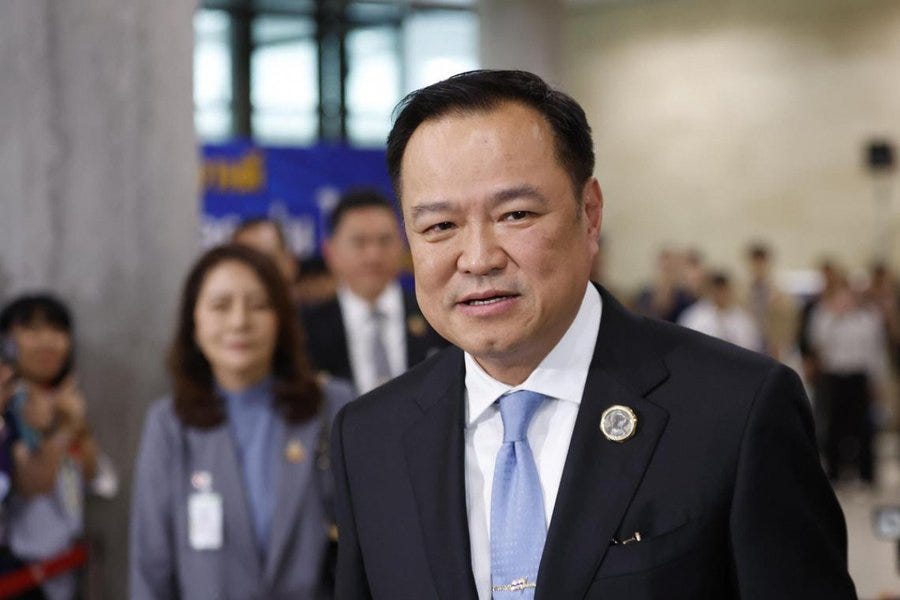
Thai Prime Minister Anutin Charnvirakul is expected to call for general elections shortly after Parliament reconvenes on December 12 with the vote in January or February, and with weeks or months of political horse trading likely to ensue if the past is any prologue. That is especially if the upstart People’s Party, running on an ambitious, youth-oriented reform platform that seeks to restrain the military’s power, decentralize the bureaucracy, improve social and economic equality, and reduce the sway of the royalty, once again gains the biggest block of seats in the 500-member House of Representatives.
If the party, the third reformist incarnation featuring most of the same faces from two previous elections, seeks to go ahead with its platform, it will face the same roadblocks to power that its predecessors faced. Some 44 of the party’s 142 MPs face potential political bans for signing a 2021 motion to amend the country’s draconian lèse-majesté law, which makes it a crime to defame, insult, or threaten members of the royalty.
While politicians have dithered, Thailand has stagnated economically and socially even since well before the military took power in a 2014 coup, plagued with deep-seated structural weaknesses that include chronic political instability, a demographic crisis with a total fertility rate as low as 1.2 births per woman, low productivity and lack of innovation, endemic corruption, the region’s highest household debt, and a non-competitive business environment.
Average 10-year GDP growth has hovered at 1.9 percent annually, significantly lower than the Asean average of 4.9 percent, reflecting a long-term decline in Thailand’s growth potential, a stark contrast to Asean’s more consistent growth pattern. Even Thai tourism, arguably Southeast Asia’s signature service industry, is falling behind despite its beaches, temples, palaces, its stunning cuisine, and its sabai sabai lifestyle, with Vietnam and even Indonesia and the Philippines recovering faster post-Covid.
Government botches flood relief
The government has hardly distinguished itself with a lack of attention to devastating floods in the south despite positioning itself as focused on practical management, public service delivery, and operational execution, said Ben Kiatkwankul, a partner at MCG Consulting in Bangkok.
The floods, which have killed at least 181 in Thailand and counting, have challenged this perception by exposing weaknesses in early-warning systems, interagency coordination and crisis logistics, triggering renewed debate about the gap between stated capability and practical crisis response, Kiatkwankul said. The lack of competent aid to the distressed could spark a resurgence of the nearly moribund Democrat Party, which once controlled the region.

Despite its overwhelming superiority in MP numbers following the September fall of the Pheu Thai government, the People’s Party had no chance of nominating a premier given elite and royalty opposition. It settled for an unlikely coalition with the royalist Bhumjaithai on a promise of early dissolution of Parliament and new elections, a process likely to take weeks if not months as contending forces joust for power. It took from the May 14 election until August 22 to form a government in 2023 although Move Forward, People Power’s predecessor, won 151 seats, the biggest total in the election. It had no candidate of its own to vie for the premiership after Paetongtarn Shinawatra was disqualified in the aftermath of a still-unexplained squabble with Cambodian political godfather Hun Sen. Pheu Thai, the surrogate of the now-imprisoned Thaksin Shinawatra.
“The People’s Party is preparing for the upcoming election by expanding its grassroots networks and reinforcing its reform platform, particularly its commitment to amending Article 112, the lèse-majesté law—a stance that energizes its core supporters but also makes the party a prime target for royalist elites and conservative institutions,” said Pavin Chachavalpongpun, a former Foreign Ministry official and trenchant government critic now in exile in Japan. “Its strengths include a large urban youth base, strong online mobilization, and a reputation for pushing transparency and anti-corruption. However, the party faces significant obstacles, such as limited resources and legal pressures, which creates uncertainty for its parliamentary stability.”
The political landscape has also shifted, with Bhumjaithai emerging as the main contender as Pheu Thai MPs jump parties, reshaping electoral dynamics and competition for key constituencies, Pavin said. While the election is still expected to move forward, the overall environment remains fluid, and the party’s performance will depend on its ability to withstand elite resistance and broaden support beyond its urban strongholds.
People Power favored
Despite Anutin’s energetic politicking, and with Pheu Thai (and Thaksin’s ambitions) failing, it appears likely that the People’s Party could once again win a decisive plurality in parliament, although its decision to tie up with Bhumjaithai, its polar opposite, in the current coalition is likely to turn off some of its more ardent supporters. It is the post-election wheeling and dealing that presents danger. Anutin, 59, with nearly 30 years as a politician, is an adept dealmaker with the motivation to outmaneuver the idealistic young People’s Party leaders.
Even if the People’s Party finishes first in seat count, as it did in 2023, it is likely that Anutin and Bhumjaithai, with the backing of King Vajiralongkorn, will find common bedfellows to form a coalition to block them, including Thaksin’s Pheu Thai and pro-establishment options like the frequently trounced Democrats and the military parties. Almost all possible combinations of coalition governments are still on the table, including those led by People’s Party, by Bhumjaithai, or even by another party.
The flashpoint when parliament reconvenes next Friday is a threat by Pheu Thai, now in the opposition, to proceed with a no-confidence motion. Anutin threatens immediate dissolution of the House. The government won’t accept a vote-based censure, it has almost no chance of surviving. For Anutin, allowing a formal defeat on the eve of an election would create an unacceptable political stigma, so dissolution is positioned as the pre-emptive alternative. By signaling readiness for an early election, the party is increasing pressure on the People’s Party to maintain its support if it wants Constitutional reform to proceed, one of the stipulations that brought it into its mariage de convenance with Bhumjaithai in the first place. The reform requires Parliament to remain in session until at least late March for all readings to be completed. This approach helps stabilize the government while shifting the political burden onto its allies.
“While Pheu Thai Party is facing many political troubles, they are still in the driver’s seat when it comes to filing a no-confidence motion. Nothing can block them, and many observers expect that motion will come before December 12,” said Phil Robertson, director, Asia Human Rights & Labour Advocates. “Anutin can count heads and knows he won’t have a majority if the People’s Party backs the motion, which is likely because they don’t want to formally vote to back this conservative government, which would certainly send the wrong message to its progressive base.
Most bets, Robertson said, “are on Anutin dissolving the Parliament to avoid the scrutiny of a no-confidence vote that he would disastrously lose in a very public, very embarrassing way. Pheu Thai Party is making hay that Anutin is not brave enough to face the scrutiny of the Parliament, but everyone recognizes this is just parliamentary maneuvering along with a bit of revenge against Anutin for abandoning the previous Pheu Thai-led government.”
As one political analyst put it, “As recent political history has shown, there are no permanent enemies in Thai politics, only permanent interests. Almost all possible combinations of coalition governments are still on the table.”