

Thailand’s 53 million eligible voters are set to go to the polls on February 8 to decide their third general election since 2019, and to vote on a referendum to write a new 20th Constitution (amid 12 successful military coups and seven to nine failed ones) since the 1932 revolution that ended the absolute monarchy. The election reflects a seemingly unending cycle of political instability in which military coups have led to the abrogation of existing charters and the drafting of new ones, with civilian forces allowed to rule until conservative royalist forces have once again uprooted them.
The race is evolving as a three-way competition between Thailand’s royalists and power elite, represented by the Bhumjaithai Party; the Pheu Thai Party, a vehicle of the powerful Shinawatra family historically representing a populist agenda geared towards rural, low-income, and urban working-class voters; and the People’s Party, which emerged from the dissolved Move Forward Party, representing the youth-oriented, progressive, anti-establishment forces.
As Thitinan Pongsudhirak, Director of the Institute of Security and International Studies (ISIS) and Associate Professor of International Political Economy at the Faculty of Political Science, Chulalongkorn University, pointed out in a recent Bangkok Post article, only once, in 2001, were voter results fully honored, with other elections either upended by military coups or manipulated by judicial interventions. That was when the Thai Rak Thai party, Pheu Thai’s precursor led by Thaksin Shinawatra, won 248 of the 500 seats on a populist platform of economic growth and anti-corruption. Thaksin was ousted in a 2006 coup and spent the next 15 years in exile trying to regain power only to end up in jail last year after he returned.
Reformists likely to win plurality
Thus if the past is any prologue, the election results – likely with the People’s Party winning a plurality as their predecessors have in the past – will probably take a back seat to political horse trading afterward in the effort to keep the elites, backed by the military, in power. In the 2023 race, negotiations went on for five months to keep Move Forward from power despite winning 151 seats in the 500-member parliament, followed by Pheu Thai with 141 and Bhumjaithai with 71. What emerged five months later was an unwieldy coalition of 11 political parties headed by Pheu Thai and Bhumjaithai, with Move Forward, later to be dissolved by the pliant courts, in opposition.
More than two years of political chaos followed, with three prime ministers and a minimum of legislative or government action to address a stagnant economy, a broken education system, a severe demographic crisis and high debt levels. The country is navigating its weakest economic growth in three decades excluding the Covid-19 crisis years, with 2026 GDP growth forecast as low as 1.5–1.8 percent.
“The public mood is clearly sour,” said Ben Raiwin Kiatkwankul, co-founder of Maverick Consulting Group Thailand. “There is accumulated frustration from a series of high-visibility governance failures and shocks over recent years, from pandemic management and economic scarring to infrastructure accidents, flooding, and controversial policy initiatives such as the digital wallet scheme. These incidents reinforce a perception of weak execution and limited accountability.” As he points out, there are no mass demonstrations paralyzing the capital as happened so frequently in the past, no dramatic confrontations between institutions but no immediate sense of systemic breakdown.
Pheu Thai on the back foot
Pheu Thai, the Thaksin Shinawatra vehicle which in previous incarnations was put out of business by courts and coups, has faded with Thaksin, now 76, in prison. He returned to Thailand in August 2023 and was promptly taken into custody after having been sentenced to eight years on corruption charges, reduced by King Maha Vajiralongkorn to a single year and was paroled and pardoned in 2024. He was later forced to serve the sentence after it became clear he had faked infirmities that kept him out of prison with a six-month stay in a VIP room on the 14th floor of Bangkok’s Police General Hospital – sarcastically dubbed “the Thaksin suite.” The resurrection of the charge is another sign of his diminished status. Pheu Thai’s prospects in the February election have thus dimmed.
Anutin Charnvirakul, Bhumaithai’s astute prime minister, has played a canny game since the ouster of former Premier Paetongtarn Shinawatra, Thaksin’s daughter, last September, playing on public sentiment over the border war last year with Cambodia centered around the Preah Vihear temple that took scores of lives on both sides. He has reportedly lured defectors from other camps, particularly from Pheu Thai, to drive up Bhumjaithai’s seat count from 71 to more than 100, according to local media estimates, offering seats in the 35-member cabinet to other camps and factions including Chart Thai Pattana, Palang Pracharath, United Thai Nation and the Democrats in anticipation that Bhumjaithai has the backing of powerful forces in the royalty and the business oligarchies to return it to office after the election.
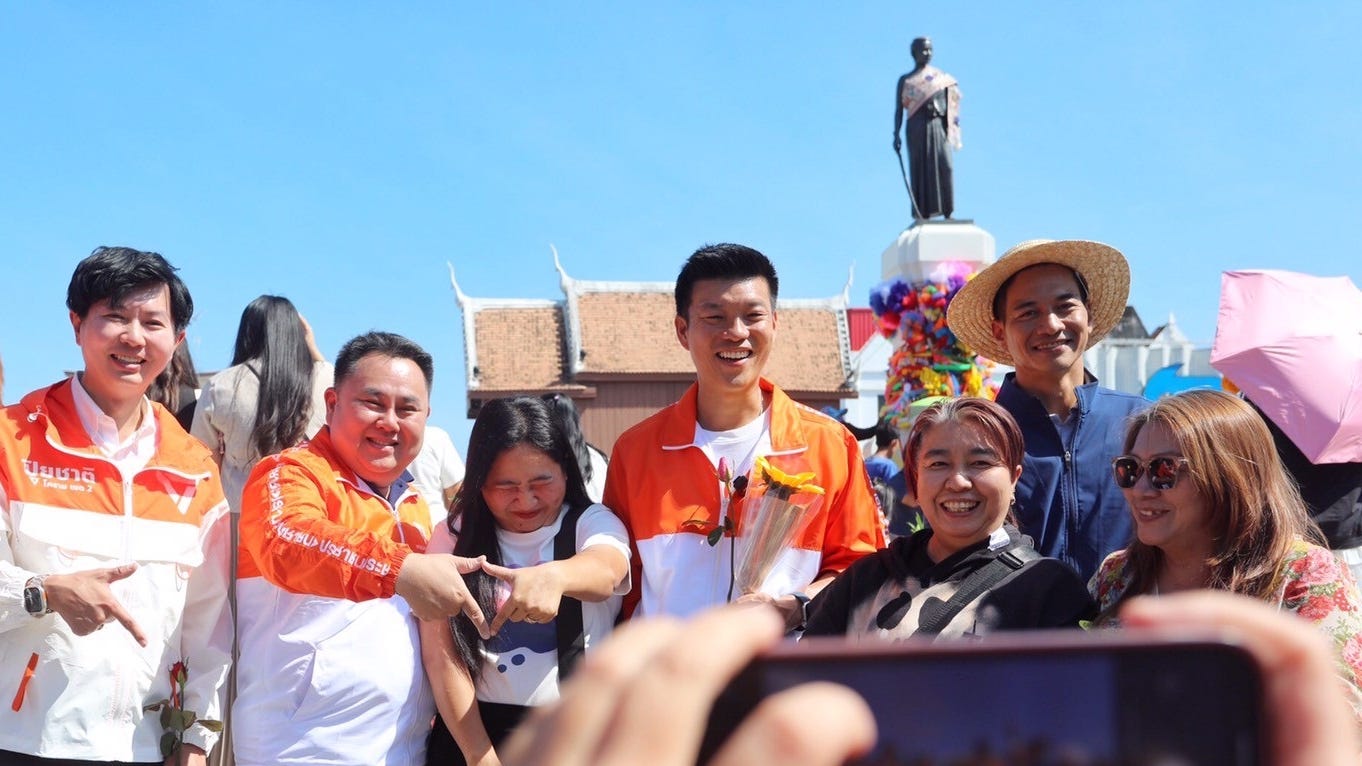
However, polls taken in mid-January show the People’s Party with a commanding lead with its prime ministerial candidate Natthaphong Ruengpanyawut as the overwhelming favorites, trouncing Bhumjaithai, which led the most previous ruling coalition after courts ousted Paetongtarn and the Pheu Thai coalition collapsed. Deputy Leader Rangsiman Rome told Reuters the party is in its best shape ever, with detailed policy proposals pulling in support.
People’s Power is currently pulling 30 percent to 34 percent support which means it would likely be forced into a coalition – if the courts and elites allow it to form a government – with any number of myriad parties, none of which shares its commitment to rooting out corruption and amending the country’s draconian lèse-majesté laws, which mandate severe punishment for even slight criticism of the monarchy, and which landed Move Forward in legal trouble. Some 44 members of the party face potential court action that could result in their suspension and banning from politics for attempting to amend the law in 2021.
“Virtually all the polls are showing the reformers of the People’s Party leading the polls in terms of both preferred party and candidate for prime minister,” said Phil Robertson, director of the Bangkok-based NGO Asia Human Rights and Labor Advocates. “But many prominent pundits are predicting that after the election, the political ‘big house’ dynasties will join forces with the unelected conservative triumvirate of military, civil servants, and palace to again deny the reformers their opportunity to govern. So there is a deja vu quality to the campaign that is hard to shake, with concerns that people’s choices will again be ignored – with serious ramifications for Thai democracy.”
Despite the campaign platforms put forward by the parties, they will amount to little in the effort to form a government. But, said a diplomatic source, the upcoming general election is a landmark event in the sense that the competing parties want to change or amend the constitution and are using the general election as a referendum. The goal of the proposals is to move away from the 2017 constitution, which entrenched military power, limited rights and allowed for the easy dismissal of elected officials.
In any case, the political landscape has shifted, with Bhumjaithai—not Pheu Thai—emerging as the main contender to People’s Power, reshaping electoral dynamics and competition for key constituencies, according to Pavin Chachavalpongpun, a former foreign service official and opposition figure now in exile in Japan. People’s Power’s strengths, he said, include a large urban youth base, strong online mobilization and a reputation for pushing transparency and anti-corruption. But the party faces significant obstacles such as limited resources, legal pressures and the unresolved case involving its MPs, which creates uncertainty for its parliamentary stability.
“The overall environment remains fluid, and the party’s performance will depend on its ability to withstand elite resistance and broaden support beyond its urban strongholds,” he said.