

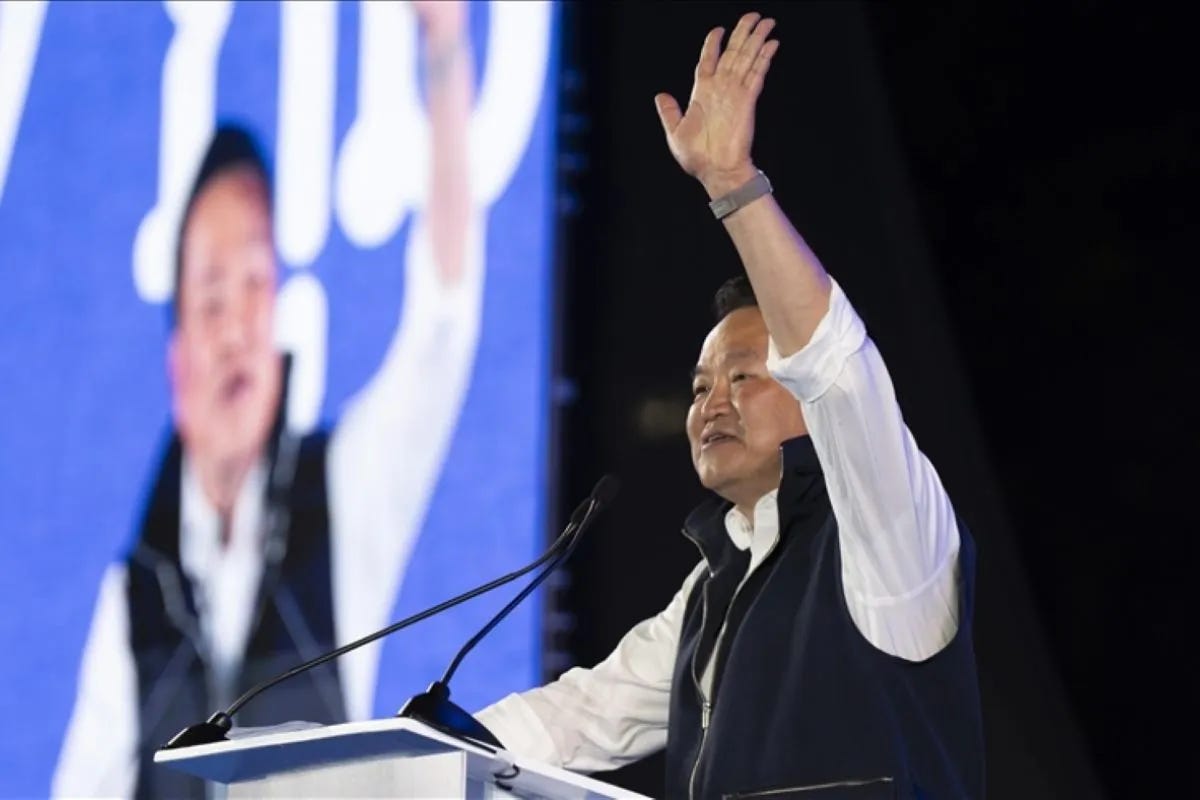
Bhumjaithai, the royalist, business-oriented party headed by Prime Minister Anutin Charnvirakul, appears to have won the gamble it made last September via an alliance with the opposition, reform-oriented People’s Party, promising new elections within four months along with a commitment to reform the 2017 constitution drafted and adopted under the military-backed government.
With the election completed and with 53.06 million voters, including 3.4 first-time ones going to the polls, Bhumjaithai has won a plurality of 194 seats in the 500-member lower house of Parliament, followed by the reformist opposition People’s Party with 116, the fading Pheu Thai Party at 76 seats, the upstart Khla Tham Party with 56 seats, and the Democrats at 21.
The likely outcome, according to a Bangkok-based economist with ties to the government, is for “rare political stability in the coalition and likely continued economic policy.” Most observers see a coalition headed by Bhumjaithai and including Pheu Thai, Khla Tham and the Democrats, with People’s Party, which is regarded as having badly muffed its chances, in opposition after its number of seats fell from 143, which had made it the biggest party in the legislature. There are unlikely to be weeks, perhaps months of maneuvering and dubious court decisions and new snap elections that have characterized politics over the past decade and unnerved the international investment community.
Anutin pulls off a triumph
The big story is Anutin, a savvy 58-year-old born into a wealthy Bangkok family controlling Sino-Thai Engineering and Construction, who took Bhumjaithai from just 71 seats in the previous coalition to a plurality that will likely run the government. Taking power as the minority component with People’s Party little over four months ago, he capitalized on nationalist patriotic fervor over last summer’s border war with Cambodia and on the declining influence of the 76-year-old Thaksin Shinawatra, whose Pheu Thai party finished a distant third.
Anutin expanded the party’s political influence and popular base, persuading numerous factions from the rival camps United Thai Nation, Palang Pracharath, Democrats, Chart Thai Pattana, and Thai Sang Thai to jump ship and come aboard, adding 50 more incumbent seats to Bhumjaithai’s 71. He reshuffled government positions in various ministries and enlisted experts including Ekniti Nitithanprapas, appointed in September, as his deputy and finance minister after royal approval to add credibility.
The result is likely to be a solid coalition with the capability to run the government for an extended period after years of political turmoil. The restive military is likely to stay in the barracks, the volatile King Vajiralongkorn could look forward to a stint back in Germany, which he is said to prefer to Thailand.
That doesn’t mean a new golden age in a country run by elites in a political structure rife with systemic corruption and a stifling mix of interlocking royalty and a permanent ruling class unwilling to cede power or allow for more equality. That was the populist ambition of the now-eclipsed telecoms billionaire Thaksin Shinawatra, who is sitting in a Thai jail after miscalculating his reentry into Thai politics by appearing too visibly anxious to take over after 15 years of exile. It is likely the end of the road for the Shinawatras, analysts say.
Big House politics
“With a mixture of political dynasty Ban Yai (”Big House” regional networks of politicians and their support bases) influence, plenty of money above and below the table to grease the wheels, and a successful strategy to encourage defections from the former ruling Pheu Thai Party, the path cleared for Anutin and Bhumjaithai to win big in the all-important constituency elections across the country,’ said Phil Robertson, a longtime western observer who is director of the Asia Human Rights and Labor Advocates NGO. “Only in Bangkok did voters resist, awarding almost all seats to the orange-clad People’s Party. Where things will get tricky for the next government is the cabinet seat allocation, where sharp elbows will come out as these very traditional political parties start to divvy up the political spoils of this victory.”
If Anutin is the big story, the flip side is the People’s Party, which had gone into the February 8 polls expecting to capitalize om its image as the vanguard of the progressive, pro-democracy movement which it inherited from the Future Forward and Move Forward parties dissolved by the courts for their attempts to clean up corruption and to nullify the stifling lese-majeste law that forbids even the merest criticism of the royalty, only to see its parliamentary plurality disappear and its aim to rewrite the constitution disappear, likely handed over to parties favoring perhaps some less onerous version of the current charter.
Reform on the ropes
“While the People’s Party managed to sweep Bangkok, the failure to win seats in the provinces isn’t just a loss of a base—it is evidence that the party never truly established a solid provincial base to begin with,” said Pavin Chachvalpongpun, a former foreign ministry official now in exile in Tokyo. “Their previous provincial gains were driven by individual candidate capabilities and a temporary wave of popularity. Once that wave subsided, the absence of Big House networks in the provinces led to this significant loss. In contrast, parties like Bhumjaithai have made long-term, sustainable investments in their local bases. Despite the positive reception we saw when PP members visited the provinces, it was never a guarantee that they had truly won the hearts of provincial voters.”
Pavin called the move to install Anutin as premier after the Pheu Thai government fell in September “a fatal mistake. It effectively threw a lifeline to Anutin, giving him the leverage to return and test-run a short-term government. This allowed him to bring in technocrats to bolster his party, crafting a modern image for his ‘Big House’ base. The People’s Party realized this mistake too late and tried to compete by launching ‘The Professionals,’ but the damage was done—not just strategically, but also in terms of destroying the faith of many supporters who felt betrayed by the decision to keep Anutin alive politically.”
The “Orange” movement, as the People’s Party is known, must now reinvent itself if it is to recover. Nationally dramatic reform is sorely needed. Projected economic growth is expected to fall below 2 percent, with some of the world’s highest household debt, now nearing 90 percent of GDP, with falling exports as other Southeast Asian nations have eaten into Thailand’s industrial base of electronics and car assembly, and with structural weaknesses including a substandard educational system, an aging population, and a falling birth rate. There is intense competition from cheap foreign imports.
And, with the voters likely having delivered another version of the status quo ante, it is questionable if this depressing panorama of issues can be addressed in the long term. Mai sabai” (ไม่สบาย), as they say in Bangkok. Not good.
John Berthelsen's analysis is solid, but it misses what actually drove Anutin's victory in the provinces. It wasn't just "Big House networks" and money above and below the table. It was something far simpler and far rarer in Thai politics: a politician who showed up.
During last summer's border conflict, Anutin was the only senior figure who came to Isan. He visited the villages that had been shelled. He sat with the people whose homes were in the line of fire. He went to the field hospitals and checked on the wounded soldiers. He asked his troops what they needed. That's not a political calculation – or if it was, it was the right one. People here remember who came and who didn't.
Then came the Trump phone call. When the US president suggested that Thai soldiers losing their legs to landmines on Thai soil were perhaps just "unfortunate accidents," Anutin didn't fold. He pushed back – directly, on the record – and made clear that Thailand wanted a permanent resolution, not a diplomatic postponement because the timing was inconvenient for Washington. In a region where bending to American pressure is practically a reflex for political survival, that took a specific kind of backbone.
This is why Anutin won Isan. Not because provincial voters are unsophisticated or easily bought. But because he did what politicians in this country almost never do: he treated the people here as constituents worth showing up for, not just a voting bloc to be managed from Bangkok.
Whether he governs the way he campaigned is the real question. Thailand has a long history of politicians who earned trust in a crisis and spent it quietly afterward. But the baseline is this: Anutin enters office with something most Thai prime ministers don't have – genuine credibility outside the capital, earned the hard way.
That's worth something. Whether it's enough is what the next four years will answer.
– Michael Hollister
PP is very similar to Hong Kong’s Yellow Umbrella movement.
Both have/had lofty ideals but fail to understand the way power and politics truly work which results in them accelerating their own demise.