
By: Jens Kastner
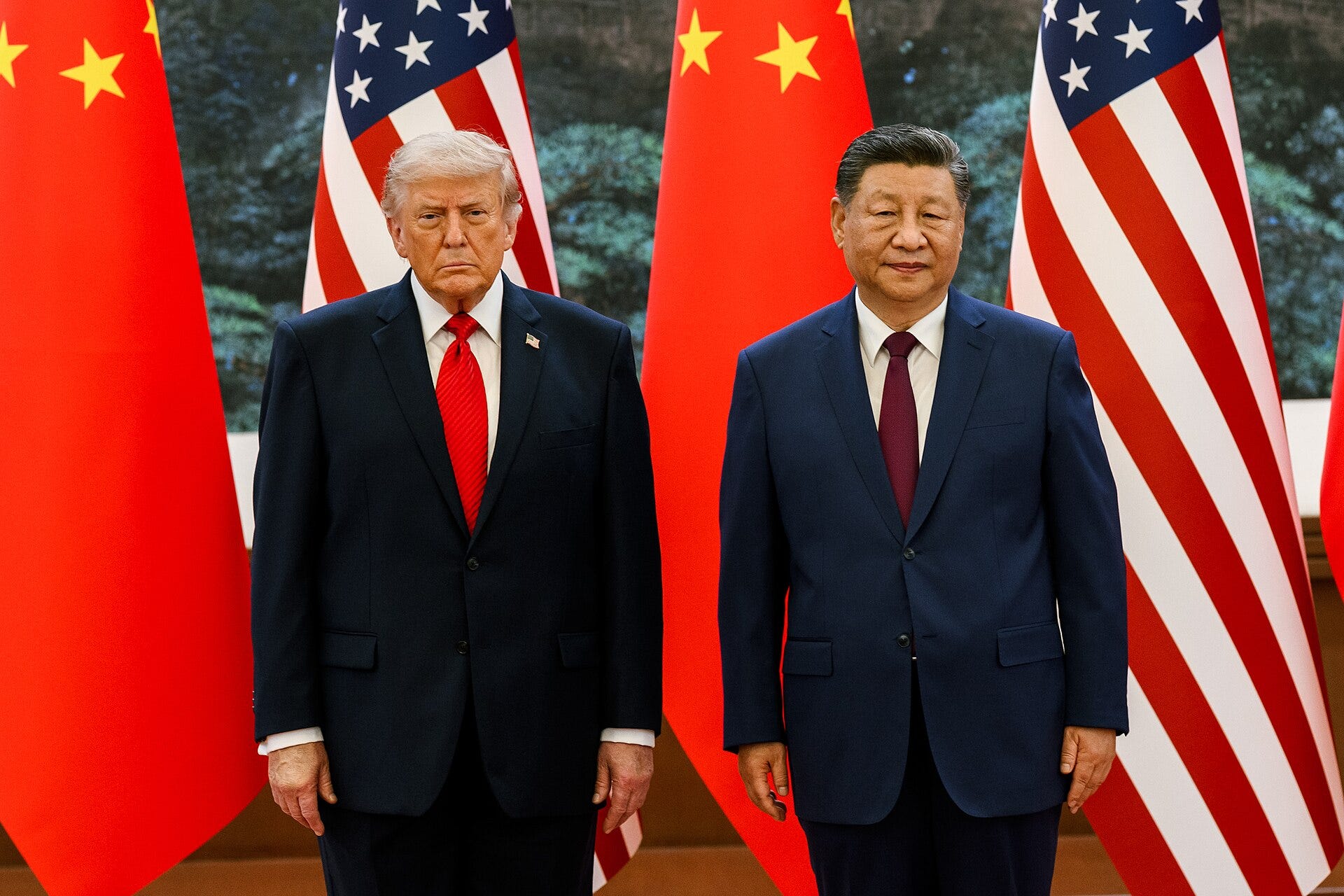
As U.S. President Donald Trump headed home after completing his flamboyant 2-day state visit to Chinese President Xi Jinping in Beijing, the Taiwanese woke up to the notion that although in the runup to the event there was a lot of pundit speculation about Xi pressing Trump on arms sales and changing the diplomatic language surrounding Taiwan, none of it came to pass.
After Trump had, prior to his trip, signaled his intention to review the US’s Taiwan arms sales policy, Xi described Taiwan as “the most important issue” in U.S.-China relations and warned that mishandling it could lead to “clashes and even conflicts.” But the White House readout then omitted Taiwan entirely, suggesting that Trump refrained from making any concessions to Xi at Taiwan’s expense.
Consulting Beijing in advance regarding arms sales to Taiwan would have directly violated the core diplomatic pledges the U.S. gave to Taiwan during the 1980s. Taiwan’s Foreign Minister, Lin Chia-lung, noted that Taipei monitored the Trump-Xi summit intently. Lin expressed gratitude to U.S. Secretary of State Marco Rubio for reassuring Taiwan that the U.S.’s strategic stance remains steadfast.
Asia Sentinel made a small survey among Taiwanese non-pundit people on Saturday, gathering some expressions of relief. People acknowledged that Taiwan received no mention whatsoever in the White House’s official summary of the meeting and that the U.S. administration did not address the unilateral claims made by Chinese state media regarding Xi’s stance on Taiwan.
“For the majority of the population in Taiwan, this is a reassuring outcome, as it signals that the U.S. has no intention of altering its current policy of support for Taiwan,” said Yeh Jing-yue, a retired translator from Taipei.
“However, I share the concern felt by many in Taiwan that the Chinese Communist Party has already succeeded in effectively infiltrating political parties and media outlets within the country. When I observe how the pro-communist rhetoric from politicians within the Blue-and-White camp [the opposition Kuomintang (KMT) and Taiwan People’s Party (TPP)], as well as from many influencers, has become increasingly brazen over the past two years, I find it deeply unsettling.”
Yeh referred to a high degree of policy gridlock resulting from China-friendly opposition lawmakers paralysing the Constitutional Court, escalating into a budget standoff freezing government functions, including defense spending and arms procurement.
In terms of China infiltrating local media outlets, more than 100 Taiwanese media executives and journalists travelled to a cross-strait media summit in Beijing in early May, being explicitly urged by Chinese officials to “expose Taiwan independence activities.”
Wang Bao Hsiang, a patent engineer from Taipei, said that the Trump-Xi meeting didn’t bring any major surprises for Taiwan because Taiwan’s importance is fundamentally tied to U.S. strategic interests. He referred to the “Silicon Shield”, the geopolitical concept that Taiwan’s dominance in the global semiconductor industry via Taiwanese chipmaker TSMC acts as an unsurmountable deterrent against a Chinese invasion.
“In the future, whoever controls advanced semiconductors will have enormous influence over the global economy and technology sector, and I believe Washington understands this very clearly,” Wang said.
“Making a deal with China at Taiwan’s expense would not really benefit the United States. It would effectively hand critical semiconductor leverage to China, while also weakening America’s strategic position in the Pacific.”
However, also Wang went on to warn that Taiwan is facing internal challenges with parts of the legislature being pro-China.
“This is ultimately an issue Taiwanese society itself has to confront,” he said. “Many people in Taiwan do not vote very seriously and sometimes oppose policies simply for the sake of opposition, without thinking about the broader long-term consequences.”
On the other end of the political spectrum stands Cindy Chen, a Chinese language teacher from Taipei, who sees the Trump-Xi meeting as evidence that the “G2” framework, in which the U.S. and China jointly dominate global military, economic, and other structures, is gradually taking shape.
This assessment, in turn, makes her feel that the main dangers are associated with the possibility of Taiwan’s ruling Democratic Progressive Party (DPP) recklessly provoking China.
“Although it was officially claimed that the Taiwan issue was not discussed during the meeting, in reality, it was undoubtedly addressed in a manner detrimental to Taiwan,” Chen said.
“Being misled by that, the DPP and other proponents of Taiwan independence will inevitably take more assertive actions, thereby escalating cross-strait tensions. We will be left with no choice but to remain bystanders or dutiful subjects in order to ensure our own self-preservation.”
Xi received an invitation from Trump to visit the White House this coming September, and there is a possibility the two leaders will also cross paths at the subsequent G20 and APEC summits toward the end of the year.
Attention will turn in the coming weeks to whether Trump will approve another arms deal, coming on the heels of a roughly US$11 billion package last year. Doubts were raised by Trump in his gaggle with the press on Air Force One, revealing that he, in fact, did discuss arms sales with Xi in great detail and indicating that he feels that the old assurances that the U.S. would not consult with China on arms sales to Taiwan are outdated.
An observer told Asia Sentinel that whether the U.S. will actually reduce or postpone arms sales to Taiwan remains uncertain and will depend on Taiwan’s handling of future arms packages.
“As no details regarding the discussion on arms sales to Taiwan have been released, it remains possible, as Trump indicated, that a final decision would only be made after further consultations with Taiwanese leadership,” said Hung Tzu-Chieh, an associate research fellow at the Institute for National Defense and Security Research, a public think tank in Taipei.
“However, Taiwan’s previous domestic political disputes over certain arms procurement packages and defense budgets, as well as opposition from some political actors to related spending, have already raised concerns in Washington regarding Taiwan’s commitment to self-defense. The Trump administration could indeed choose to delay, adjust, or even reduce certain arms sales to Taiwan in exchange for broader economic and trade arrangements with China.”
it appears there is enough pressure from the american defense industry to maintain sales, and so status quo. "no outcome" is a victory for anyone outside of china.
when trump gets desperate enough to sell out taiwan, or receives a large enough bribe, there is no shortage of excuses he can use and the gop will accept.