
By: Khanh Vu Duc
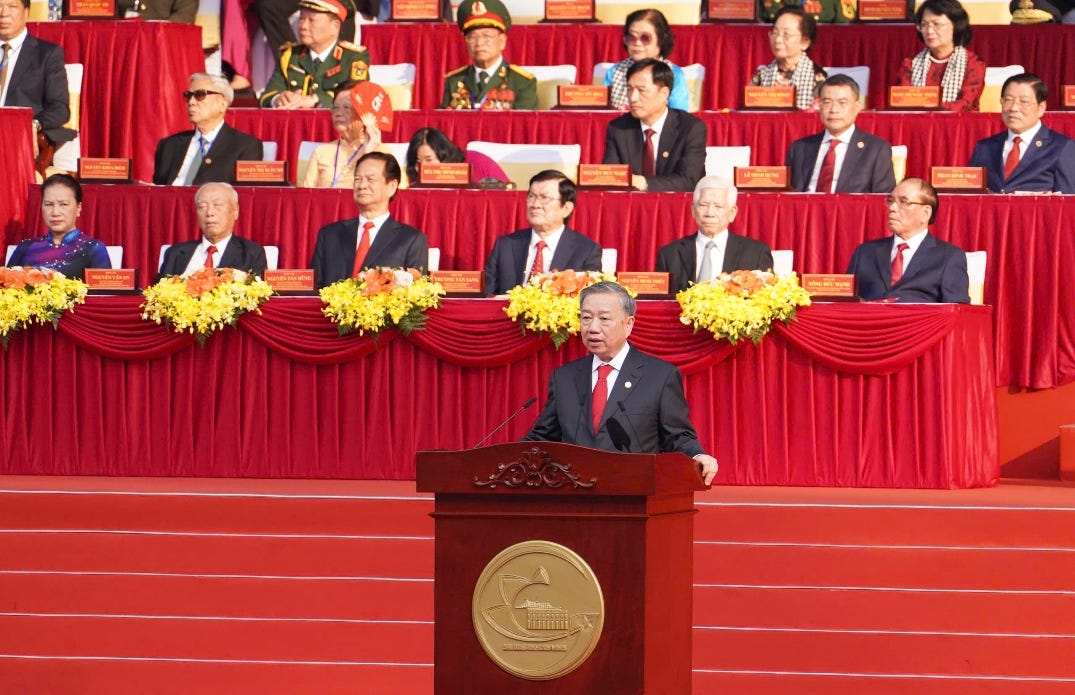
Vietnam is entering the second and more unpredictable phase of its political transition following the July 2024 death of Communist Party General Secretary Nguyễn Phú Trọng and the unexpected elevation of Tô Lâm to replace him as General Secretary in August of that year. The speed and intensity of centralization under Tô Lâm, a 40-year career police officer-turned politician, has triggered counterbalancing dynamics within the party, the military establishment and the technocratic bloc, upending upended traditional party equilibrium.
While the country remains stable, elite competition between the security apparatus, the military, and technocratic blocs is intensifying. For policymakers and analysts, the central question is no longer merely who leads, but which governance model will define Vietnam’s trajectory in a more contested Indo-Pacific. Whether or not Tô Lâm faces immediate challenge, the system is clearly testing its limits. The country is not in crisis but seemingly in a transition without a guaranteed endpoint.
The 68-year-old Tô Lâm’s rise represents an unprecedented centralization of power under the Ministry of Public Security, generating alarm in more traditional locuses of power. Over the past 16 months, the party has tightened control over personnel, accelerated anti-corruption measures and enforced ideological conformity. Operationally, the security apparatus now dominates both the information environment and the levers of political discipline. Under his leadership, the government has continued to stifle civil and political freedoms, prohibiting independent rights groups, labor unions, media, religious organizations and all entities outside its control, earning international criticism from the UN and EU – mostly ignored – of reports of arbitrary arrests, imprisonment and surveillance of activists, bloggers, and journalists as well as lack of judicial independence, and control over religion and media.
The political system, however, is uneasy with the “Security-State” model. Tô Lâm’s rise marked the first time a Ministry of Public Security cadre has assumed Vietnam’s ultimate leadership, creating a precedent that many have referred to as a “Vietnamese 18 Brumaire,” a parallel to Napoleon’s 1799 coup that ended the French Revolution and established strong executive rule including rapid consolidation of control, dominance of information and centralization of personnel decisions under security logic.
Yet the concentration of power faces structural limits. The military, historically a co-equal pillar of authority stemming from its decades of successful liberation conflict, remains vigilant. Technocratic and economic actors are wary of security overreach that could disrupt regulatory reform and foreign investment. Even within the party, traditionalists resist further erosion of collective leadership norms. The result is a political system balancing on the edge of its own hyper-centralization—a scenario where efficiency is high, but resilience may be brittle.
Elite Negotiation and the Rumor Economy
In Vietnam, rumors are often a signal, not noise. Speculation surrounding potential leadership recalibration, including the possible rise of military figures, reflects ongoing elite negotiation rather than uncertainty over governance capability. Rumors circulating ahead of the 15th Central Committee Plenum on January 16 – including the possibility of a leadership reshuffle involving senior military figures such as Minister of National Defense Phan Văn Giang – reflect structural stress, not merely factional gossip. Regardless of their accuracy, these rumors indicate that Vietnam has not stabilized its new equilibrium.
Historical precedents such as Nguyễn Phú Trọng’s 2016 victory over Nguyễn Tấn Dũng, whose stewardship over impressive economic growth was overshadowed by major corruption scandals, or Lê Khả Phiêu’s early removal in 2001, allegedly for excessive deference to China, demonstrate that the party can abruptly rebalance power to prevent over-concentration. The current dynamic follows a familiar pattern: internal actors test the boundaries of acceptable centralization while maintaining institutional continuity. For policymakers monitoring Vietnam, the intensity of rumor circulation is a real-time indicator of intra-elite bargaining and potential structural shifts.
Strategic Implications for Policy and Security
Vietnam’s political evolution is shaped as much by external pressures as internal dynamics. Economic performance, investor confidence, and regional security commitments constrain domestic maneuvering. The country’s multi-vector foreign policy, carefully calibrated between the United States, China, Japan, and the EU, is unlikely to change dramatically. However, the international environment increasingly constrains Vietnam’s domestic political choices, including trade uncertainties with an unpredictable and tariff-happy administration in Washington, an occasionally belligerent administration in Beijing, especially over islets in Vietnam’s economic exclusion zone, climate change impacts, pressure on macroeconomic stability with persistent downside risk from trade tensions and general policy uncertainty, all for a country with a trade-reliant economy. Expect assertive continuity in foreign policy.
However, the concentration of power within the security apparatus may alter policy execution, particularly in economic regulation, cybersecurity, and regional security enforcement. Policymakers and intelligence analysts should monitor three indicators closely in early 2026 -- personnel movements in the Politburo and Central Committee, which signal elite recalibration, shifts in institutional balance, especially between the military and the security bureau, and regulatory and policy continuity affecting economic stability and foreign investment.
Vietnam is entering 2026 at a delicate inflection point. The abrupt leadership shift in 2024, followed by the rapid consolidation of authority by Vietnam’s first former police chief to assume the top post has upended traditional party equilibrium. For policymakers and analysts, the central question is no longer merely who leads, but which governance model will define Vietnam’s trajectory in a more contested Indo-Pacific.
The structure of Vietnamese politics intentionally eliminates pathways for mass political agency. There are no competitive elections and no independent unions or civil-society organizations. Media autonomy, including in the cyberzone, is limited and the costs for political mobilization are prohibitive, leading to the overarching conclusion that Vietnam’s public remains largely excluded from the decision-making process. Legitimacy continues to rely on performance, stability, and delivery of national advancement, not participatory politics. For foreign observers, the focus should be on understanding elite negotiations and institutional trends rather than predicting abrupt regime change. Generally, analysts and Hanoi-watchers should prepare for short-term unpredictability but long-term pragmatism.
Khanh Vu Duc is a lawyer and part-time law professor at the University of Ottawa who researches on Vietnamese politics, international relations, and international law.