
By: Ainur Rohmah
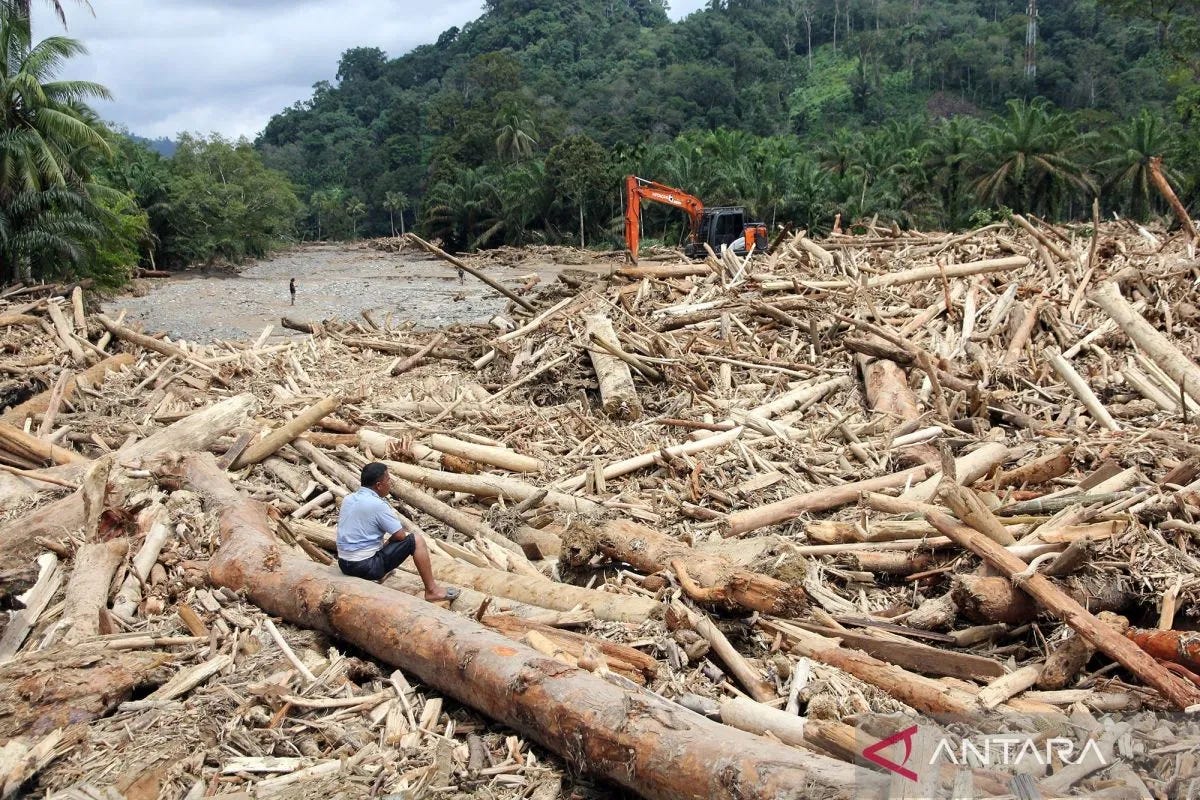
Indonesia’s latest string of flash floods and landslides, which have killed hundreds across Sumatra, has exposed a long-ignored truth: the country’s most devastating natural disasters are increasingly human-made, fueled by years of unchecked deforestation, industrial expansion, and political permissiveness that degraded some of the archipelago’s most fragile ecosystems.
For several weeks, much of Southeast Asia has been battered by extreme rainfall, floods, and storms stretching from the Gulf of Thailand to the Pacific. Climate experts say the region’s unusually intense rainfall this year stems from the convergence of two major climate patterns: La Niña and a negative Indian Ocean Dipole (IOD), a phase characterized by warmer-than-normal sea surface temperatures.
Millions of people have been displaced, with more than 1,300 deaths across Vietnam, Indonesia, Sri Lanka, and Thailand, exacerbated by deforestation and poor land management. An extraordinary low-pressure system over Hat Yai in Southern Thailand brought rains so overwhelming that waters reached 3.5 meters in some parts of the city, flooding areas that had never flooded before. Agencies are scapegoating the mayor, governor, and others, although given the intensity of the storm, observers say nothing could have prevented the floods. Human unpreparedness prevented evacuations. Logging and mining had little impact. The construction of roads in some areas stopped water flowing naturally, but this time rainfall was overwhelming, with 500mm in a single day over 3 days.
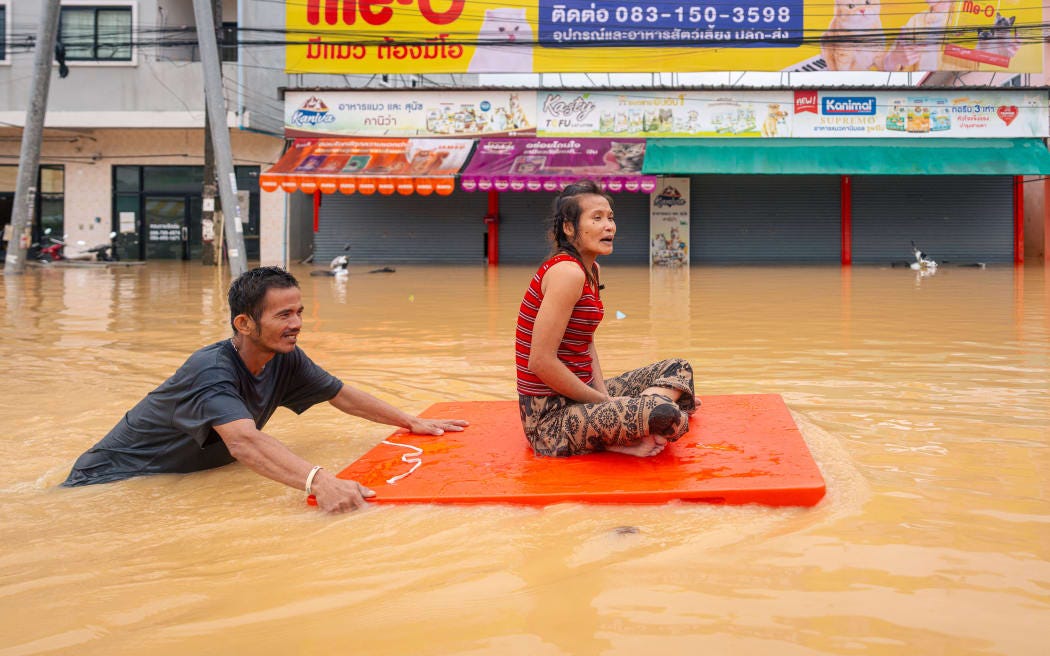
In Indonesia, flash floods and landslides have swept across several provinces in Sumatra including Aceh, North Sumatra, and West Sumatra, causing heavy damage to settlements and local infrastructure. As of December 3, the National Disaster Management Agency (BNPB) reported 753 deaths, with hundreds still missing. Access to many affected areas was temporarily severed after bridges collapsed and roads were buried under landslide debris. Aceh and North Sumatra recorded the highest casualties, with thousands of residents forced to abandon their homes and seek refuge in evacuation centers.
Online discussions have intensified following the circulation of viral videos showing hundreds, even thousands, of logs drifting along rivers and piling up in multiple locations after the massive floods struck the three provinces. The scenes have fueled widespread suspicion that forest destruction and industrial activity in conservation zones have greatly amplified the scale of the disaster.
Severe Environmental Destruction
The extent of land exploitation and environmental degradation is difficult to dispute, with environmental activists arguing that massive deforestation and ecological fragility—exacerbated by government policies that facilitate extractive investment—are the primary drivers of the disaster’s scale and severity in the three provinces. The Indonesian Forum for the Environment (WALHI) released data showing that from 2016 to 2025, 1.4 million hectares of forests across the three provinces were deforested, linked to the operations of 631 companies holding various concession permits.
Data from the Ministry of Forestry’s National Monitoring System show that natural forest cover in most watershed areas (DAS) in Sumatra has now fallen below 25 percent, placing their hydrological function in a critical state. The large-scale conversion of natural forests—crucial ecosystems for water absorption—into monoculture plantations has drastically reduced the land’s capacity to retain water, increasing runoff during heavy rainfall.
In North Sumatra, satellite imagery recorded more than 2,000 hectares of forest loss over the past decade (2016–2025). The worst-hit area is the Batang Toru Ecosystem, which experienced 72,938 hectares of deforestation from 2016 to 2024.
Ahmad Solihin, Executive Director of WALHI Aceh, said the scale of the disaster shows that nature can no longer withstand the burden imposed by corporate expansion. “This disaster is not merely a natural phenomenon—it is an ecological catastrophe produced by government policies that are negligent, permissive, and enabling the destruction of people’s living spaces through space-hungry extractive investments,” Solihin said.
In West Sumatra, environmental degradation is systemic and longstanding, evident in satellite imagery that shows destruction within conservation areas and protected forests, including the hilly terrain of Kerinci Seblat National Park. Illegal mining and rampant logging continue to worsen conditions in districts such as Dharmasraya, Agam, Tanah Datar, and Pesisir Selatan. The Legal Aid Institute (LBH) and the Indonesian Legal Aid Foundation (YLBHI) West Region reported that between 2020 and 2024, hundreds of thousands of hectares of forests in West Sumatra were damaged.
In Aceh, 20 of the province’s 954 watersheds are already classified as critical. Severe forest cover degradation has been recorded in the Peusangan Watershed, where damage has reached 75.04 percent, and the Singki Watershed, which has degraded by 66 percent over the past decade.
Government officials appear to acknowledge the concerns raised by environmental observers. Environment Minister Hanif Faisol Nurofiq stated that the floods in Sumatra were not caused solely by Tropical Cyclone Senyar but were also exacerbated by industrial activities that encroach on water-absorption areas. Hanif’s ministry has identified eight companies suspected of worsening the flooding in the Batang Toru watershed in North Sumatra. The firms operate in industrial forestry, gold mining, hydropower, and palm oil plantations.
“There are eight companies which, based on our satellite imagery analysis, contributed to intensifying the rainfall impact. We are currently investigating, and I have instructed the law enforcement deputy to take swift and measured action,” he said. He added that North Sumatra recorded the highest fatalities and that Batang Toru had always been considered a high-risk zone. “The cities of North Tapanuli and Central Tapanuli lie along the slopes and valleys. The terrain is steep, and there are activities on those slopes,” he said.
The Environment Ministry plans to summon all related companies to explain their operations in the watershed, including environmental risks and land clearing that may have contributed to the scale of the floods. The government also intends to review corporate environmental permits for companies operating in affected regions of Aceh, North Sumatra, and West Sumatra.
Longstanding Neglect
As the disaster unfolded, social media reignited discussions about the government’s longstanding neglect of environmental preservation. A documentary clip resurfaced showing actor and environmental activist Harrison Ford’s 2013 interview with then-Forestry Minister Zulkifli Hasan—now the Coordinating Minister for Food Affairs. In the clip, Ford expressed frustration over severe damage to Tesso Nilo National Park in Riau, while Zulkifli, serving during Susilo Bambang Yudhoyono’s presidency, responded with a smile. As of July 2025, about 70,000 hectares of the park’s total 81,793 hectares have been converted into illegal palm oil plantations.
According to a 2022 WALHI study, the widespread granting of forest exploitation and management concessions to corporations began during the New Order era under President Suharto. Over his 32-year rule, at least 78.7 million hectares of land were allocated to corporations in forestry, palm oil, and mining.
Although Yudhoyono governed for just 10 years, he granted 55 million hectares of concessions, making him the second-largest distributor of corporate land rights. President Joko Widodo ranks third, issuing nearly 8 million hectares of concessions from 2014 to 2022.
But the granting of concessions has been fraught with problems. From 2015 to 2023, the Environment Ministry’s Law Enforcement Directorate (Gakkum) handled nearly 8,000 environmental crime complaints, ranging from illegal logging and forest encroachment to pollution and environmental degradation.
In July 2025, WALHI reported 29 corporations to the Attorney General’s Office for alleged environmental destruction and indications of corruption in natural resource management. The companies operate in sectors including coal, gold, tin, and nickel mining; palm oil plantations; forestry; and real estate. WALHI estimates potential state losses from natural resource-related corruption by these 29 companies could reach Rp200 trillion.
WALHI notes that corruption schemes in the natural resources sector remain largely unchanged: policies are altered to ease licensing processes and weaken law enforcement. Meanwhile, the government’s push to boost exports of raw commodities like nickel has opened the door to lax permitting practices, weak oversight, and vulnerability to corruption.
Exploitative corporate activity has destroyed livelihoods, damaged sources of income, triggered agrarian conflicts, and generated external costs ultimately borne by the state.
Environmental destruction, activists say, is also enabled by backing from security forces. Greenpeace Indonesia has highlighted the close ties between the police and corporations involved in environmentally harmful operations. Leonard Simanjuntak, the organization’s Country Director, noted the increasing number of retired police generals taking on strategic roles in companies—particularly those suspected of violating the law.
Simanjuntak said the pattern gives corporations a sense of impunity because influential figures once embedded in the police hierarchy now stand behind them. The hierarchical nature of the police, he added, allows former senior officials to retain significant influence over regional police leadership, making law enforcement vulnerable to bias.
Greenpeace has also criticized the repressive handling of public protests, especially those led by environmental defenders, Indigenous communities, and local groups. Leonard stressed that peaceful demonstrations are often met with excessive force, and in many cases, Indigenous peoples face intimidation or violence when voicing their rights. Greenpeace argues that the pattern demonstrates the police’s weak commitment to protecting citizens—especially those fighting for environmental causes.
Murray Hunter contributed from southern Thailand for this report
this is a very accurate summary of what's happened