
By: Shim Jae Hoon
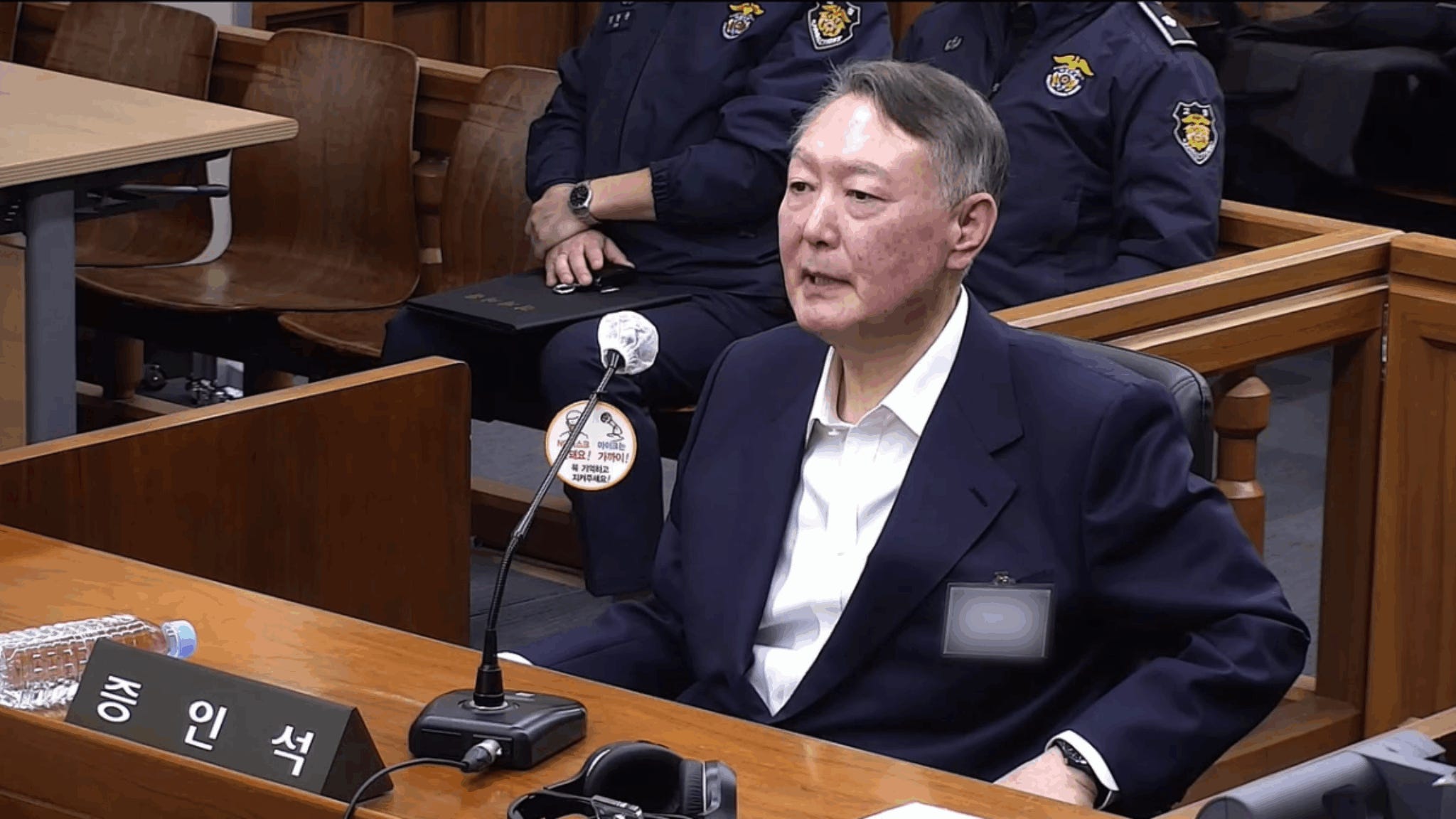
The Seoul court’s sentencing of former South Korean President Yoon Suk Yeol on February 19 to life imprisonment on sedition charges is sending shockwaves across the country, prompting concern over the likelihood of worsening political unrest.
If the court’s verdict ends one phase of legal combat, its political impact presents another facet of a running political crisis. It appears to have intensified rather than resolved political divisions, with the ruling Democratic Party, which took power last June in the wake of Yoon’s impeachment, seeking to squeeze every drop of political benefit from the current campaign, condemning Yoon’s quixotic declaration of martial law on the night of December 3, 2024.
Yoon apologized today [February 20] for his short-lived declaration of martial law, saying, however, that while he was sorry for the “frustration and hardship” brought upon the people by his martial law decree, he stood behind the “sincerity and purpose” behind his actions. The life sentence, he said according to Reuters, was “predetermined” and political retaliation.
“Forces that seek to smear a decision made to save the nation as an ‘insurrection’ and to use it beyond political attacks as an opportunity to purge and eliminate their opponents will only grow more rampant going forward,” he said. He also questioned whether an appeal would have meaning in what he described as an environment where judicial independence could not be guaranteed, while telling supporters to “unite and rise.”
The verdict “looks to be an excessive [sentencing] for a matter dealing with politics,” said one business figure in Seoul, asking that he not be quoted by name for fear of government reaction. But his cautious comment itself testifies to the tension still simmering at the end of a protracted crisis triggered by Yoon’s arbitrary declaration, which lasted for just six hours. First Lady Kim Keon Hee, Yoon’s wife, has also been jailed for accepting valuable gifts, such as Chanel handbags and diamond necklaces from the controversial Unification Church, making the couple the first to be simultaneously under detention.
Steady parade of convictions
All three recent South Korean presidents have been jailed, most recently Park Geun-hye, who was impeached and sentenced to more than 20 years for bribery and coercion, although she was later pardoned. Before that, her immediate predecessor Lee Myung-bak was sentenced to 15 years in 2018 for bribery, embezzlement and abuse of power. While that record is viewed by some as a testament to the country’s strong rule of law and the independence of its judiciary, others describe it as a cycle of toxic legacy of political polarization and political revenge.
At earlier court hearings, an independent counsel nominated by the national assembly demanded a death sentence, insisting that Yoon’s martial law declaration amounted to an act of “sedition” and “insurrection” aimed at subverting the country’s constitutional process.
Yoon, however, has defended his action on the grounds that the Democratic Party, then leading the opposition, was using its numerical strength on the floor of parliament to block his political agenda. He has justified his action on the need to break constitutional immobility with the opposition blocking his political agenda, including the passage of the state budget.
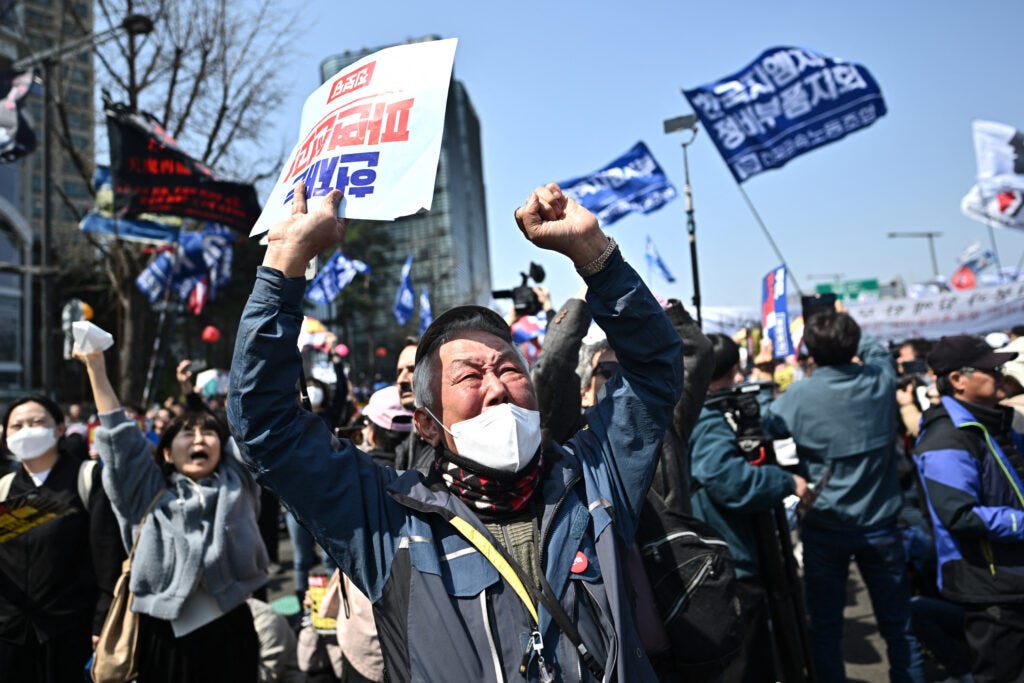
Under South Korea’s legal procedure, Yoon can expect to have two more hearings in the process to defend his case, prompting speculation that his life term may face changes. But the center-left Democratic Party is headed by Jung Chung Rae, a hardliner who remains unmoved, continuously campaigning for Yoon’s execution. “If you don’t deal severely with cases involving sedition and insurrection now, it can open the door for more such seditions in the future,” he has declared.
Conservatives badly split
The court’s conviction has left Yoon’s conservative People Power Party badly split, with one faction calling for a nationwide campaign to boycott the verdict. This internal split is expected to worsen in the months ahead, with the country scheduling new local government elections in June. Today, South Korea remains acutely divided regionally over how to deal with Yoon’s conviction, with the conservative southeastern region supportive of Yoon and southwestern provinces of Cholla region sympathetic to the Democrats’ center-left progressive line. While Yoon’s group is calling for street demonstrations against the government of President Lee Jae Myung, the Democrats are demanding stronger punishment.
People Power, now in opposition, is itself torn between hardliners demanding continuing rounds of street demonstrations calling for a boycott of the verdict, while another group is calling for clear, unambiguous acceptance of the sentence, conceding that his action amounted to a serious challenge against the country’s democratic institutions, achieved at the cost of many demonstrations for ending control by a succession of military regimes.
But the party’s “realist” group, headed by incumbent Seoul mayor Oh Se Hoon, is urging that the party unambiguously accept the court’s verdict, saying South Korea should move ahead to a mature democracy, rejecting Yoon’s “regressive” adventurism. Such moderate views reflect the results of the majority of South Koreans hoping to maintain Korea’s hard-won democratic process through years of pro-democracy movements against the army-led military regimes.
New polls in June
Further complicating the situation is the timetable for the next local government elections, scheduled in four months. The Lee government is facing tricky political challenges with the economy slowing and trade prospects darkening. For the first time in many years, the economy grew at an exceptionally low pace of less than one percentage point last year.
At the same time, South Korea’s main economic engine of exports faces exceptional challenges from a huge US tariff regime, with the rate raised on imports to the US from 15 percent to 25 percent. With the Lee administration under obligation to invest at least US$20 billion each year in the US for the next 10 years, in exchange for a lower 15 percent levy, the Korean won is showing signs of weakening, despite stock market outperformance.
The prospect of a looming economic crisis presents a narrow choice for the ruling Democrats. Additional court hearings on Yoon’s case are expected to be impacted by the economic situation as well as by political divisions.
In addition to Yoon, the court has also convicted a number of senior military leaders headed by former Defense Minister Kim Yong Hyun, who received a 30-year prison sentence, and Major General Noh Sang Won, a top military intelligence commander, to an 18-year prison term on charges of collaborating with Yoon. On top of these military leaders now criminally implicated, former Prime Minister Han Duck Soo also stands accused of assisting in Yoon’s abortive coup.
While the conviction of military leaders in uniform has worried the country’s large military establishment, Han’s possible conviction for suspicion of endorsing the coup may impact the country’s huge technocratic community, which plays an integral role in running the economy.
Several national police leaders are also on trial for failing to have Yoon delivered for questioning. With so many power holders facing possible convictions, the ongoing legal process is expected to have a strong political impact for years to come.
Shim Jae Hoon is a former Seoul correspondent for the now-defunct Far Eastern Economic Review and a regular contributor to Asia Sentinel
this particular conviction, and also bolsonaro in brazil, are seen as one of the few positives for democracies. should aspirational autocrats have no limits? many americans (and turks) wish some accountability at home.
but yes, the track record of presidential convictions in south korea may suggest other problems and\or cultural inertia.