

Singapore, which cherishes its image as the most economically advanced state in Southeast Asia and the home of an expanding number of multinationals and media outlets fleeing a growing Chinese crackdown in Hong Kong – including the Wall Street Journal, the US’s most prestigious business and financial publication – has become the international focus of embarrassing charges of political repression after top opposition figures have fled the city-state to apply for asylum or shelter overseas.
They include Lee Hsien Yang, the second son of Singapore’s founding prime minister, who has been granted political asylum in the UK; former Reform Party Chairman and lawyer Charles Yeo Yao Hui, who fled Singapore in 2022 and has applied for UK asylum;, and Kenneth A. Jeyaretnam, the current leader of the Reform Party, who is recovering from serious illness in the UK and has been told he is in danger of being branded an “absconder” from justice under Singapore’s controversial fake news law. Pritam Singh, 48, chairman of the Workers Party, has been on trial for a week in Singapore on allegations that he gave false evidence testimony during parliamentary committee hearings in 2021 that could cost him his position as official opposition leader.
In each case, the government has said it has had ample reason for its actions and that the charges are merited. A long list of rights organizations including Human Rights Watch and Amnesty International, however, have condemned Singapore’s use of the law to curtail political activity.
In its 2023 Country Reports on Human Rights Practices: Singapore, the US Department of State said that in more than five decades of continuous rule, “the PAP (People’s Action Party) employed a variety of measures that effectively limited the ability of the opposition to mount a serious challenge to its hold on power. In recent years opposition parties won additional seats that amounted to only a small fraction of seats in parliament.” The PAP, the report said, “controlled key positions in and out of government, influenced the press, and benefited from structural advantages such as the group constituency system and short campaign period that disadvantaged opposition parties, according to some human rights groups. While the PAP’s methods were consistent with the law and the prerogatives of parliamentary government in the country, the overall effect was to perpetuate PAP power. The PAP maintained its political dominance in part by circumscribing political discourse and action. There were 34 registered political parties, which were legally free to organize. Authorities, however, imposed strict regulations on their constitutions, fundraising, and accountability, including a ban on receiving foreign donations and a requirement to report donations.”
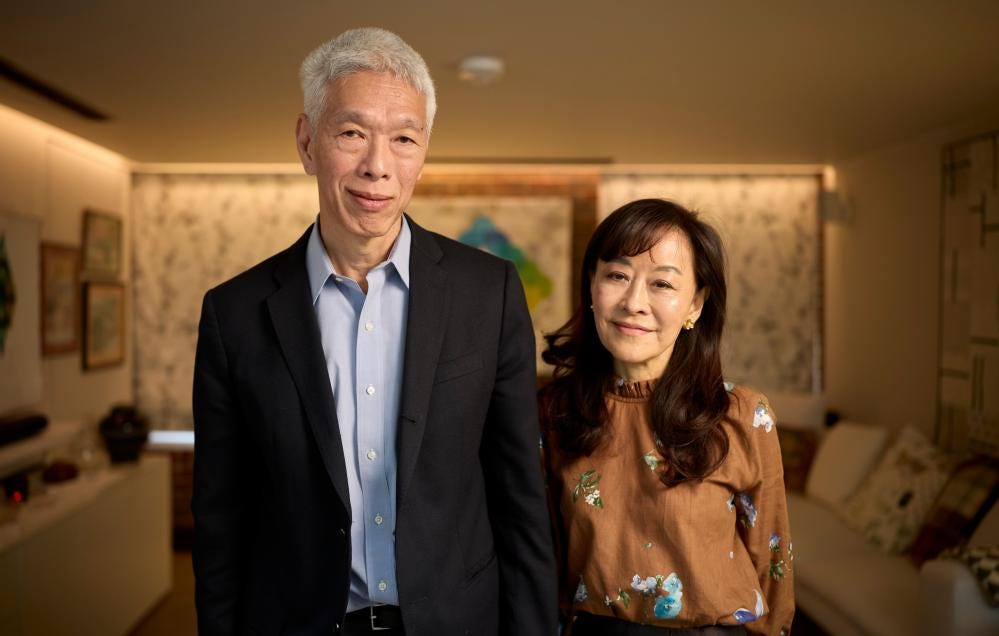
The Labour government of Sir Kier Starmer in London quietly granted asylum to Lee Hsien Yang in August, in implicit condemnation of the tightening political situation in the island nation. Hsien Yang, the estranged brother of former Singapore Prime Minister Lee Hsien Loong, announced the grant of asylum on Facebook on October 22, saying he is a "political refugee" after going into exile along with his wife Lee Suet Fern amid a public feud that began in 2017 over the disposition of the colonial-era home of the late patriarch, Lee Kuan Yew. Hsien Yang has accused his brother and Singapore's government of persecuting him, his wife, and his son over the affair.
The couple fled to London in 2022 amid a criminal investigation by authorities and an accompanying perjury threat over allegations of tampering with the patriarch’s will over the home, which Lee Hsien Loong wants preserved. During his lifetime, Lee Kuan Yew said the property should be demolished to avoid it becoming a shrine. Lee Hsien Yang and his wife want his wishes enforced. Lee Wei Ling, the third sibling, died earlier this month in the home after a long illness, and Hsien Yang has petitioned to have it destroyed, which seems likely to rekindle the feud.
In a reply to the Guardian which reported on this matter, the Singapore government said the charges against Hsien Yang and his wife are "without basis" and were established by a police investigation and an independent judicial commission looking into allegations of improper influence on Lee Kuan Yew’s will. Lee Hsien Yang’s eldest son Li Shengwu, a professor of economics at Harvard University, tweeted on October 22, “The Singapore government has released an outraged response in the state media. All the points the SG government makes are old news, and were considered and rejected by the UK when it granted asylum.”
In a Facebook post on October 22, Lim Tean, the leader of a Singapore opposition party, People’s Voice, said, “The Son Of Lee Kuan Yew Had To Seek, And Was Granted Political Asylum By The UK Government! It is shameful what our country has become!!”
In another action, another opposition figure, former Reform Party Chairman and lawyer Charles Yeo, who served as the chairman of the Reform Party between 2020 and 2022 left Singapore to apply for asylum in the UK after allegations of harassing a police officer and “wounding the religious feelings of Christians in some social media” posts. Yao, 31, left while on bail over allegations of criminal breach of trust and forgery in the wake of police reports against the law firm where he worked, Whitefield Law Corporation. The court granted court permission for him to travel to Vietnam. Instead, he flew to the UK to apply for political asylum, maintaining the charges were politically motivated. He is still awaiting a ruling on his asylum petition. Singapore police categorically denied that the arrest was "politically motivated.”
As Asia Sentinel reported in July, current Reform Party leader Kenneth A. Jeyaretnam, recovering from a serious illness in the UK has been told he is in danger of being branded an “absconder” of justice under the country’s fake news law and could be subject to penalties that could disqualify him from standing in the next election, which must be held before November next year. Authorities said they are waiting for Jeyaretnam’s assessment on how long he would be away so they can consider the next steps.
“The Singapore Police have informed me that I remained ‘out of jurisdiction’ and had failed to return, painting me as an absconder,” he told Asia Sentinel. “They have now written to me giving me till July 23 to tell them whether I intend to return or they will proceed in my absence. I’m sure they intend to fine me enough to prevent me from standing in the approaching GE (general elections).”
The 65-year-old Jeyaretnam is required to correct allegedly false statements or face contempt of court charges stemming from a June 15 Facebook post claiming the government intentionally sets artificially high land prices for sale to the Housing Board, that endowment and trust funds are not transparent, and that the government maintains a large land bank of heritage properties to keep prices as high as possible to boost reserves. If not corrected, he faces possible jail time and fines.
Yet another political figure – Pritam Singh, 48, opposition leader chairman of the Workers Party, has been on trial in Singapore where he was accused of giving false evidence testimony during parliamentary committee hearings in 2021 after former Workers’ Party member of parliament (MP) Raeesah Khan was said to have lied to parliament about accompanying a rape victim to a police station. Khan falsely told Parliament she had accompanied a sexual assault victim to the police station, where she was treated insensitively. She repeated the claim later in parliament before admitting she had lied. Pritam Singh faces a fine of up to S$7,000 (US$5,315), a jail term of up to three years, or both for attempting to cover up Khan’s false testimony.
“Usually, the UK is only in the business of granting safe sanctuary for despots of former British colonies fleeing from political uprisings in their home countries, not for political scions of ruling families and leaders of former British colonies seeking refuge from their siblings abusing state power for personal vendettas,” said one person now in exile in the UK. “This can also be seen as a decades-old karmic turn of judgment by the UK against the Singaporean judiciary. Lee Kuan Yew had previously abolished the rights of Singaporeans to seek UK Privy Council appeals (partially in 1989, fully in 1994) for lawsuits heard by the Singaporean judiciary. This had never been an issue until former Singaporean Workers’ Party leader J.B. Jeyaretnam, Kenneth Jeyaretnam’s father, successfully had the UK Privy Council reverse his disbarment in Singapore in 1988 and call his conviction by the SG government under Lee Kuan Yew a ‘grievous injustice.’”