
By: Ying Yu Lin
In early February 2026, the 10th Singapore Airshow was held in Singapore. Marketed as the largest annual aerospace and defense exhibition, the airshow serves not only as a commercial event but also as a reflection of national defense industrial capabilities and broader geopolitical competition. Compared with the relatively region-focused defense exhibitions in Japan and South Korea, the Singapore Airshow targets a far more diverse global market, naturally attracting defense companies from different political and strategic camps.
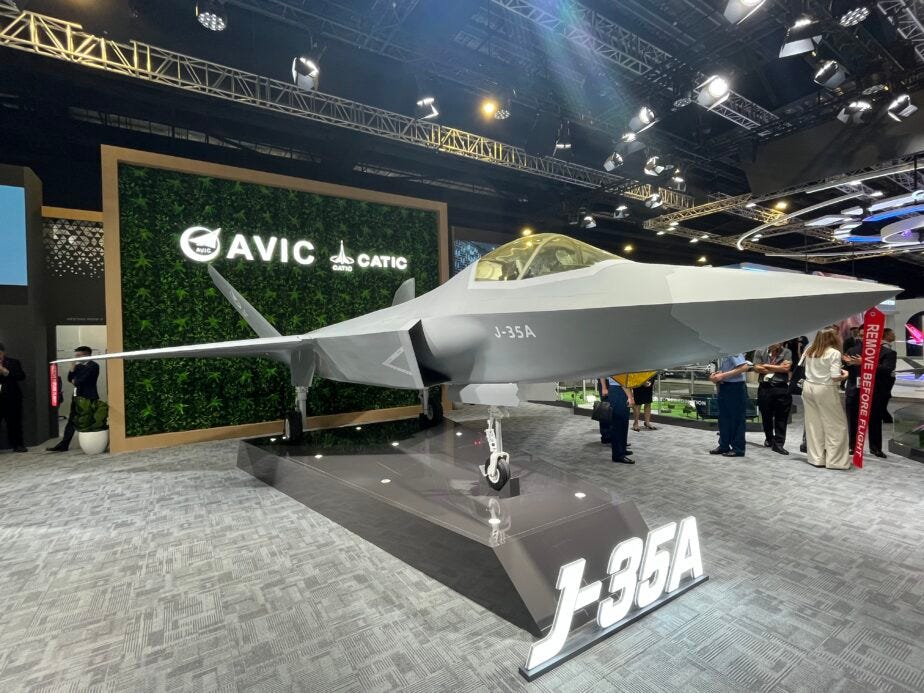
China once again participated by renting exhibition space behind the main booths of the host company, ST Engineering. A large-scale model of the J-35 stealth fighter was on display. There were also live flight demonstrations by the People’s Liberation Army Air Force’s August 1st Aerobatic Team flying the J-10C. Chinese sources emphasized that the J-10C aircraft flew to Singapore using aerial refueling throughout the journey, and during the airshow conducted multiple formation flights.
However, aviation enthusiasts attending the event noted that the J-10C’s flight demonstration remained conservative, with no display of aggressive vertical climbs or high-angle-of-attack maneuvers. Some analysts argue that future air combat will place less emphasis on individual aircraft performance and more on cost-effective, system-of-systems operations. From this perspective, the J-10C’s restrained performance was intended to highlight its affordability and its suitability for helping budget-constrained countries rapidly establish an integrated air combat force.
This approach was also reflected in the participation of numerous Chinese civilian component suppliers, including manufacturers of bearings, seals, valves, and other defense supply chain products. At the same time, it was noticeable that the number of Chinese exhibitors had declined compared to previous years. This reduction appears to stem from increasing international procurement restrictions on non-Western supply chains, as well as tighter domestic government subsidies for overseas exhibitions. While Chinese products continue to enjoy price advantages, their target markets are increasingly focused on customers with limited defense budgets or those procuring consumable or expendable systems.
Unmanned systems remained a central focus of the airshow. The global UAV market is increasingly polarized. Companies such as Anduril Industries – well known for its frequent interactions with Taiwan – showcased UAVs integrating AI systems, stealth-oriented designs, and extensive use of carbon-fiber composite materials, such as the “Fury” drone, developed to support fifth-generation fighter “loyal wingman” concepts.
However, lessons drawn from the war in Ukraine and recent conflicts in the Middle East have highlighted that unmanned platforms are no longer primarily reusable assets, but increasingly function as expendable munitions for one-way attack missions. As a result, the ability to mass-produce systems quickly and at low cost has become a critical factor. In the small- and medium-sized UAV segment, trends include the use of 3D-printed modular components, simplified operating procedures, and designs that allow operators with minimal training to deploy systems rapidly. These developments reflect the growing emphasis on low-cost, attritable unmanned capabilities.
In response to demographic challenges such as declining birth rates, many exhibitors also showcased solutions aimed at maximizing manpower efficiency and reducing training costs. Virtual-reality–based training simulators and more intuitive, human-centered control interfaces were notable highlights of the exhibition.
In the field of counter-UAV systems, attention extended beyond electronic warfare and signal jamming. A key focus was on how to counter low-cost drones using equally cost-effective defensive methods. Concepts on display included the integration of proximity fuzes – first developed during World War II – with AI technologies and modern intelligence, surveillance, and reconnaissance (ISR) systems. Using drones to intercept other drones was also presented as a viable option.
These approaches, however, significantly increase demands on power generation and energy management. Improving energy efficiency, reducing system weight through advanced materials engineering, and enhancing system integration and autonomous control were recurring themes, particularly at Japanese exhibitors’ booths, where civil–military technological integration was clearly evident.
Beyond the defense industry, Singapore also hosted its first Space Summit (Space Summit 2026) during the airshow and announced the establishment of the Singapore National Space Agency (NSAS) in April. Organizers indicated that future Singapore Airshows will increasingly integrate space technologies.
Some observers question whether Singapore truly requires a dedicated space strategy, unlike major powers such as the United States and China, or regional actors like Japan, South Korea, and India. However, modern space strategies no longer demand the high costs or dedicated launch facilities of the past. In particular, the deployment of low-Earth-orbit (LEO) satellites and other small satellites can be supported through commercial providers and international cooperation, significantly reducing entry barriers and costs.
LEO satellite communications are expected to be one of the primary motivations behind Singapore’s establishment of a national space agency. In terms of resilience, Singapore shares concerns similar to those of Taiwan: whether redundant communication systems can be maintained under attack or persistent gray-zone pressure. LEO satellite communications are directly relevant to these resilience challenges.
These developments suggest that future Singapore Airshows will expand further in scale and scope, attracting a broader range of military and civilian participants. As global aerospace and defense supply chains undergo restructuring, companies are no longer evaluating partners solely on cost considerations. Resilience, political reliability, and geopolitical alignment are becoming equally important. For many firms, these shifts also represent new opportunities to enter or reposition themselves within the evolving defense industrial landscape.
Dr. Ying Yu Lin is an associate professor at the Graduate Institute of International Affairs and Strategic Studies at Tamkang University in New Taipei City, Taiwan, and a research fellow at the Association of Strategic Foresight. This article is the result of a cooperative sharing agreement with The Diplomat, the Tokyo-based current-affairs magazine for the Asia-Pacific region.