
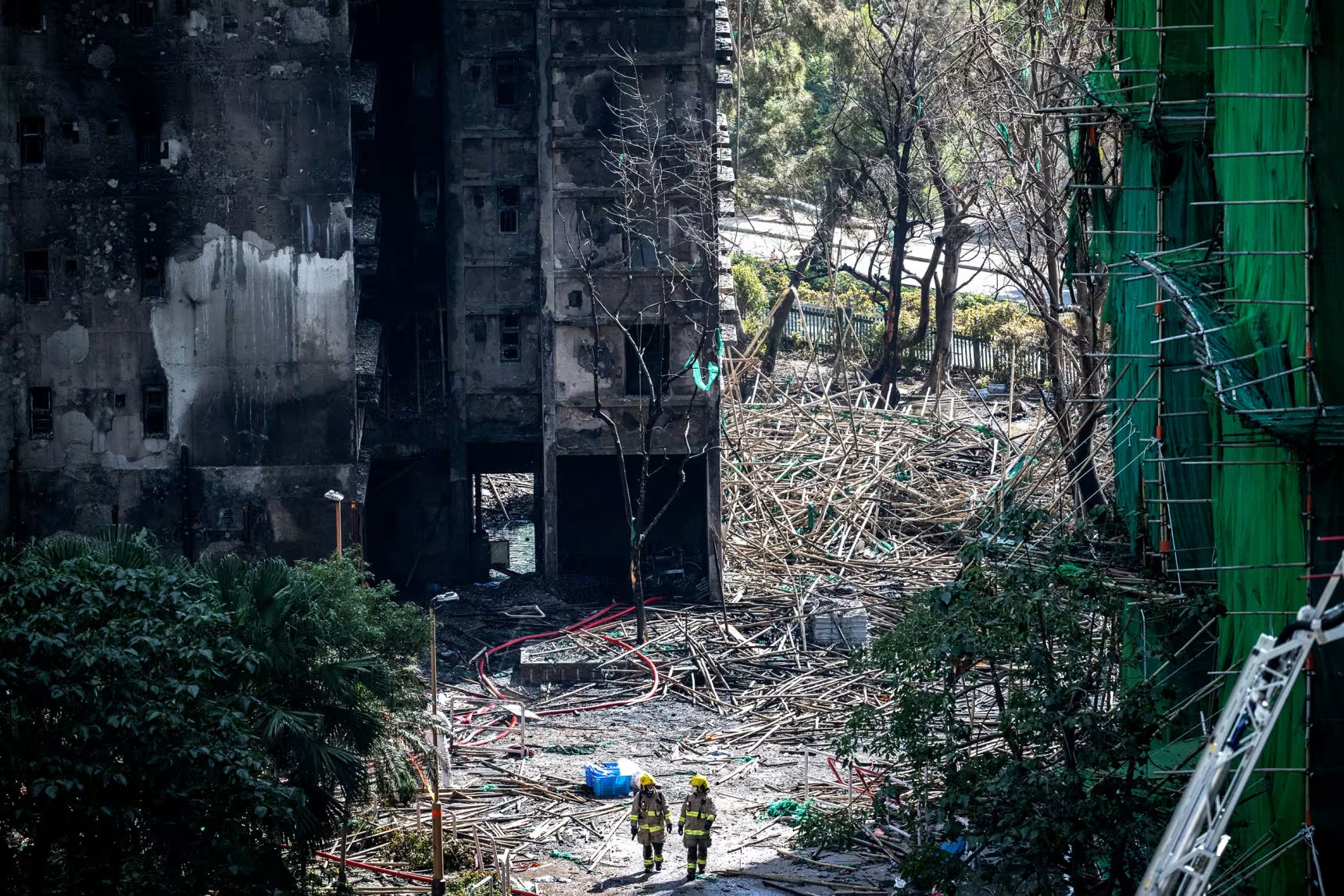
With at least 159 dead in Hong Kong’s devastating Tai Po fire, now should come the accounting for the immediate causes and the commercial and official practices which lay behind it. The government has announced the creation of a Committee of Inquiry led by a judge which will look at a very wide range of issues, including the use of materials, the practices of consultancy companies and owners’ corporations in awarding officially-demanded renovations, and the extent on corruption in both the awarding of contracts and the use of materials.
Behind the physical issues of the fire lies a murky world of relationships between owners’ committees and corporations, management companies, building and architectural consultants, and contractors. However, transparency and justice have long been in short supply in Hong Kong partly due to vested interests and now also to the government view that the executive is the overriding power. The Office for Safeguarding National Security, established by Beijing in 2020, warned against “using the disaster to cause chaos in Hong Kong.”
Government shies away from blame
Included in an inquiry too should be the role of officials from relevant government departments, which presumably include the Buildings, Housing, and Labour Departments, in ensuring existing standards are met. The committee will doubtless come up with suggestions for improvements in standards and supervision. However, the government appears to many to be aiming to shut down discussion of its own contribution to the tragedy. Authorities have shut down an online petition which attracted 10,000-plus signatures almost overnight and several have been arrested under the National Security Law imposed by Beijing in 2019 which effectively shut down opposition politics. Ever fearful of any criticisms that might go close to the rule of the party and its minions, Beijing hit out at alleged “hostile external forces who had attempted to stir up opposition” under the pretext of the fire. Local officials accused those demanding better government of “sabotaging society’s efforts to support victims.”
Public anger has been real and sustained but the government has been trying to head it off by arresting various people involved in the renovation project that caused the fire on suspicion of either manslaughter or corruption. It has ordered the removal of green plastic netting, thought to be a contributor to the fire, from other buildings under renovation while suggesting that fires were caused by illegal materials – netting which did not meet fire retardant standards.
It may be difficult to entirely bury the government failings which have already come out from the owners of the eight high-rise blocks concerned. However, the Committee of Inquiry is singularly lacking the judicial teeth of a Commission of Inquiry which can require witnesses to give evidence under oath. Such Commissions were appointed to investigate the 2012 Lamma Ferry sinking, which killed 39 people, and the 1996 Garley Building fire which killed 41. The government claims a committee can work faster but critics say it is less independent as well as being less powerful.
Residents sought to show dangers
Issues which have come to light in recent days including the fact that back in September 2024, the residents gave an exhibition of the flammability of the Styrofoam materials used to block windows and air-conditioning but their concerns were dismissed by the overseeing consultancy. It appears that there was nothing illegal about the use of Styrofoam, which now seems the leading cause of the fire spreading so quickly. The role of green netting remains is also suspect, as are some of its safety certificates. Contrary to reports in international media, the use of bamboo scaffolding probably played little or no role in the fire. Bamboo is very slow to burn compared with plastics and artificial fibers.
In this case, it appears that owners were dissatisfied with the price agreed with the contractor, which averaged HK$160,000 (US$20,550) per 450 square-foot flat. They were so upset with the cost that the committee which agreed the deal was replaced, but couldn’t change the contract. (The 1,984-unit estate was built under the then-government’s home ownership scheme for lower-middle-income families).
Estates with huge numbers of owners are naturally prone to becoming dominated by cliques with the ability to profit from contract awards. Meanwhile, estates over 30 years old may be subject to government renovation orders which provide potentially lucrative business for consultants, contractors, and possibly, management committees.
The awarding committee included a District Councillor from the most stalwart pro-government party, the DAB (Democratic Alliance for the Betterment of Hong Kong). She has since called for an ICAC investigation into a contract award, for which she was partly responsible.
The Labour department and the Housing Bureau made various visits to the site in recent months but apparently didn’t identify any serious issues with the works, which had been ongoing for more than a year, all eight blocks being simultaneously covered in scaffolding, green netting and with windows blocked by Styrofoam panels.
Another significant immediate cause of the high mortality rate was the fact that the alarm system throughout the whole project was not operating, apparently to facilitate work at the site. As a result, residents, about a third aged over 65, were unaware of the fire until it was too late to escape. Scaffolding and netting on the buildings – a mere three meters between the 1980s-built blocks – made them even closer together.
It doesn’t help the government that before the National Security Law effectively shut down the democracy movement in the 2019 election saw a landslide victory for the pro-democracy candidates for the Tai Po district Council. It was subsequently replaced by a mostly DAB “patriots only” council.
Ominous delay of ferry probe
Meanwhile, those expecting a quick and thorough investigation of the causes and culprits behind the tragedy are not going to be reassured by the denouement of another one that took unnecessary lives more than a decade ago. On the very same day that the Committee of Inquiry was announced for the Tai Po fire, a Coroner’s court announced a further delay in a verdict on the deaths of the 39 who died in the Lamma ferry sinking in 2012. More than 13 years on, a conclusion is awaited, although it seems unlikely to bring even belated justice for a tragedy which was the subject of an extraordinarily detailed Commission of Inquiry report published in 2013 with evidence from a wide variety of witnesses and experts, some from overseas.
This subsequently was almost entirely ignored by the Department of Justice and the police. An internal government inquiry has never been published, an apparent cover-up which has infuriated victims’ families. Some legislators had been given a sight of the report – but with the names blacked out. The captains of the two involved vessels were jailed, although the loss of life was primarily due to the smaller vessel sinking very quickly due to improper modifications to increase capacity by removing a vital bulkhead. It also lacked adequate life jackets. Neither the owner, the HK Electric Company, part of tycoon Li Ka Shing’s empire, nor the boatyard which had made the structural alterations, nor anyone from the Marine Department which signed off on improper construction, was prosecuted. Just two modestly paid seamen.
Relatives of the dead have been fighting for proper accountability ever since against official obstruction. Eventually, they had to go to the Court of Appeal in Hong Kong in 2023 to get an inquest at all. The latest delay in issuing the inquest report may point to more behind-the-scenes interaction between the executive and the courts.
An extraordinary story, about an unspeakable and unnecessary tragedy that should never have taken place.