
By: David Scott Mathieson
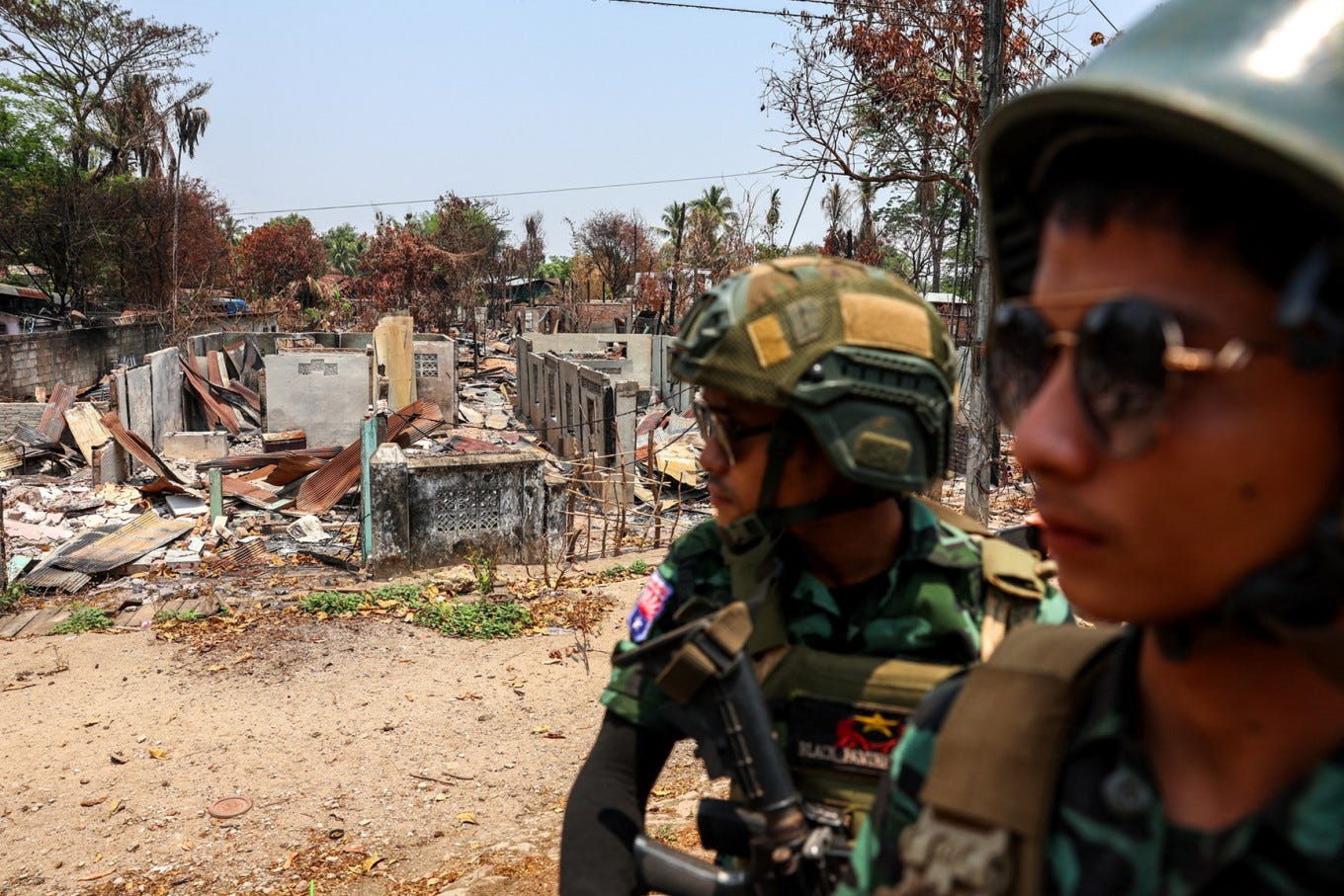
As Myanmar marks five years since the February 2021 coup d’etat that ended representative democracy, the country’s civil war shows little sign of de-escalating. The three-stage election cycle has concluded, and any retrospective must conclude that fighting during that month was less about “election-related violence” by all sides, and more followed the logic of pre-existing combat dynamics that have been shaped by years of expanding conflict, which has resulted in more than 3.5 million displaced people, an estimated 90,000 deaths on both sides, and nearly half the population requiring humanitarian assistance.
The election, with the final stage held on January 25 amid junta claims of overwhelming victory, occurred only in areas under military authority only with parties it approved, and has done nothing to assuage international condemnation of the junta, which has largely beggared the country, and has had no effect on Myanmar’s economic crisis. Inflation is projected to remain above 30 percent in 2026, with GDP continuing to contract.
A closer look at several battle fronts suggests that far from the stalemate some analysis has suggested, the conflict remains highly kinetic and the Myanmar military’s counteroffensives over the past year have produced mixed results. Following the success of Operation 1027 in October 2023, members of the Three Brotherhood Alliance and multiple People’s Defense Force (PDFs) seized large swaths of territory and inflicted heavy casualties on military regime forces, known as the Tatmadaw. Phase 2 of the operation in 2024 saw the capture of major cities such as Lashio and Mogok in the north, although these cities were then relinquished following the intervention last year of a China increasingly concerned over its border security and its economic projects in the country.
Counteroffensives win back some territory
Well-planned counter-offensives, bolstered by new recruits, advanced drone warfare, and more decentralized military tactical operations saw the army retake the towns of Nawnkgchio, Kyaukme and Hsipaw in Northern Shan State. The Mandalay rebel defense force was also forced to retreat from the township of Madaya north of Mandalay after heavy air strikes accompanied by ground troops exerted too much pressure on the resistance forces, who retreated into the hills.
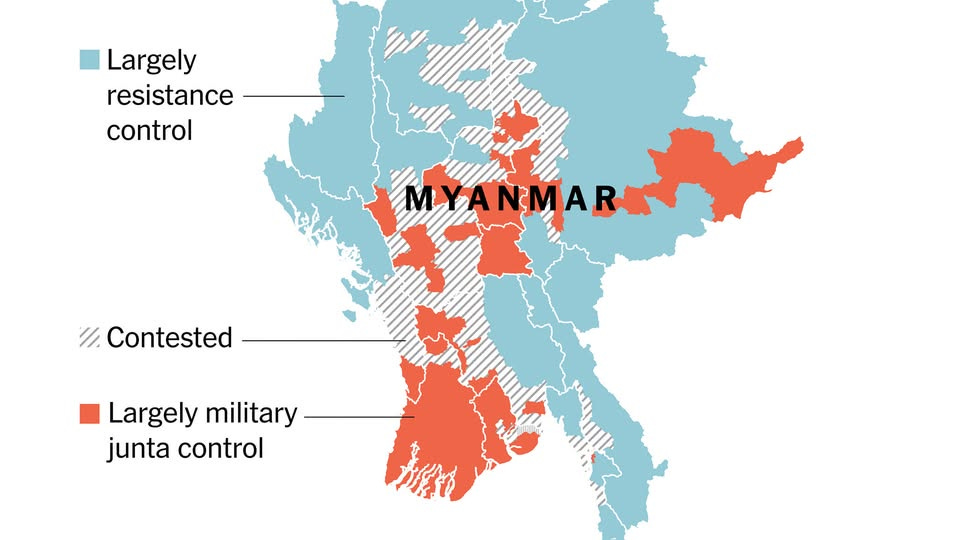
The rebel Kachin Independence Army (KIA) has still failed to take the strategic town of Bhamo on the Ayeyarwady River since besieging the area in late 2024. Air strikes and heavy artillery bombardment, plus air and river resupply, have, for the time being, bolstered the Tatmadaw army defenses. Perhaps one of the most notable reversals of fortune has been in Kayah State and Southern Shan State, where multiple Ethnic Armed Organizations (EAOs) have lost territory over the past year to methodical army advances.
In January, 80 Myanmar military prisoners of war staged a dramatic prison break in Kayah, stealing weapons and crossing into Thailand before being handed over to Myanmar authorities, suggesting activist narratives of collapsing army morale in the past few years to be questionable at best.
Some rebel progress
Yet elsewhere, setbacks for the multiple rebel ethnic organizations and defense forces are less pronounced. Indeed, progress is being made. In Rakhine State, the Arakan Army (AA) has not just held onto territory it captured between 2023-2014, but has edged closer to the state capitol of Sittwe and the major port area of Kyaukphyu: at some points AA forces were just kilometers from the town center of Sittwe. It remains to be seen if the AA will take these twin offensives to fully overrun both locations, and likely invite punitive air strikes, but China’s major investments in Kyaukphyu will be a decisive factor. The AA has also expanded its governance and service delivery across the majority of the state it controls.
To the north of Rakhine State, the AA and multiple PDF allies it trained and equipped are continuing an incremental advance into Magwe Region, threatening the network of Defense Services Factories (Ka Pa Sa). The AA appears to be pursuing a gradual offensive of clearing army outposts along key roads, taking its time advancing instead of a risky ‘thunder run’ to key urban centers. To the west, the AA allied Chin Brotherhood (CB) has managed to dent army advances into Chin State.
The Karen National Union (KNU) spent 2025 finishing its years-long operation clearing out almost all Myanmar army bases along the border with Thailand: in time to mark its 77th anniversary of revolution against the central state, the longest continuous insurgency in the world. In neighboring Bago Region, PDFs backed by the KNU have expanded attacks against army outposts in multiple locations around the Sittang River in January. Thousands of civilians have reportedly been displaced.
New alliance bolsters rebels
But perhaps the most notable news on the rebel front has been the formation of the Spring Revolution Alliance (SRA) in December. This group’s 19 PDFs into one umbrella organization, including the Karenni National Defense Force (KNDF), the Bamar People’s Liberation Army (BPLA), the CB and groups from the Yaw Valley region in Magwe Region, and ethnic Mon, Pa-O and Danu resistance forces.
Notably, many of the members of the SRA have been trained by the Arakan Army and other members of the Three Brotherhood Alliance over the past three years, including the Ta-ang and Kokang armed groups from Northern Shan State. These are powerful benefactors. The composition of the alliance makes them a formidable national military player, as well as symbolically diverse but ‘networked’ in ways the exiled National Unity Government (NUG) has failed to achieve since 2021.
The widely respected KNDF commander Khun Bedu is the SRA’s official spokesperson, who told The Irrawaddy magazine in an interview that “we’ll operate across Sagaing, Magwe, Bago, Chin, Mon and K(ayin). Now the junta has gained an advantage through drones, we’re upgrading our own drone capabilities and other technologies to ensure the revolution can advance nationwide with greater strength. We don’t plan to seize or govern one specific territory. Rather, our purpose is to build a strong, interconnected alliance capable of working collectively across all regions.”
Khun Bedo was at pains to downplay speculation that the new alliance was a rebuke to the National Unity Government coalition, which is facing intensifying criticism for its failures in coordinating the kaleidoscope of resistance forces. But the Spring alliance formation was greeted by renewed optimism, especially among the younger generation of post-coup fighters and their supporters, and the kind of innovation many people in Myanmar, exhausted by five years of war, wanted to see. But just as the military regime is not close to collapse, neither are its opponents down for the count. Armed conflict across Myanmar looks set to persist for some time.
David Scott Mathieson is an independent analyst working on conflict, humanitarian and human rights issues in Myanmar and a regular contributor to Asia Sentinel
let me make a prediction right here, right now. the china backed rebels will sign the caese fire with the junta in 2026. that includes the aa. but a low intensity conflict will continue beyond 2026.