
By: Toh Han Shih
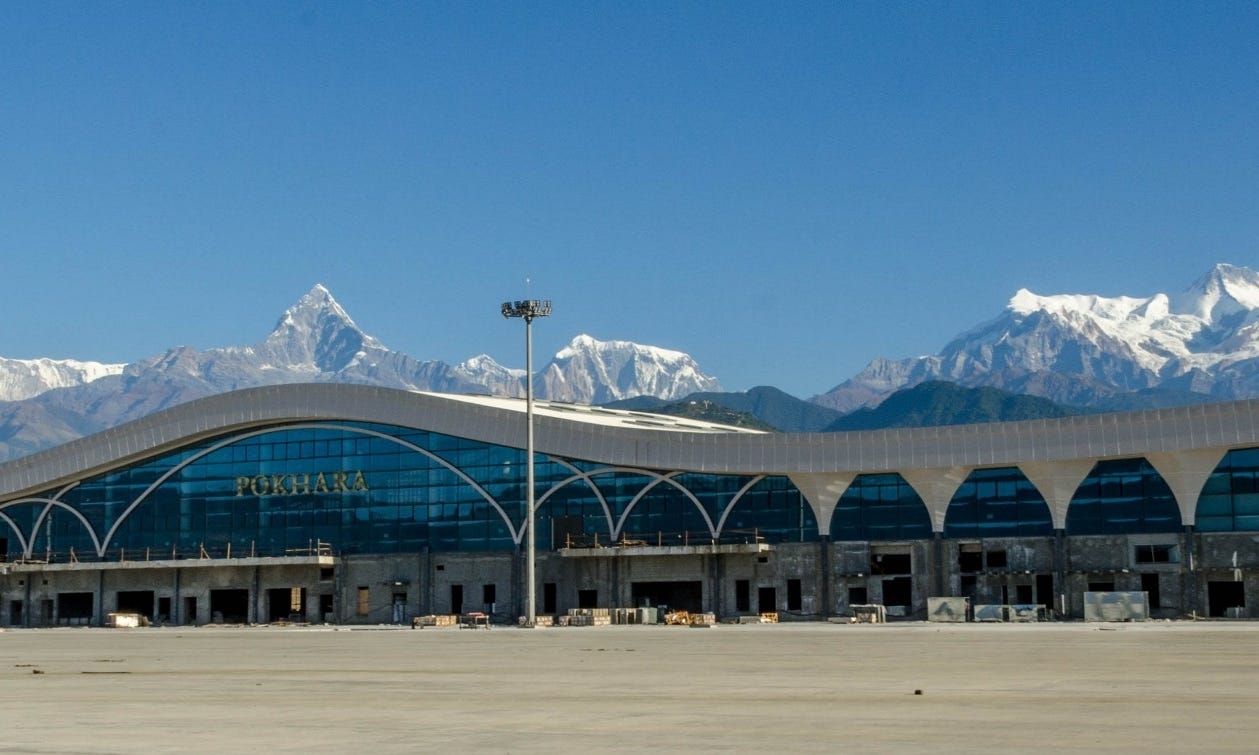
A multi-million-dollar bribery scandal over Nepal’s Pokhara airport has given ammunition to critics who accuse China’s Belt and Road Initiative (BRI) of corruption in the biggest case filed at Nepal’s Special Court in terms of the money involved under a state procurement process. The accusations against a Chinese state-owned enterprise (SOE), China CAMC Engineering, its chairman and another senior executive, have dealt a blow to the reputation of the BRI, China’s megaproject to forge economic links with other nations through infrastructure projects like airports.
“China has been trying to address the international reputational damage by instituting a number of “corruption purges” within BRI projects since mid-2024. They had been making some progress. The Nepal story will undo much of these reputational gains. But the civil society backlash and reputational damage will be significant,” Andre Wheeler, chief executive officer of Asia Pacific Connex, an Australian consultancy, told Asia Sentinel.
A risk consultant said, “Cases like this chip away at the narrative that the BRI is purely a mutual-benefit development tool. Unless addressed transparently, they feed narratives of overpricing, indebtedness and local capture. For many citizens, it will look like proof of what critics have been saying: foreign money plus weak oversight equals big losses. Politically, that’s toxic.”
“This is not just about one firm or one airport. It exposes recurring governance gaps around large, state-backed infrastructure financing that create corruption risk in BRI deals,” added the risk consultant, who declined to be named.
Nepal’s Commission for Investigation of Abuse of Authority (CIAA) alleged the overpricing in a charge sheet filed at Nepal’s Special Court on December 7. The anti-graft watchdog’s charge sheet alleges officials and CAMC colluded to inflate costs, breach procurement laws and compromise construction quality. The harshly worded charge sheet alleges the group misused 8.36 billion Nepalese rupees (US$74.3 million) by raising the airport’s approved cost estimate from US$145 million to US$215.95 million “with malicious intent.”
CAMC, which is listed on the Shenzhen Stock Exchange, built the airport, which was financed by a loan from China’s state-owned Export and Import Bank. CAMC’s controlling shareholder is China National Machinery Industry Corporation (Sinomach), an SOE.
The defendants include CAMC and 55 individuals including CAMC chairman Wang Bo and regional general manager Liu Shengcheng as well as five former Nepali ministers, comprising former Finance Minister Ram Sharan Mahat and four former tourism ministers, namely the late Post Bahadur Bogati, Bhim Prasad Acharya, Deepak Chandra Amatya and Ram Kumar Shrestha.
The CIAA is seeking a US$74.3 million fine from CAMC, Wang and Liu for violating Nepali laws on corruption.
“This case is unusually consequential. It combines large financial recoveries with criminal charges against high-level local politicians and a foreign contractor, signalling a tougher enforcement posture in Nepal. What makes this unusual is the scale and the fact that the anti-graft agency named both ministers and senior executives of a Chinese firm. It’s meant to send a message,” said the risk consultant.
“BRI projects bring money and speed, but where local procurement and audit systems are weak, that combination can be exploited. This case is a text book example,” he added.
“This is certainly not the first time that there has been alleged corruption in BRI projects. Many in South Asia have had similar allegations made,” said Dane Chamorro, head of global risks and intelligence at Control Risks, an international risk consultancy. “The same has occurred in several African states too. BRI projects tend to be large with accompanying large price tags so they are often ripe opportunities for corruption.”
Many big infrastructure projects globally suffer from the same alleged problems because of the large amounts of money at stake, so accusations of corruption are not unique to Chinese overseas investments, Chamorro said.
“The countries where many BRI projects happen are also notorious for corruption, Nepal being just one,” Chamorro pointed out, adding that several big Chinese contractors have had similar allegations of corruption leveled against them, and in some cases legal action as well, but that has not stopped them from continuing to do business overseas.
In Transparency International’s 2024 Corruption Perceptions Index, Nepal ranks 107th. China, despite its 12-year anti-corruption campaign, ranks 76th.
According to a report by AidData, a US research institute, in March 2024, 18 percent of the respondents said Chinese government support of development projects in their countries has made corruption much worse and 33 percent said it has made corruption worse. The survey polled 1,650 respondents around the world.
CAMC did not reply to Asia Sentinel’s questions. To date, the Shenzhen-listed firm has not published any announcement on the corruption accusations against itself. The SOE continues to win overseas projects. On December 5, CAMC and Indonesia’s Otis International signed a contract for a liquefied natural gas project in East Java, Indonesia, CAMC announced on December 8.
“As long as the funds from the Chinese side keeps pumping out, they will continue to be much sought after,” said a Malaysian analyst who declined to be named.
CAMC can still win projects in countries that do not have sound and meaningful corporate governance and accountability systems, said Wheeler. “They will find it increasingly difficult in those developing countries that have has first-hand experience in BRI corruption allegations.”
The risk consultant said, “Companies survive single scandals, but repeated problems or formal blacklisting by lenders could shut doors quickly.”
If China wants to address accusations of corruption in BRI project, it needs to have a lot more transparency in terms of commercial viability of a project, financing and costing projections, employment of locals in senior roles, intellectual property (IP) transfer and protections, Wheeler advised.
Chamorro said, “The best thing the Chinese government could do to combat this alleged behavior would be to insist on an open and public bid and contracting process as too often these BRI projects are done “no bid” and with no information released on the terms of the agreement.”
Local politics
In September, Prime Minister KP Sharma Oli resigned amid Nepal’s worst unrest in decades, when Generation Z protestors in the country’s capital Kathmandu, angered by the deaths of 19 anti-corruption protesters, clashed with police and set fire to buildings. Elections in the South Asian nation are scheduled for next March.
Home Minister Om Prakash Aryal recently said the Nepali government is committed to acting against corruption “as per spirit of Gen Z movement,” as it prepares for elections, according to media reports.
“Quite often, the local operating environment is highly politicized and the BRI project is used as a political weapon against opponents. Given the current status of Nepal’s political transition, this could also be a factor in this situation,” Chamorro commented.
Toh Han Shih is a Singaporean writer in Hong Kong and a regular contributor to Asia Sentinel