
By: Wong Chin Huat
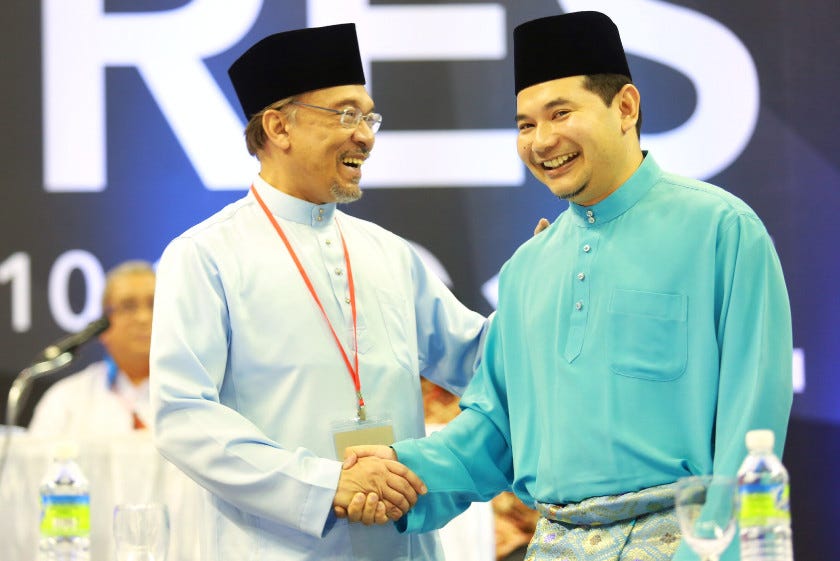
Three and a half years into leading an ideologically diverse coalition government, Malaysia’s Prime Minister Anwar Ibrahim has been busy courting the support of ethnic Malay voters. He now faces a formidable challenger for the urban, minority, pro-reform vote base that propelled his Parti Keadilan Rakyat which led the Pakatan Harapan (PH) coalition to power.
In early May, two of his former ministers took over a small party and rebranded it to court Anwar’s increasingly disenchanted PKR/PH supporters. Former Economy Minister Rafizi Ramli, 50, and Nik Nazmi Nik Ahmad, 44, resigned from Parliament, reducing the majority’s Anwar’s Madani coalition government to 151, just three more than the two-thirds majority necessary for constitutional amendment. Rafizi has six more allies in the government backbench, whose departure would deny Anwar the super majority and might even trigger him to seek an early election.
This is not just a succession struggle between the Gen X Rafizi and baby-boomer Anwar, 78. It poses a larger question: is inclusive reformist politics politically viable in a former British colony divided by reinforcing cleavages of ethnicity, religion, and language?
Having broken away from The United Malays National Organization in 1998 after his purge and imprisonment by former Prime Minister Mahathir Mohamad, Anwar eventually came to power 24 years later in 2022 on the support of the party that had spurned and imprisoned him, along with regional parties from the eastern Malaysian states of Sarawak and Sabah.
Despite winning 38 percent of votes and 37 percent of seats in the federal election, Pakatan Harapan was constantly accused of selling out the ethnic majority Malay-Muslims. This makes Anwar beholden not only to UMNO but also to the powerful Malay royalty and the predominantly Malay bureaucracy. To survive, Anwar went soft on kleptocrats in UMNO and his Sabah regional ally and tried hard to woo the Malay electorate.
Not only have his efforts failed to pay off in winning UMNO’s loyalty and raising Malays’ approval, but Anwar has also alienated his predominantly Chinese urban base. In a leaked internal analysis in May, only seven of Parti Keadilan Rakyat’s 31 seats were considered safe, and that excluded Anwar’s. The larger casualty has been Anwar’s Chinese-based partner, the Democratic Action Party (DAP). DAP and PKR were wiped out from urban centres in the Sabah state election last November, prompting DAP to push Anwar to expedite reforms or the party would withdraw from his cabinet.
Unlike Anwar, who rose meteorically in UMNO to become Mahathir’s Deputy Prime Minister after a brief stint as a Malay-Islamist student activist in the height of the Cold War, Rafizi and Nik Nazmi joined politics to defend Anwar and oppose UMNO after his purge from the nationalist party. Hailing from a humble working-class background, Rafizi was a model Malay talent that UMNO’s pro-Malay policies aspired to groom. Rafizi rose to fame for exposing UMNO’s corruption. His use of data analysis and targeted campaigning was widely credited for PH’s electoral success in the 2018 and 2022 elections.
As Anwar’s deputy in PKR, Rafizi was appointed to economy minister, whose signature project to integrate the government data of every citizen into a single database, however, did not take off. His detractors see him as elitist and aloof and nicknamed him “the formula king.”
Ironically, Rafizi regained his popularity when he started his “Hiruk” roadshow in PKR’s party election in early 2025 when Anwar’s daughter Nurul Izzah led a camp to challenge him and his ally. Meaning “noisy” in Malay, “Hiruk” is also an acronym for “Living the Idealism of Reform in the test of Power.” Rafizi and Nazmi lost the party election, which his camp alleged to have been marred by irregularities. They impressed many Malaysians by resigning from cabinet, citing that cabinet positions are based on party mandate.
As a backbencher, Rafizi became an outspoken critic of Anwar’s coalition government. He took on Anwar’s confidantes in the government and private sector. The break with Anwar became irreversible when Rafizi’s teenage son was jabbed by syringe in a carpark, in an obvious warning to the father. The police never arrested a single suspect.
Rafizi’s new party is known in acronym as “Bersama” (together) and in logo as a “mouse deer”, the resourceful animal that outsmarts bigger enemies in Malay folklore. Rafizi attacks Anwar’s compromises in the coalition and signals that its party would rather stay out of a coalition government than bend its principles. To indicate their break from established parties captured by dynasty and factionalism, Bersama talks about moving away from the patronage network that has blighted Malaysian politics for decades and recruiting non-partisan local talent as election candidates. They even aspire to build a lawmaker-based party in the British and American mold.
Before the new party can change Malaysia’s landscape, however, they must be able to survive and triumph over PH, PN, and UMNO in multicornered contests. Bersama enthusiasts hope the mousedeer can replicate the success of Warisan – a Muslim-dominated multiethnic splinter of UMNO – in exterminating PH in virtual straight fights in Sabah. However, here in Peninsular Malaysia, many PH supporters fear that the shift to Bersama would not be complete and PN – especially the Islamist opposition PAS – may emerge as the minority winner. If such fear looms large, even incumbents from Rafizi’s camp may not survive.
Rafizi would decide where his party would contest based on data analysis, but ultimately, his challenge is simple yet complex under Malaysia’s First-Past-The-Post elections: can Bersama avoid being seen as a spoiler to PH that would cannibalize PH’s vote base and hand over the seats to PN and UMNO?
Bersama’s base is primarily middle class and Gens X and Y. Can Rafizi succeed where Anwar has failed in courting young Malays? If he can’t, Bersama may end like many other admirable political startups in Malaysia. If he can, then Malaysian politics may see changes beyond just a generational renewal.
Wong Chin Huat is a political science professor at Sunway University, Malaysia
[1] Not him gain -- i.e. Anwar Ibrahim. Well might some call Rafizi Ramli, Anwar's now nemesis, "hiruk" (the noisy-maker), I call Anwar Ibrahim "pandai berbohong" (clever to lie). That is all Anwar is, and you can track his antelope of lies and hoodwinks from the time he became an Umno politicians from ABIM, to his time through being an education minister (and how he so cleverly screwed up that country's education system, to the time he was Mahathir Mohamad's finance minister and his ceremonious sacking (deservedly), and every other musang (fox) lies he perpetrated as opposition leader in his desperate bid to win power and approval of Malays and non-Malay voters. He has not learned any of those lessons because Anwar is a desperate politician who -- like Donald Trump, Xi Jinping, Kim Jong-un, Vladimir Putin, Narendra Modi and Recep Tayyip Erdoğan -- loves himself more than anything or anyone else. His lies about reformasi are legendary. Not one reform has been undertaken. Just a whole pack more of Anwar Ibrahim's bagful of big, fat lies.
[2] Whenever "analysts" write about Malaysia, one thing stands out more than anything else: race, religion, language, royalty, endemic corruption, racism and more lies. In short: nothing ever changes in Malaysia except more new glass towers and glitzy shopping malls owned and operated by Umno and Anwar's cronies and nepotists, and other entrenched "investments controlled by Malaysia's cannot-ever-be-questioned-or-condemned royalty (lese majeste). I am yet to see one academic study, one bureaucratic report, that digs into Malaysia's royalty's ownership of businesses in Malaysia's crony-infested, corrupt economy. We know why: Malaysia's academics, or those who profess to be Malaysia experts in and outside Malaysia, are a cowardly bunch. Besides, other than recycling old arguments, what else can they write that can be called genuinely new or a novel argument?
[3] The DAP. What a fantastic bunch of predominantly Chinese political party that found it so convenient to join Anwar Ibrahim and his PKR -- and join at the bhip with the genuine belief -- that real reforms will be undertaken and that a "new Malaysia" will emerge, if not before the next election then -- Allah forbid -- during Anwar's second term as prime minister and his self-appointed post as finance minister (if his master-ji Mahathir can, so can Anwar). But, mplease: don't hold your breath, especially if you know Anwar Ibrahim's modus operandi. He's not in power to bring "greatness" to Malaysia; he's there to make greatness of himself, to be written and praised and sung about like hymns in the country's history books -- the ones that will be written his like-minded pals, brown-washed and all. Just you wait and see.
[4] Nurul Izzah: Anwar's daughter. The one her old man had tried to bring into his government (oops: regime) through the backdoor and a famut of other lies and excuses, will not last. He contribution to Malaysians (what is a "Malaysian"?) have been zero, and another reason Rafizi Ramli pulled up stumps from PKR and with his closest ally, Nik Nazmi, wants to try -- try being the operative word -- right Anwar's litany of wrongs and everything else that is fundamentally wrong about Malaysia since long before independence from Britain, the wrong that are structurally embedded in Malaysia's politics, economy, society and -- yes ! -- even all the agama, including the frightening contradictions with Islam (as is, to be fair, within every religion).
[5] Among the big questions that Wong Chin Huat has not, and probably won't, dwell on is whether the Chinese DAP has the guts, the nerve to pull out of Pakatan Harapan because, to all intents and purposes, it simply has not and will not and cannot call the shots despite the seats it won federally (but bombed to smithereens, decimated, reduced to ash in the last Sabah elections). It simply does not have the intellectual legs to stand on on the policymaking side of Malaysia's politics nor the spine to grunt against Anwar and say do this or we leave. Because, truth is, it could have left within the first year of the Anwar regime -- but didn't. Why the hell not? Was it, and is it, because UMNO now wield the power and influence in the Anwar regime, that Zahid Hamidi, the man with the crooked hand, the crooked mouth, the crooked spin, is the real prime minister of Malaysia, the one who can step on Anwar Ibrahim's shrinking testes and call the shots and Malaysia's rotten-to-the-core Malay royalty are backing Hamid and not Ibrahim?
[6] Would any Malaysia expert worth his or her salt can to comment -- with analysis -- and not run-of-the-mill commentary -- yet again?