

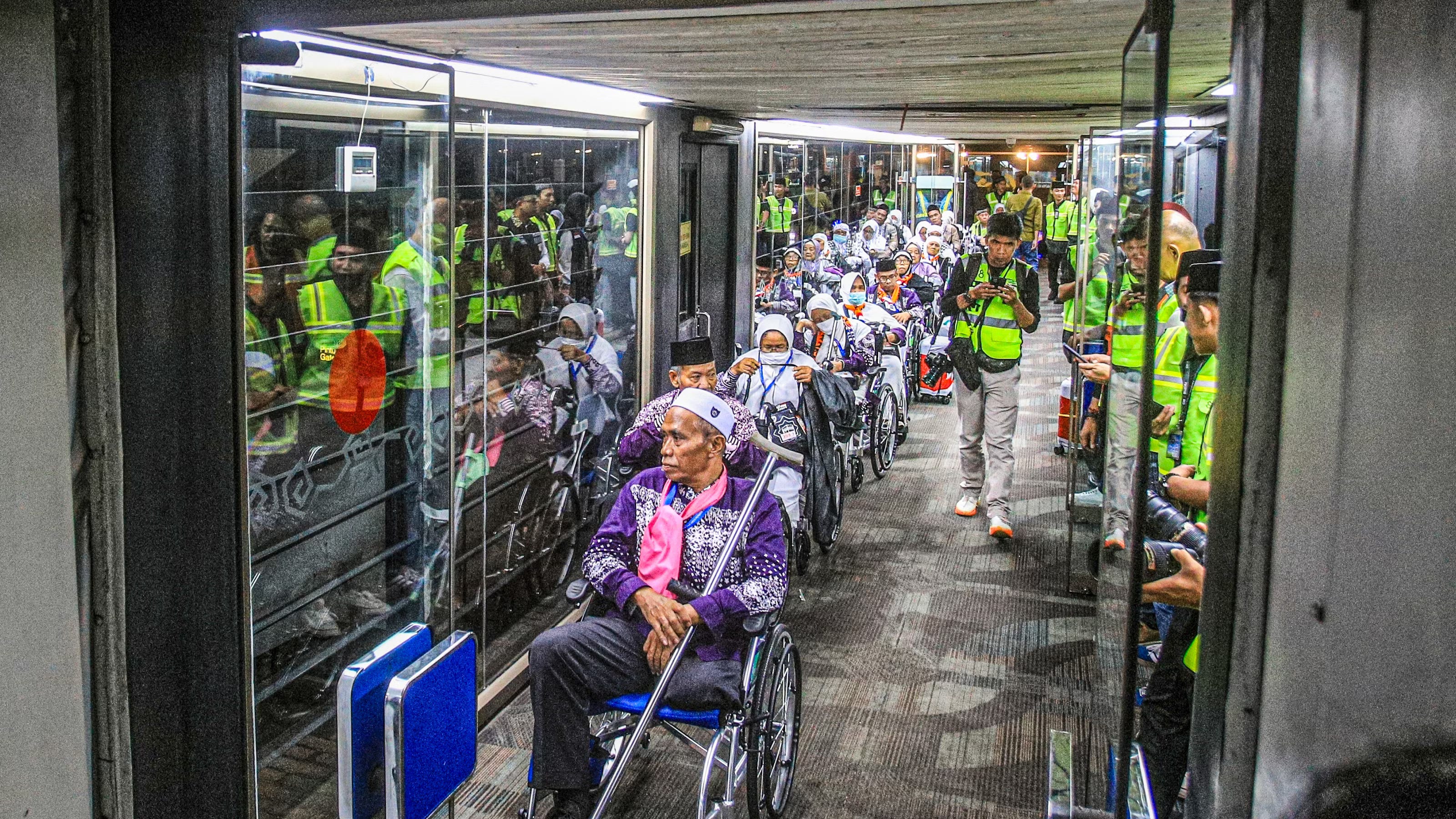
Prior to a May 1 takeoff for a midnight flight out of San Francisco’s International Airport, by actual count, 61 wheelchair passengers or the people who were pushing them were congregated in a roped-off area waiting to board Philippine Airlines flight 105 for Manila, a Boeing 777-300ER carrying 370 passengers.
After PR 105 landed at Ninoy Aquino International Airport 14-1/2 hours later, the scrum of passengers galloping off the plane left just two wheelchair patients aboard. Another half dozen or so sat down in wheelchairs in the jetway and ended up in the baggage area where Philippine airline attendants wrestled their luggage for them.
This is a phenomenon that has become known to flight attendants and ground handlers as “Jetway Jesus” or “miracle flights,” according to a December 18, 2025 Wall Street Journal article complaining that it creates severe delays and leaves passengers with legitimate mobility issues waiting for limited assistance. Those who fly regularly have seen an exponentially growing number of their fellow travelers sitting in wheelchairs. The spike in wheelchair requests has led to up to 80 percent usage on certain flights, according to one study.
But for those in wheelchairs, it guarantees avoidance of notoriously long lines and immigration attended by sour TSA agents, not to mention a first crack at limited overhead bin space aboard, especially for any flight involving Filipinos, who are famous for packing on bags of pasalubongs and other flotsam and jetsam for the folks back home. It’s a chance to get on first, check out the movies on the seat back while the flight attendant strains her back throwing your carry-on baggage into the overhead bin and not have to face the hundreds of passengers stumbling by you. Flying out of Manila, you’re met at the curb by a cheerful numbered staff attendant who handles you all the way through passenger registration, immigration, the waiting area and onto the plane.
For Marites Danguilan Vitug, a Filipino journalist and author, it was a transformative experience. Vitug in March caught herself at a Bangkok International Airport brief layover to find out that the queue to immigration was incredibly long.
“We knew that we couldn’t catch our flight,” she said. “An airport staff told us to proceed to transfer desk 3 for a speedier process. Which meant that we had to walk and run, again, anxiety written on our faces. Two Thai men in white tops and dark pants, apparently their uniform, approached us and asked where we were going. Manila, we said.”
“Mama, Mama, ride here, wheelchair! Your gate is C7, we take you there. You will be on time!”
“I was hesitant. Never have I used a wheelchair in my travels, but we had little choice,” she wrote on Facebook. “Time was running out. The two men zoomed the wheelchairs past the slow-moving queue. ‘Excuse me, excuse me,’ the lead pusher said with a strong sense of urgency, and everyone gave way. And there we were, at the Immigration, in a short queue of passengers on wheelchairs.”
“From there, it only took a few minutes to our gate. I started to get off the wheelchair, but my pusher said to sit down. He wheeled me down the ramp to the waiting area! Whew! The boarding would begin in 5 minutes or so. Thank God for these wheelchair men. We made it.”
For the airlines, it’s a growing nightmare as they face major operational and financial challenges due to the unprecedented surge in requests, stemming from a mix of genuine passenger needs, a growing aging population, and a viral trend of able-bodied travelers faking disabilities to skip security lines, gain priority boarding, and secure better seating. Many airlines express frustration over a rise in what they describe as “shameless line-skipping hacks” where able-bodied travelers request wheelchair assistance to bypass long security and boarding lines.
This sharp increase in wheelchair assistance requests is creating severe logistical and safety strains across the aviation industry. Each wheelchair transport costs airlines between US$30 and US$35 according to an Air India study, which reports handling more than 100,000 assistance requests monthly, leading to severe resource depletion and delayed flights. Airline executives say this severely disadvantages and delays passengers with genuine mobility impairments.
Airlines, according to studies, mishandle an unacceptable number of genuine wheelchairs and mobility scooters. Industry data shows top carriers mishandle or damage more than 1100 wheelchairs annually, a much higher rate of damage than standard checked luggage. In extreme cases, a ruined chair leaves travelers stranded at their destination.
There seems to be little that can be done. Airlines are legally prohibited from capping the number of disabled or incapacitated passengers they carry and certainly not all disabilities are visible. Instead, the International Air Transport Association (IATA) says it is focusing on improving accessibility, standardizing assistance, and accommodating the rising demand through better infrastructure and technology.
Aviation authorities are pushing for solutions ranging from biometric screening to proposing stiff penalties for service abusers, similar to fines for parking in a handicap space, according to the IATA. But for now, as passengers stand in immobile lines awaiting grumpy TSA agents patting them down and demanding their shoes and belts, there’s little that can be done besides standing there and watching the passengers in wheelchairs merrily sailing down the concourse towards their flights -- and meeting them again on landing as they scramble out of the plane with you side by side.
As a disabled person in a wheelchair this makes me angry. Yes, we get special treatment but there is no need to abuse this privilege by pretending you are disabled. My wife is a Filipina and we are often witnessing queue jumpers at the airport and even the local supermarket. They get a rude awakening when they arrive in Australia because Aussies do not put up with that kind of BS. Please show respect because you leave a bad impression on the good Filipinos who do the right thing.
this seems global abuse by asians with non-formative years in the west.
spend enough time at departure level in any part of the world, and witness some walk to their pickup\cab\uber.
is it partly cultural?