
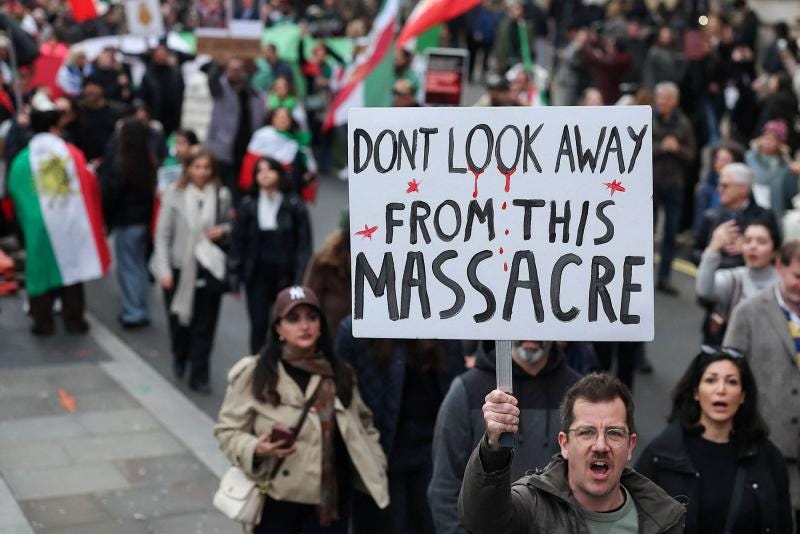
Iran today resembles the Iran of the late Sassanids: a frail body, a heavy, swollen head (the militarized state) and a weary soul ready to open the gates to anyone promising change. The longing for the alien is not born of treachery but is the final refuge of a nation that has become a stranger in its own fatherland. The path from 2009, when protests broke out in major cities in support of opposition candidates, to 2026 has been a descent from civic agency to waiting passivity. If in 2009 people asked: “Where is my vote,” in 2026, through silence or monarchist chants, they ask “Where is the Savior?”
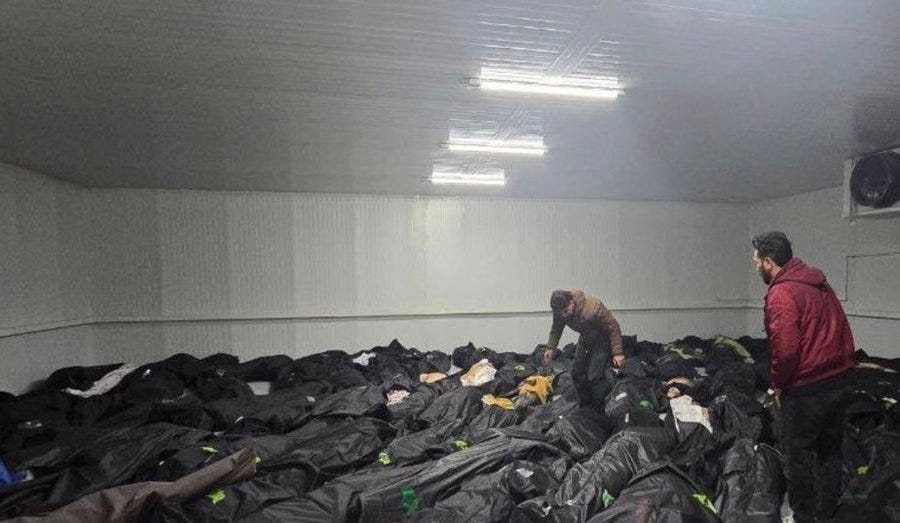
The 12-Day War last June with Israel and this January’s massacre have driven the final nails into the coffin of the social contract. A society that witnesses 36,000 dead and Black Bags has nothing left to lose. But the danger lies in this very desperation: A society that ties its hope entirely to the Other is susceptible to accepting any form of change from without, even if it entails territorial disintegration or infrastructural ruin. The absence of “Woman, Life, Freedom,” the rallying cry for women’s rights and autonomy following the September 2022 death of Mahsa Amin, in 2026 is a grave warning; a warning that democratic and human rights values have been crushed under the boot amid the struggle for survival.
The history of the Iranian plateau has often been narrated through the lens of invasion and resistance, a narrative in which the “Other” or “Foreigner” has invariably occupied the position of the antagonist against whom national identity is forged. However, deeper examination reveals a more complex dynamic: oscillation between aggressive xenophobia – prejudice against people from other countries – and desperate xenophilia – longing for help from anything foreign.
Contemporary Iranian society is undergoing a painful transition from hope for endogenous reform to longing for exogenous intervention. This national desperation is rooted in the total asphyxiation of civil society, the collapse of the middle class, and the failure of reformist paradigms.
The Semantic Rupture of 2009
The 2009 Green Movement, the mass protests following the disputed reelection of President Mahmoud Ahmadinejad, marked a turning point in Iranian society’s engagement with the concept of foreign power. Previously, the dominant discourse, even among critics, was based on independence. However, the slogan “Obama, Obama, are you with them or with us,” directed at former President Barack Obama, heralded a new paradigm.
Contrary to interpreting this as a call for military intervention, it was a moral appeal for recognition. Protesters were signaling to the US President that the policy of engagement should not come at the cost of ignoring the suppression of civil society. At that juncture, society still believed in reform. The request to Obama was not for crippling sanctions, but for the delegitimization of the Ahmadinejad administration.
The Obama administration’s relative silence and continuation of diplomatic tracks was interpreted by many protesters as a betrayal. This sense of abandonment sowed deep cynicism. Society realized that global diplomacy prioritizes security interests over human rights. This disillusionment laid the groundwork for the shift from reformist discourse to more radical postures in the following decade.
The Rise of the Punitive Savior
With the US withdrawal by the Trump administration from the Joint Comprehensive Plan of Action, the 2015 agreement between Iran and the world powers to limit Iran’s nuclear program in exchange for sanctions relief, the dynamic between Iranian society and the West underwent a fundamental transformation. If the request in 2009 was for “solidarity,” by 2019, segments of society began to welcome pressure.
The first Trump administration’s campaign pushed Iran’s economy to the brink. Yet, statistical and field evidence suggests a significant portion of society blamed domestic inefficiency, not sanctions, for their plight. A 2021 survey by the Netherlands-based Group for Analyzing and Measuring Attitudes in Iran (GAAMAN) revealed that 86 percent of Iranians believed domestic corruption and mismanagement were the primary causes of the economic crisis, while only 10 percent blamed foreign sanctions.
For parts of the opposition, Trump embodied the strict father figure who does not hesitate to punish the unruly child (the regime), which can be viewed as strategic self-destruction, in which society is willing to endure the pain of sanctions if it leads to the weakening of the ruling structure.
The Death of the Middle Class
Sanctions and mismanagement shattered the backbone of the Iranian middle class. This class, the primary carrier of democratic values, plummeted below the poverty line. The Grey Layer merged with the Barefoot Class. The result was a massive, angry populace no longer concerned with the intellectual nuances of 2009, but seeking bread and revenge, a shift evident in the slogans of 2017 and 2019, which directly targeted the core of the system.
The final turning point in the collapse of society was the brief but devastating war between Iran and Israel last June, which severed the regime’s last thread of legitimacy: the promise of security. The conflict began with preemptive Israeli strikes on nuclear facilities at Natanz and Fordow. Iran retaliated with over 550 ballistic missiles and 1,000 drones. Israeli and US defenses intercepted the majority of the projectiles. The Israeli Air Force, maintaining air superiority, destroyed critical infrastructure, including refineries and the state broadcaster studios in Tehran. The destruction of air defense systems left the country virtually defenseless.
The most shocking aspect was the societal reaction. Unlike the Iran-Iraq War, which galvanized patriotism, the 12-Day War exposed a complete state-society rupture. A September postwar GAMAAN survey revealed bitter truths: 44 percent held the Islamic Republic responsible for starting the war, 51 percent believed Israel was successful and achieved its objectives. These figures indicate absolute alienation – Iranians interpreted the bombing of Islamic Revolutionary Guard Corps facilities not as an attack on the country, but as the weakening of the jailer. The myth of “we provide security,” used for years to justify internal repression and regional intervention, evaporated.
National Desperation and the Black Bags
The protests of January 2026 were not a civic movement for reform but a rebellion of absolute despair. Facing internal collapse following the military defeat, the regime opted to erase the problem. The Supreme National Security Council issued orders for direct fire against protesters. Hospital lists confirmed by surgeons indicate over 30,304 deaths in just two days, January 8 and 9. The scale of killing overwhelmed the logistical system. Reports emerged of authorities running out of body bags and using refrigerator trucks to transport piles of corpses. The term “Black Bags” became a grim symbol of this era.
January slogans reveal a profound ideological metamorphosis. The progressive slogan “Woman, Life, Freedom” central to the 2022 uprising was completely absent from street protests. 65 percent of slogans were negative/negating (”Death to the Dictator,” “We don’t want...”). 20 percent of slogans explicitly praised the Pahlavi era (”Reza Shah, Bless Your Soul”). This shift signifies desperation regarding modern democratic models. When society faces naked violence and absolute poverty, priorities shift from civil liberties to order and sustenance. The return to monarchist slogans is a plea for a strongman from the past, a desire for a savior to end the chaos with an iron fist.
Why the Stranger?
Shi’a culture is intertwined with the concept of “Waiting” (Intizar) for a Savior. The Islamic Republic attempted to fill this void with the “Velayat-e Faqih,” or guardianship of the Islamic Jurist. With its failure, society did not discard the mechanism of “waiting” but secularized it. The savior is no longer the Hidden Imam, but an external force –Trump, Israel – or a historical king.
Repeated cycles of protest and suppression (1999, 2009, 2017, 2019, 2022, 2026) have induced learned helplessness in the collective psyche. Iranians have concluded that internal change is impossible against a ruthless apparatus. Thus, the only salvation lies in a superpower capable of militarily matching the IRGC.
In political psychoanalysis, the despot plays the role of the “bad father.” When the father kills his children and loots their future, the children suffer from unresolved Oedipal conflict. In this state, the children turn to the neighbor – the foreigner – to punish the father. Implicit support for foreign pressure is a manifestation of the desire for patricide. Society is willing to see the house (homeland) damaged, provided the tyrannical father is buried under its rubble.
This psychological state is not a new phenomenon but has been brewing in the intellectual subconscious for decades. It was diagnosed by the renowned poet Mehdi Akhavan Sales (M. Omid) in the 1960s. Addressing himself by his pen name Omid (Hope), he wrote in a moment of historical despair:
“Again they say: wait for another tomorrow...
Wait until another appears...
No Kaveh [The Internal Hero] will be found, Omid...
Would that an Alexander [The Foreign Conqueror] be found...”
Akhavan’s verse captures the chilling essence of 2026. He realizes that Kaveh the Blacksmith, the mythical internal champion of justice, will not rise. In this vacuum, the collective unconscious trades the dream of a national hero for the nightmare of an Alexander, willing to accept the alien conqueror if it means the end of the current stagnation.
This is written by a resident of Tehran who writes to Asia Sentinel: “I managed to access the internet using various VPNs and some specific workarounds during a brief window where the connection seems slightly more accessible. I have not stopped writing; for me, it is the only way to shout to the world that I am still alive and surviving.”