
By: Ainur Rohmah
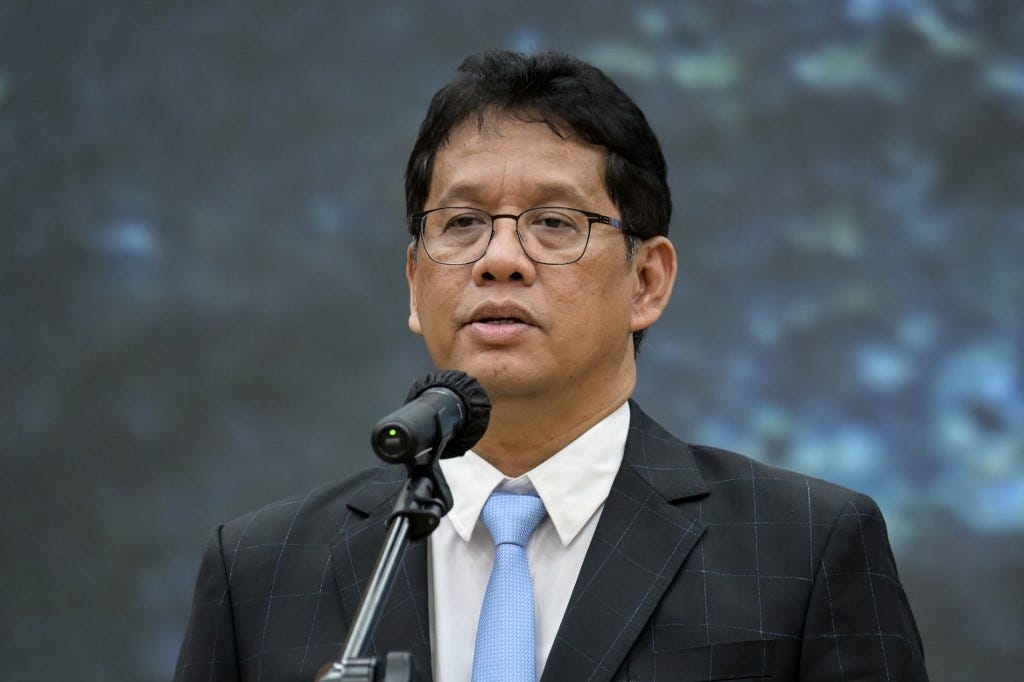
Indonesian President Prabowo Subianto dismissed outspoken Finance Minister Purbaya Yudhi Sadewa on September 14, exactly one year after appointing him to take over from globally respected finance chief Sri Mulyani Indrawati.
He was replaced by Deputy Finance Minister Suahasil Nazara, a widely respected former aide to Sri Mulyani.
The move came as tensions were growing over state revenues and the government’s relationship with Danantara, Indonesia’s powerful sovereign investment authority.
Prabowo’s government is facing mounting criticism over fiscal stability and costly flagship programs, including the corruption- and quality-plagued free lunch initiative and the establishment of tens of thousands of village cooperatives.
Investors have grown cautious, the rupiah has been hit hard this year and the stock market has suffered losses over the integrity and transparency of the bourse.
Several polls have pointed to a sharp decline in public satisfaction with the government. A Tempo Data Science survey conducted from July 31 to Aug. 11 found that 62 percent of respondents were dissatisfied with government performance. The speed of the decline is striking: in the same survey, satisfaction stood at 75 percent in December 2025.
A separate poll by the respected Saiful Mujani Research and Consulting (SMRC) showed Prabowo with an approval rating of 51.1 percent in July, down from 81.2 percent a year earlier. Indonesia traditionally gives its leaders very high approval ratings, which makes this decline sobering.
The government’s declining support is beginning to test a more consequential asset: its performance-based legitimacy.
A fight over Rp120 trillion
Purbaya’s dismissal is widely believed to be linked to internal tensions and growing dissatisfaction within the presidential palace over the management of state revenues and the Finance Ministry’s relationship with Danantara, the powerful asset fund that Prabowo put in charge of all state-owned companies in 2025.
Danantara was launched with the promise that it would manage and invest the assets of all 1000 or so SOEs and thereby propel the country to higher growth. Purbaya turned that on its head last week, when he said about Rp120 trillion ($7.1 billion) from Danantara’s SOE revenues would go to the state budget. The money was intended to be recorded as non-tax state revenue and used as a fiscal buffer.
Purbaya said the payment had effectively been agreed upon and that the amount reflected a commitment made by Danantara’s leadership to Prabowo. But days before his removal, he publicly acknowledged resistance from Danantara, saying the agency had questioned the proposed payment.
The episode fueled speculation that Prabowo was unhappy with the communication and coordination between the Finance Ministry and Danantara over the effort to secure the funds. Purbaya had also been embroiled in a dispute with Bank Indonesia, the central bank, which culminated in the resignation of its governor, Perry Warjiyo.
Danantara’s head and concurrent Investment Minister Rosan Roeslani, who is very close to Prabowo, is said to have been surprised by the announcement.
The government’s apparent decision to draw $7.1 billion from Danantara’s profits so soon after its creation has raised questions about whether the authority is being treated as an investment institution or a source of budget financing. The issue is clouded by the fact that Danantara itself has yet to issue a financial statement for 2025, a fact that contributes to investor skepticism.
Where is the money?
The government is under pressure to find additional fiscal room as non-tax revenue is expected to weaken in 2027, partly because of lower assumptions for commodity prices. At the same time, spending demands remain high. That makes Danantara’s profits an attractive source of cash — but one that may come at the expense of its ability to invest.
Bhima Yudhistira, an economist and executive director of the Center of Economic and Law Studies (Celios), said internal coordination problems may have contributed to the dismissal. Bhima pointed to tensions between the Directorate General of Customs and Excise and the Directorate General of Taxes, including disputes over the replacement of senior officials and the policy of withholding tax refunds from companies.
He said a policy to withhold tax refunds was initially intended to allow the government to scrutinize companies in the natural resources sector. But the policy was later expanded to other industries, triggering dissatisfaction among businesses. The broader application of the policy, Bhima said, contributed to differences between Purbaya and Bimo Wijayanto, the director general of taxes.
The tensions went beyond taxation to the promised $7.1 billion dividend payment from Danantara to the Finance Ministry.
Taken together, Bhima said, the disputes pointed to poor internal coordination under Purbaya. He said the minister’s increasingly overconfident leadership style and public communications had aggravated the problems. In short, Purbaya is boastful and relishes attracting controversy.
“Purbaya’s way of coordinating internally, including his communication style, became increasingly problematic and overconfident,” Bhima said. “That is what ultimately led to his reshuffle.”
Purbaya was sworn in on September 8, 2025, replacing Sri Mulyani, who had served under three presidents and is a former Managing Director of the World Bank. During his year at the Finance Ministry, he replaced Sri Mulyani’s caution with a more interventionist approach to fiscal policy, including the controversial placement of Rp200 trillion in government reserve funds at five state-owned commercial banks in September 2025 to spur lending.
See related story:

Economic growth also accelerated during his tenure, although it remained below the government’s 6 percent target. GDP grew 5.39 percent in the fourth quarter of 2025 and 5.61 percent in the first quarter of 2026, before slowing to 5.29 percent in the second quarter. Some economists have questioned the quality of that growth, arguing that government spending, rather than stronger household and private-sector activity, is driving the economy.
A familiar face
The appointment of Suahasil could be reassuring. Suahasil said the president had instructed him to maintain the health and credibility of the country’s finances and to improve public communication about fiscal policy.
“The state budget must be healthy. It must also be credible and trusted,” Suahasil said after his inauguration as quoted by local media.
He played down the prospect of any major change in economic policy, describing his appointment as a continuation rather than a break with the ministry’s existing direction.
“The market has its own logic,” he said. “But in my view, this is not a change. It is a continuation.”
Suahasil served as head of the Fiscal Policy Agency from 2016 to 2017 and has been deputy finance minister since 2019, working alongside Sri Mulyani in formulating and implementing national fiscal policy.
He has a master’s degree from Cornell University and a doctorate in economics from the University of Illinois. Before joining the ministry, he held several public-policy positions, including work on fiscal decentralization and poverty-reduction programs.
His appointment may provide continuity, but the central fiscal dilemma facing the government remains unchanged: how to finance an ambitious spending agenda without weakening the institutions and investment capacity that are supposed to generate Indonesia’s future growth.
Ainur Rohmah is a freelance journalist and regular contributor to Asia Sentinel.