

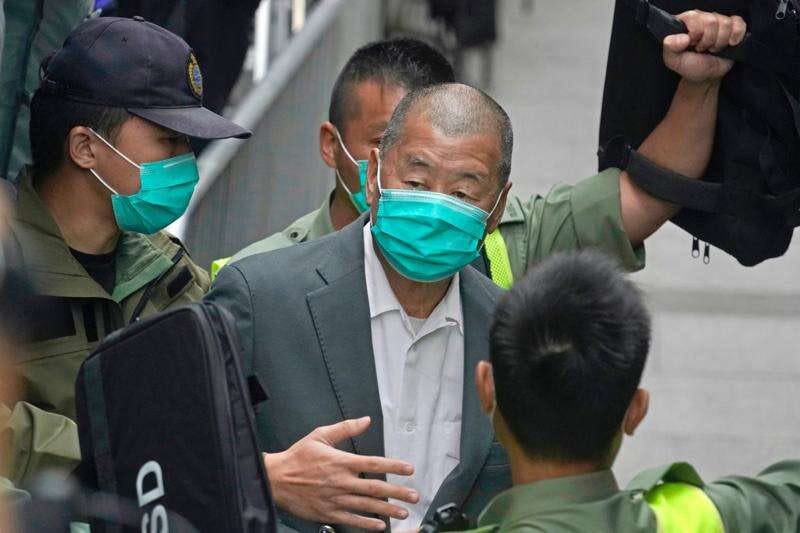
As expected, a three-judge panel handpicked by Beijing today (February 8) sentenced the 78-year-old Hong Kong publisher and democracy icon Jimmy Lai to 20 years in prison on charges of conspiracy to collude with foreign forces and publishing seditious material in his now-defunct Apple Daily, which was abruptly closed by authorities in the 2021 crackdown that ended any hopes for democracy in what had been one of the most open cities in Asia.
A 20-year prison sentence typically means actual imprisonment of at least 13 years and 4 months, assuming maximum remission. The sentence is thus plainly calculated to keep Lai behind bars for the rest of his life. It was assailed by human rights organizations across the globe, with Amnesty International labeling it a “grim milestone” and a “cold-blooded attack on freedom of expression.” The organization officially designated Lai, who is in ill health, a prisoner of conscience. Human Rights Watch, Reporters Without Borders, The Committee to Protect Journalists, Chinese Human Rights Defenders and the International Press Institute, among others, all issued statements condemning the sentence, requesting that the UK and US governments intervene on humanitarian grounds.
Prisoner swap or other agreement only hope
Realistically, however, the only hope for Lai, a British citizen, is some sort of prisoner swap or other agreement with the government in Beijing, probably with the United States rather than the UK, which realistically has nothing to offer. US President Donald Trump last August renewed a promise to try to “save” Lai when Trump is expected to meet with Chinese President Xi Jinping. “I’m going to do everything I can to save him. I’m going to do everything … His name has already entered the circle of things that we’re talking about, and we’ll see what we can do,” Trump said.
It is uncertain, however, if any force can spring Lai, a particular bete noir for his insolence to Beijing. He is viewed as a primary mastermind and instigator of anti-China activities and riots in Hong Kong, often portrayed as an American “pawn” aiming to destabilize the city. He has been on Beijing’s radar since the 1990s when, then the founder of the popular clothing chain Giordano, he famously insulted the late Premier Li Peng in response to Li’s role in the 1989 Tiananmen Square crackdown, calling him a “son of a turtle’s egg,” implying illegitimacy since turtles are understood to not know their fathers. That led to the Chinese government forcing him to divest from Giordano.
During the 2010-2020 decade of protest against increasing pressure on Hong Kong from Beijing, authorities accused him of working with foreign entities to endanger national security, a charge intensified by his high-profile meetings with US officials. They regarded his actions, including supporting the protests, and his brash newspaper’s editorials and reporting, as crossing what were called “red-line” challenges to central government authority.
Crackdown from Beijing
Authorities finally had enough of protest by academics, journalists, lawmakers and others against Beijing’s increasing pressure on Hong Kong’s freedom of expression – and Lai’s newspaper – on January 6, 2021, when, using the draconian National Security Law, as many as 1,000 police detained journalists and most of the lawmakers involved in 2020 District Council primary elections that Beijing opposed. Some 72 locations were said to have been searched with at least 53 people arrested, police said, for the crime of “subverting state power.” In addition to Apple Daily, police closed two other anti-Beijing media outlets, Stand News and In-Media.
With a handful freed, those who remained in custody became known as the “Hong Kong 47.” After spending months awaiting trial, two were acquitted. Sentences of the other 45 ranged from four years and two months to 10 years. Benny Tai, whom the court described as the “mastermind” in the unrest, was handed the longest jail term. As of February 1, 18 of those sentenced have been released.
“The prosecution of Jimmy Lai has been from the outset a perversion of the rule of law in Hong Kong, with the outcome pre-determined. Today’s sentence risks being a death sentence for a 78-year-old who is in poor health after some five years in solitary confinement,” Committee for Freedom in Hong Kong (CFHK) Foundation chairman and former US Consul General to Hong Kong James Cunningham said. “Jimmy Lai’s only ‘crime’ was to defend the freedoms Hong Kong’s people were promised by Beijing and London, through peaceful actions that were legal and should have remained so. Lai and his Apple Daily colleagues, also sentenced today after years in prison, should be released immediately. That they have been persecuted and held without bail in this travesty of justice is reprehensible.”
Held for five years
Lai has been in Hong Kong’s Stanley Prison since December 2020, marking over five years in confinement. He was convicted of fraud on what legal scholars called a minor breach of office lease conditions, which contrasts with the non-prosecution of several government officials for major breaches of land use regulations. That more than the National Security case with its specially appointed judges shows how the whole judicial system and its judges will bend the law according to government demands. His detention, often spent in solitary confinement, and deteriorating health have been raised repeatedly by his family and international advocates. His son, Sebastien Lai, criticized Western governments for failing to take concrete action on his father’s behalf during recent diplomatic engagements, including a high-profile visit to Beijing by the British Prime Minister Sir Keir Starmer.
Six former Apple Daily executives were sentenced alongside Lai: Executive editor-in-chief Lam Man-chung, editor-in-chief Ryan Law, and editorial writer Fung Wai-kong all received 10 years in prison. Publisher Cheung Kim-hung received a sentence of six years and nine months while associate publisher Chan Pui-man was handed seven years, and editorial author Yeung Ching-kee received a sentence of seven years and three months. All previously pleaded guilty to one count of “collusion with foreign forces” under the National Security Law.
In the meantime, the prevailing mood in the city has continued to deteriorate. Newspapers refrain from printing articles critical of Beijing, “patriotic” education has been encouraged in schools, freedom of expression in universities has been curtailed. Amnesty International reported that the city has been transformed “from a bastion of free speech into an environment defined by fear, self-censorship, and strict adherence to national security narratives. This erosion…has been driven by the imposition of the National Security Law, the 2024 Safeguarding National Security Ordinance and a sweeping crackdown on media, civil society, and public discourse.”
"US President Donald Trump last August renewed a promise to try to “save” Lai when Trump is expected to meet with Chinese President Xi Jinping. “I’m going to do everything I can to save him. I’m going to do everything … His name has already entered the circle of things that we’re talking about, and we’ll see what we can do,” Trump said."
In fact, bloviating, blathering Trump is powerless.