
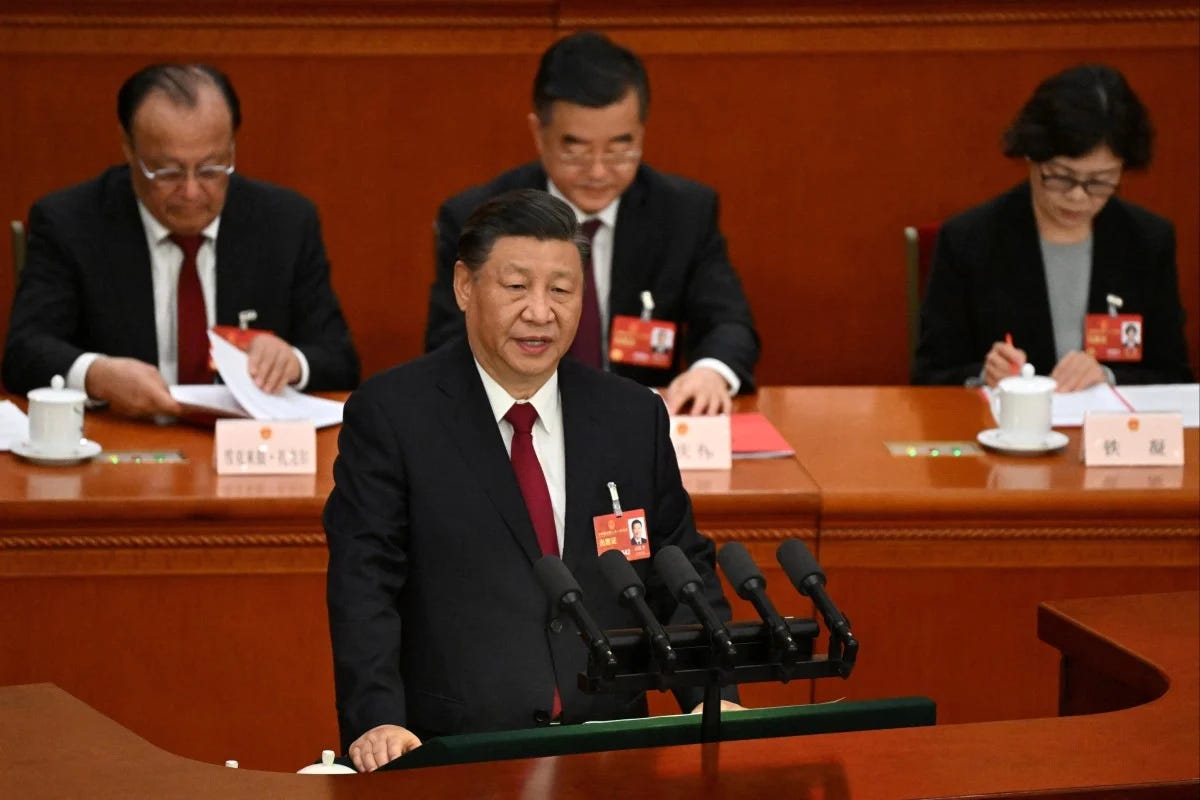
During the recently ended Two Sessions huddle, the annual Beijing meeting of China’s two top deliberative bodies, what wasn’t said is as important as what was. Two top Chinese generals, Zhang Youxia and Liu Zhenli, were conspicuously not mentioned at the March 5-12 conclave, suggesting President Xi Jinping’s control of the People’s Liberation Army (PLA) is not absolute and he faces pushback after purging the two in January, analysts say, and raising questions about the military’s operational readiness.
Zhang was previously the PLA’s most senior general and a former vice chairman of the Central Military Commission (CMC), the team of the nation’s most powerful military leaders, with Liu previously a member. Xi’s purges have shrunk the CMC from six members last June to just Xi himself as chairman and General Zhang Shengmin as vice chairman, meaning it has ceased to function as an effective decision-making body. Many important operational and administrative posts at lower tiers are also vacant or only recently filled, including theater commands, service headquarters and national-level branches.
The absence of any mention of Zhang and Liu during the Two Sessions, the yearly conclave of the National People’s Congress (NPC), China’s parliament and the Chinese People’s Political Consultative Conference (CPPCC), means their purge lacks substantial support among the PLA, Willy Lam, a senior fellow of the Jamestown Foundation, a US think tank, told Asia Sentinel. “Xi lacks full control over the army. Zhang is still a popular figure amongst the brass. So no mention (of Zhang) to lighten tensions. Xi lacks confidence in openly accusing Zhang because Zhang has sufficient support amongst the brass,” Lam said.
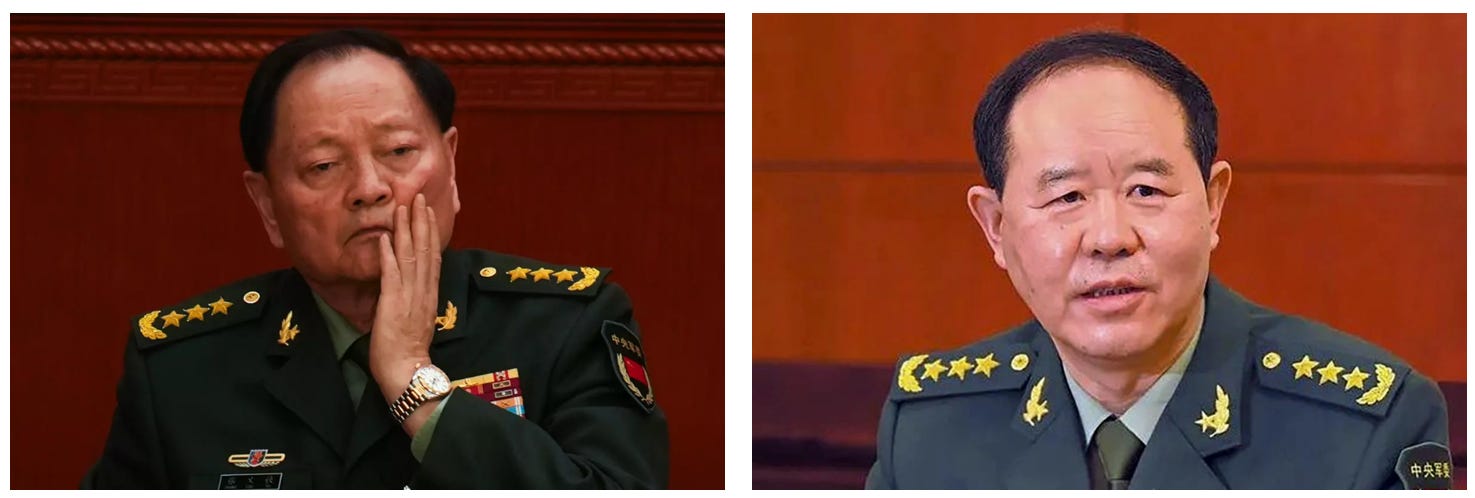
A search of the Ministry of National Defense’s website using Zhang’s name found only an announcement on January 24 that Zhang and Liu were under investigation for “serious violations of discipline and law.” That contrasts with Bo Xilai, a once-rising political star and potential Xi rival. After his downfall, many articles appeared in state media cursing “the toxic influence of Bo Xilai.”
In a March 7 speech to delegates of the PLA and People’s Armed Police (PAP), Xi said the military must “unswervingly uphold and strengthen the party’s absolute leadership over the military,” adding that “There must be absolutely no corrupt elements and double-hearted (disloyal) people within the military.”
Although major commentaries in the PLA Daily stress the absolute leadership of the party over the PLA in the first paragraph, that is only nominal, said Li Nan, a visiting senior research fellow of the East Asian Institute of the National University of Singapore, in an article in the Organization for Research on China and Asia on September 26, 2023.
A March 7 article of China’s Ministry of National Defense said the military must resolutely accept the Chinese supreme leader’s guidance and “not let Xi worry,” possibly implying he, in fact, is worried.
“Double-hearted generals are widely deemed to be moniker for generals Zhang and Liu,” Lam said.
Xi’s lack of mention of Zhang and Liu contrasts with the March 2012 session, when then Chinese Prime Minister Wen Jiabao criticized the government of Chongqing. While not naming Bo, he was more explicit in his criticism because Bo was the leader of the city. This sparked Bo’s dismissal and downfall, culminating in his life sentence in September 2013.
Childhood friends
Zhang’s downfall in January shocked many, because he and Xi were childhood friends and their fathers were comrades in arms during the Chinese war against Japan and the Chinese civil war.
“At the very least, the offhand and callous manner in which Zhang was handled was not well received in the power structure,” said a Southeast Asian analyst who declined to be named. “I don’t think Zhang is in some position of power anymore, but he may remain influential, in the sense that many in the military and beyond are still deferential to him and sympathetic of his plight, which might befall them without much notice.”
If Xi doesn’t handle this gingerly, “it could detract from the military morale,” the analyst warned.
By flouting Zhang, the government wants to “keep it under the radar essentially as he will be expelled from the party after the event, then charged,” said a British consultant, who also declined to be named. The issue of Zhang is a distraction, said the consultant who declined to be named, adding, “they don’t need to draw attention to it, but focus on governance and policies.”
Purges of the military
Since 2023, more than 100 senior officers from across virtually all areas of the armed forces have been arrested or investigated for corruption, including more than 70 in the PLA’s rocket force. In June 2024, two former Chinese defense ministers, Li Shangfu and Wei Fenghe, were expelled from the party and prosecuted for corruption, Asia Sentinel reported on June 29, 2024.
In October 2025, General He Weidong, a former CMC vice chairman, was expelled from the Chinese Communist Party and PLA for corruption. Three months later, He was dismissed from the NPC along with four other military officers.
“In authoritarian systems, power tends to be very flimsy, as it is not built on democratic or meritocratic credentials, but the personal bravado or charisma of a particular leader. The powers of all such authoritarian leaders, from Putin and Xi to Kim and beyond, are in reality quite flimsy. That’s why they conduct constant purges,” the analyst explained.
On March 3, Chinese state media announced the removal of three retired generals from the CPPCC, Han Weiguo (a former commander of the PLA ground force), Gao Jin (a former head of the defunct PLA Strategic Support Force) and Liu Lei (a former political commissar of the PLA ground force).
On February 27, the NPC announced the removal of nine senior military officers including General Li Qiaoming (a former commander of the PLA ground force) and Admiral Shen Jinlong (a former chief of China’s navy).
Yet as of March 13, the names of generals Zhang Youxia and Liu Zhenli remain as members of the NPC on its website. Some analysts believe they will be later dismissed from the NPC, as happened with General He and Bo, while others see their continuing presence on the NPC website as a sign of infighting.
“Xi Jinping still looms large in the PLA, but his power is finite,” Joel Wuthnow, a senior research fellow at the US National Defense University, said in an article of the China Leadership Monitor on February 27, 2025. “There are also limits on Xi’s use of his appointment powers to corral the bureaucracy. The fact that many of those targeted in the second round of purges were in sensitive positions and had been appointed by Xi himself is evidence that the vetting processes were broken.”
It is “dubious,” he said, that Xi has cut so imposing a figure as CMC chairman that officers don’t dare pursue their own interests. “Again, the persistence of scandals at the highest echelons of the officer corps suggests that some of those close to Xi are not sufficiently intimidated to remain compliant.”
Xi was careful not to antagonize the army at the component level, which remains the PLA’s most important constituency, Wuthnow wrote. “Xi’s success in cleaning up the PLA has been partial at best. While the purges indicate that Xi was eventually able to uncover and correct problems that might have previously gone unnoticed, the fact that they occurred more than a decade into his tenure and implicated his own appointees signaled that the system remained flawed: senior leaders were not intimidated.”
does xi have any true goal other than to avoid debate over a taiwan blockade\invasion?