


On March 6, the US State Department announced that the first charter flight of Americans from the Middle East had arrived back in the Unted States, the latest in a flurry of such messages internationally as government-sponsored refugee flights landed in Germany, the UK, Spain, India and other countries carrying stranded diplomats, tourists and others eager to escape the widening war, which has seen retaliatory missiles and drones spatter wreckage not only in Israel and Iran but a long list of other gulf states.
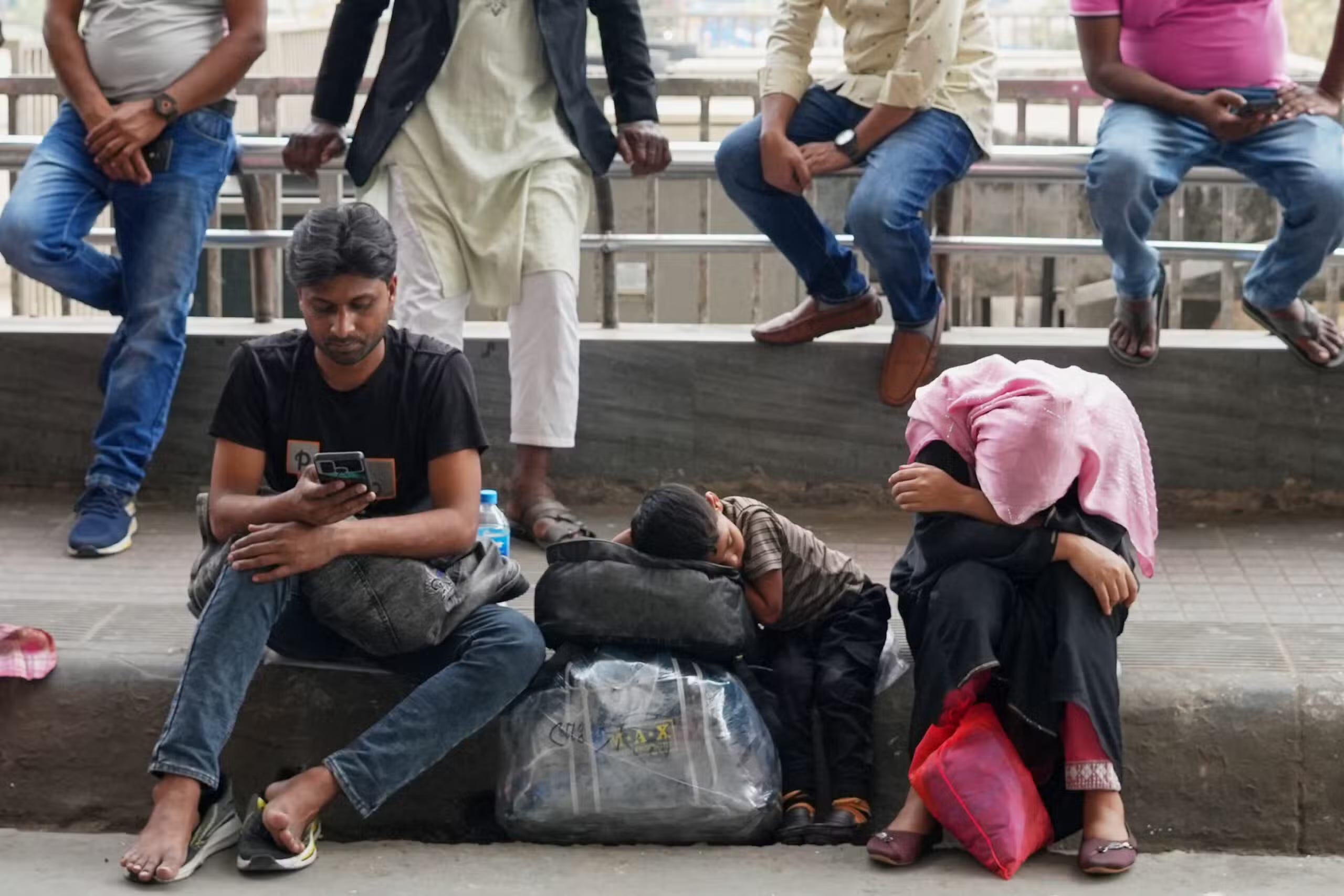
But there seemingly has been little attention paid to the plight of as many as 41.4 million international migrant workers and refugees hosted by Arab countries, according to the International Labor Organization. More than 24 million of them are migrant workers, 83 percent of them men, representing a significant portion of the Middle East workforce, particularly in Gulf Cooperation Council (GCC) countries. There are also millions of women from the Philippines, Indonesia and Bangladesh who have signed contracts as domestic helpers.
Governments seeking solutions
Governments of the Philippines, Indonesia, Thailand and Pakistan said they are monitoring the location of their citizens and urged them to shelter in place. Although some governments are preparing evacuation and repatriation plans should the attacks worsen, which they seem to be doing, commercial airports throughout the region are closed. Many of the unfortunate are in low-income work and often lack adequate protection.
The situation is characterized by a “perfect storm” of physical danger, economic desperation, and, for many, abandonment by employers, according to reports by the Geneva-based International Organization for Migration, which reported on March 2 that the conflict “has already resulted in the deaths and injuries of migrant workers, including Filipinos, Pakistanis, Nepalis, and Bangladeshis, due to missile and drone strikes on civilian and critical infrastructure. Workers in areas like Lebanon, Israel, and Iran face immediate risks from airstrikes. In early March, a Filipino caregiver was killed in Israel during a counterattack.”
Other media describe thousands of workers trapped in their accommodations, unable to commute to work, with limited access to food, medical care and security. Thousands are seeking, or have already initiated, repatriation, which means losing their source of income and facing financial ruin at home, as many are the sole breadwinners for their families, according to the Philippine Inquirer. Previous conflicts in the Middle East have seen some migrant workers abandoned by employers, often without their wages or travel documents, according to the London-based Business and Human Rights Center.
Implications likely to endure
Beyond the immediate human rights crisis, the rise of these countries is thanks to the labor or tax benefits of people with no stake in them. And even if the war is short, the implications for the Gulf states and their economies will endure. This time, instead of being confined to the warring parties Israel and Iran and its client states, the war is being taken to countries with large foreign worker populations that previously hadn’t had to endure the violence. That includes Saudi Arabia, the United Arab Emirates, Qatar, Kuwait, Oman, Bahrain, Iraq, Jordan, and Cyprus, all of which have been hit, putting these workers’ lives in danger and triggering a wider exodus – if they can find transportation out. The violence has closed thousands of commercial flights.
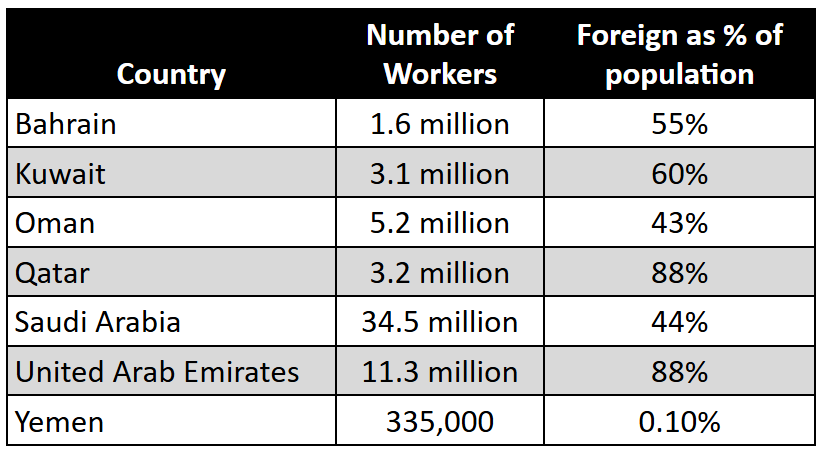
The scale of dependency on foreign workers in the Middle East is breathtaking as the oil-rich find poverty-stricken workers, the preponderance of them from the Global South, to do what is called “3D” jobs—Dirty, Dangerous, and Difficult— construction, engineering, healthcare, and domestic service. Local citizens universally avoid these jobs. The jobs are largely managed through the Kafala (sponsorship) system, which gives employers significant control over workers’ legal status and movement.
In Qatar and the UAE, foreign workers make up 88 percent of the population of each, 60 percent of Kuwait, 55 percent of Bahrain, 44 percent of Saudi Arabia, and 43 percent of Oman.
At the other end of the pipeline, foreign remittances are a significant contributor to poor countries’ GDP, leading to overseas foreign workers being termed “economic heroes” although “economic hostages” might be more appropriate given the strain and damage to family and community relationships back home.
India, the world’s largest recipient, with 10 million workers in the Gulf, received US$137 billion in 2024 from overseas workers although it benefits from a shift toward high-skilled workers in the US and Europe, according to the World Bank. Although that is a fraction of India’s US$4.15 trillion economy, other countries like Nepal, for instance, with 1.7 million Nepali nationals estimated to be living and working across the Middle East, derived 25.2 percent of GDP from inward remittances.
More than 4.5 million Pakistanis live and work in the Middle East, sending home roughly 10 percent of the country’s GDP. Formal remittances to Bangladesh equaled roughly 4.6 percent to 5 percent of its GDP based on 2022-2023 data. In 2025, total cash remittances from all overseas Filipino workers (OFWs) reached a record high of US$35.63 billion, accounting for 7.3 percent of GDP. Although the US is the top source of remittances, the Middle East, particularly Saudi Arabia and the UAE, account for roughly 30 percent. Total remittances from 946,000 overseas Indonesian workers reached a record US$12.7 billion by Q3 2025, although given the size of Indonesia’s US$1.5 trillion economy, that amounted to less than 1 percent.
Desperate plight
Returning home for tens of millions of these workers prematurely not only means losing jobs, which could lead to severe debt for those who paid for the jobs, according to the American Community Media, but loss of income for millions of families in home countries, posing a significant threat to local economies, especially in South Asia. But staying where they are means many are in the direct line of fire, with reports of casualties among Filipino, Pakistani, Nepali, and Bangladeshi nationals. Many have been forced to take shelter as missiles and drones strike near residential and work areas. There seem no viable choices.