
By: Nirupama Subramanian
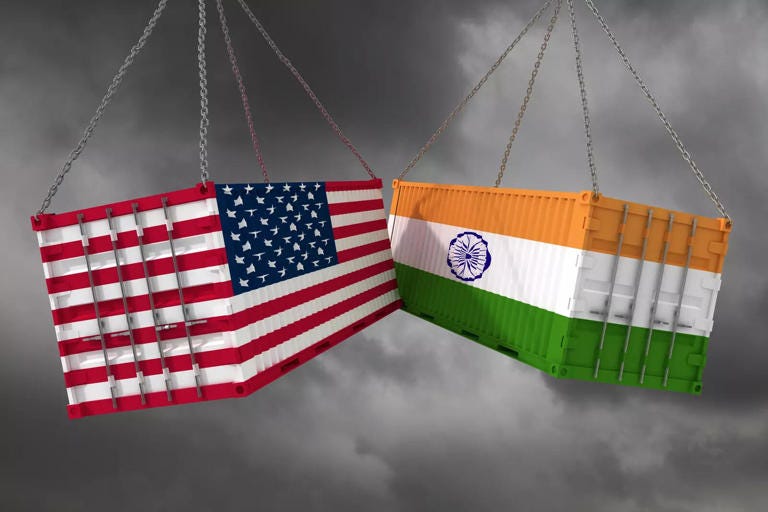
The dark clouds over the “most consequential relationship of the 21st century” appear to have lifted with US President Donald Trump’s announcement earlier this week that he was slashing the reciprocal trade tariff on Indian goods from 25 percent to 18 percent. Though Trump didn’t specify it, he is also reported to have dropped the 25 percent punitive tariff for India’s purchase of Russian oil. If indeed it comes off. There is plenty of pushback on the Indian side over some of its stickier details, particularly agriculture and Russia’s crude.
Indian markets, anyway, have cheered up after months of gloom. It isn’t just exporters who are celebrating. The tariff rapprochement and the mention of a “trade deal” by Trump in his announcement on his Truth Social media platform have brought back faith in the US-India partnership. Advocates of the relationship are seeing the latest development as reaffirmation that the US and India can now return to the original purpose of their partnership, which is balancing China in Asia. There is talk that the postponed Delhi summit of the Quad grouping might be held this year, bringing Trump to India.
The mood in Delhi is self-congratulatory. India’s “strategic patience” is being hailed, as is the “silent treatment” Modi gave to Trump, even while officials from both sides continued to negotiate.
Trump’s announcement came days after India and EU wrapped up a landmark free trade agreement. In India, the belief is widespread that the timing was not coincidental, that the India-EU deal, described as the “mother of all trade deals,” may have been shock treatment that caused a rethink in the Trump administration. After last year’s US tariff shock, India also fast-tracked and finalized trade agreements with the UK, Oman and New Zealand. It is possible the US may have had a bout of FOMO – or, in Trump’s lexicon, TACO.
Did Trump have a Fear of Missing Out, or does Trump Always Chicken Out?
The good tidings on the India-US front appear to have put the stride back in Modi’s steps. His carefully cultivated vishwaguru (teacher to the world) image suffered a setback when India failed to find support even from friends during its attack on Pakistan in May 2025 after a terrible terrorist massacre in Kashmir, and Trump’s contested claims that he forced India and Pakistan into a ceasefire to prevent a nuclear showdown damaged his strongman status at home.
The morning after the tariff breakthrough, Modi tweeted a Sanskrit verse about self-confidence making everything possible. Later in the day, he told a meeting of parliamentarians of his National Democratic Alliance that India had renewed respect in the word. “The world is looking at India and is recognizing its strengths,” Modi is reported to have said at the meeting, where he also described the deal with the US as a “big decision” that would bring big benefits for India.
But is the champagne being uncorked too early? Trump’s Truth Social post also claimed that Modi had made big concessions to secure a “trade deal.” India agreed to stop buying Russian oil to end the war in Ukraine, Trump said. Second, Trump spoke of a “commitment” from Modi to “buy American” beyond the commitment to purchase more than US$500 billion of US energy, technology, agricultural, coal, and many other products. And third, Trump also said India had agreed to lower tariffs and non-tariff barriers on US exports to zero.
Modi’s tweet thanking Trump was silent on these claims, but a prominent farmers’ association has called Trump’s asserted Indian concessions on agriculture, as a “betrayal of the people.” A social media post by US Agriculture Secretary Brooke Rollins that US agricultural exports to the massive Indian market would lift prices and “pump cash into rural America” has heightened the concern among India’s farm lobbies even more. The farmers’ association warned that US agricultural products would flood the Indian market and “devastate the entire peasantry of India”.
Congress leader Rahul Gandhi lashed out at the government for selling of the “seat and blood” of farming by buckling under to US pressure in order to save Modi’s industrialist buddy Gautam Adani, who has been indicted in a US court on charges of bribery involving one of his firms under the Foreign Corrupt Practices Act.
In Delhi, the minister for Commerce Piyush Goyal, who led the trade negotiators, said the trade agreement is still being finalized, and would be ready in “weeks.” He also denied claims that India had opened its markets to US agricultural products such as corn and soya, important farm crops across India. The Prime Minister would never let down India’s farmers, Goyal said. He claimed the Indian team of negotiators had “shielded” the politically sensitive sectors of agricultural and dairy farming, while other worker-intensive sectors such as textiles, gems and jewelry exports, which employ large numbers of workers, would benefit from the deal.
Goyal’s silence is telling on Trump’s other claim of India stopping its Russian oil purchase in return for the removal of the 25 percent additional tariff that he had imposed as a “secondary sanction.”
Over the past four years of Russia’s invasion of Ukraine, India has justified its decision to work around international sanctions on Russia to buy Russian oil as an exercise of its strategic autonomy in its economic interests. Now Delhi must defend the opposite. If it is indeed the case that India will no longer buy oil from Russia under US pressure, the decision is bound to impact relations with Moscow. As of now, the only other statement on the subject is from the Kremlin, where deputy Prime Minister Dmitri Preskov said Moscow had not received any communication from India in this regard.
A US-India joint statement, which Goyal said would be made in days, may throw more light on the actual contents of the deal. But if the concessions made by India are as sweeping as Trump claims, the opposition to it may come from within Modi’s own Hindutva family. The Rashtriya Swayamsevak Sangh, the ideological mentor of the BJP, is dead set against taking dictation from another country.