
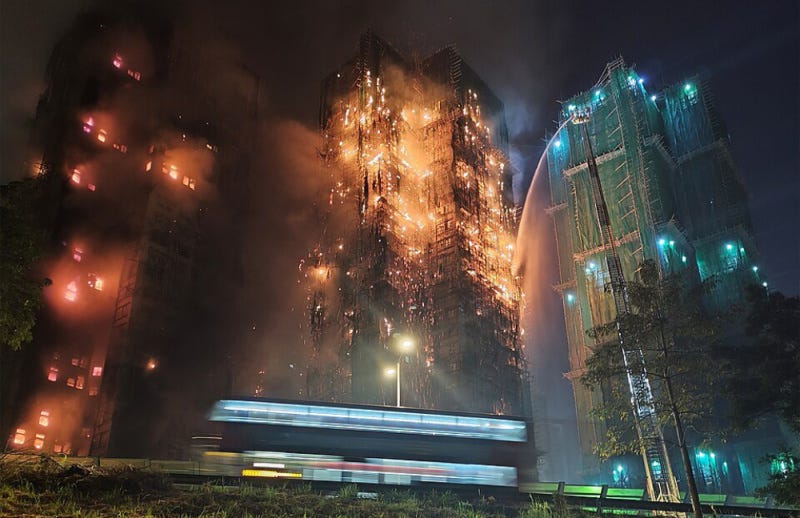
On February 5, an “independent committee” investigating the cause of last year’s Wang Fook Court fire, which consumed seven of the eight blocks of the complex and took the lives of at least 168 people, will begin its work. Hong Kong police arrested executives from a construction company involved in the renovations on suspicion of manslaughter and gross negligence including employing highly flammable construction mesh and polystyrene foam boards during exterior renovations, which allowed the fire to spread rapidly across the seven towers.
Although reports indicate that fire alarms and safety systems were ineffective and questions have been raised regarding inadequate government inspection of materials and potential corruption in the tender process for the renovations, Beijing’s national security office has warned against using the tragedy to fuel political unrest, while some observers suggest the disaster highlights deeper issues with corporate misconduct and regulatory neglect.
Justice grinds slowly
Friends and relatives of the bereaved, and indeed the public at large, will be hoping for a swifter and more persuasive conclusions than in the case of the 2012 Lamma Ferry disaster, which killed 39 people including eight children on their way to a National Day (October 1) fireworks display.
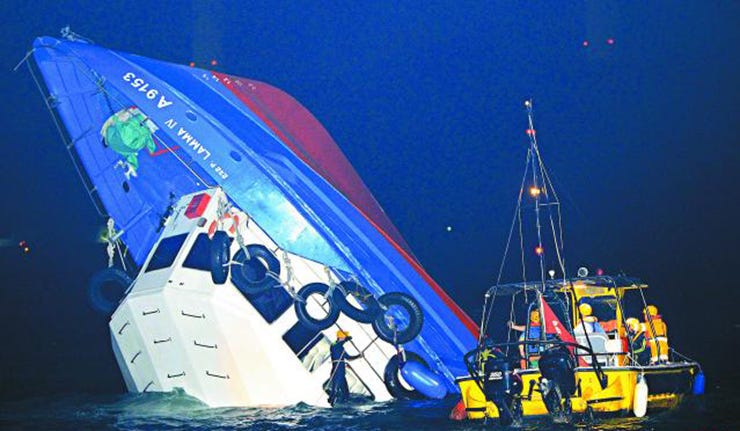
The ferry disaster occurred at about 10:30 pm when the passenger ferries Sea Smooth and Lamma IV collided off Yung Shue Wan, the main population center on Hong Kong‘s Lamma Island. It was the deadliest maritime disaster in Hong Kong in more than four decades. The bow of Sea Smooth collided with the stern of Lamma IV on her port side, rupturing two of the latter ship’s watertight compartments, which quickly flooded, with Lamma IV’s bow rising almost 90 degrees into the air. Lamma IV soon capsized with her aft sinking into the sea and going down in less than two minutes, so quickly that more than 100 passengers were thrown into the water unprotected despite an abundance of life vests on board. Sea Smooth left the scene after the accident and continued on to the pier.
On 14 February 2015, Sea Smooth′s captain Lai Sai-ming was convicted of 39 counts of manslaughter over the deaths, while Lamma IV′s captain Chow Chi-wai was acquitted of the same charges by the High Court. Both men were found guilty of endangering the safety of others at sea. On 16 February, Lai and Chow were each sentenced to eight years’ and nine months’ imprisonment, respectively.
Earlier this week, on January 21, a coroner finally ruled the ferry matter was a case of “unlawful killing” but suggested that this was the result of the actions of the captains of the vessels involved. The coroner rejected claims that the vessel, which had undergone extensive modification to increase capacity, was to blame for its rapid sinking, or that it wasn’t in compliance with requirements relating to bulkhead doors.
Stunning conclusion
The conclusion stunned many observers who were familiar with the case and, in particular, with a 270-page report released in 2013. Presided over by two senior judges and hearing a large number of expert witnesses on naval architecture, navigation and other relevant subjects, that report concluded that the cause of so many fatalities was less the collision itself than the very rapid, stern-first sinking due to the absence of a bulkhead door, the addition of lead ballast to the keel during modification, and other issues including seats which detached easily and lifejackets that passengers had no access to. Modifications hadn’t met the required standards but nonetheless had been repeatedly approved by the Marine Department despite not meeting Damage Stability requirements. Other issues included inadequate crewing.
The report was a damning document casting blame on the Lamma IV ferry owner Hong Kong Electric Company, controlled by billionaire Li Ka-shing, which had organized the company outing, but it couldn’t be used as evidence. An official report by the Transport Bureau was subsequently made in the following years, but most of it was never released, including the names of various officials. In addition to the charges against the captains, two Marine Department personnel were briefly jailed for failure to ensure lifejackets for children. But no action was taken against the owners, designers, builders or officials responsible for the seaworthiness of the vessel after modifications had been made.
As Asia Sentinel wrote in 2014, the secrecy surrounding the bureau’s report was viewed as “another bureaucratic cover-up” in which most of the blame could be saddled on captains working very long hours and not on the state of the vessel that sank. Thus, with the convictions in 2015, it seemed that the matter was at an end, however unfair and however the result of internal government issues.
But some people, particularly relatives of some of the dead, were not to be brushed off. They repeatedly sought an Inquest into the full cause of the tragedy and hence responsibility for the deaths. That request was repeatedly denied until 2023, when it was allowed by the Court of Appeal. Eventually, there was a hearing in 2025, 13 years after the tragedy, which heard from 84 witnesses. Announcement of the conclusion was twice delayed, giving rise to further speculation. As for the coroner’s conclusions, the families and followers of the case could only note the stark differences between that decision and the contents of the 2013 report.
Justice has taken a very long time and, in the view of many, remains denied by the system. The public will be expecting better things from the fire enquiry, not least actions against influential parties. Given Beijing’s warnings, the public has a right to be skeptical.
Hong Kong’s justice system now specializes in two things: belated outrage and exquisitely targeted amnesia. The Wang Fuk Court inferno and the Lamma ferry catastrophe form a matched set of civic indictments—proof that the authorities can incinerate bodies and evidence with equal efficiency.
The smoke hasn’t yet lifted from Wang Fuk Court’s charred remains, yet Beijing’s commissars are already warning against “drawing conclusions.” Heaven forbid that anyone conclude the obvious: that corruption, neglect, and servility to capital have combined, once again, to turn human life into kindling.
The managed “independence.”
An “Independent Committee” has been summoned over Wang Fuk Court, chaired by a judge and flanked by worthies, to “review” causes and recommend that, next time, the dead be more considerate and burn slowly. Beijing’s national security office has already warned against “exploiting” the tragedy, which is a way of saying: conclusions are permitted, provided they are pre-cleared in Mandarin.
Lamma: a template for impunity.
The Lamma disaster showed the template: drown the passengers, then drown the truth. A 270-page inquiry exposed a missing watertight door, bogus stability data, lead ballast, and systemic Marine Department incompetence, yet when the dust settled, it was the overworked captains, not Hong Kong Electric or the supervising officials, who were marched to the dock.
Scapegoats and sacred cows.
Thirteen years on, a coroner finally utters “unlawful killing,” only to alight—like a nervous bird—on the two coxswains as the exclusive villains, while assuring us that the vessel “met the standards of the time.” In Hong Kong, standards are written by the rich, violated by the state, and enforced against whoever is least able to hire counsel.
Fire, water, and cultivated forgetfulness
Wang Fuk Court’s flammable cladding, dubious materials, and suspected corruption now sit before a justice system that has already demonstrated its house rule: structures don’t fail, only individuals do.
Expect a few expendable contractors, a pious report, and the usual sermon about “social harmony,” while the truly culpable retreat into well-sprinklered mansions.
In this necropolis of excuses, the dead are granted inquests, not justice, and the law has become a sort of liturgy—solemn, repetitive, and designed above all to ensure that nothing essential ever changes.