
By: Toh Han Shih
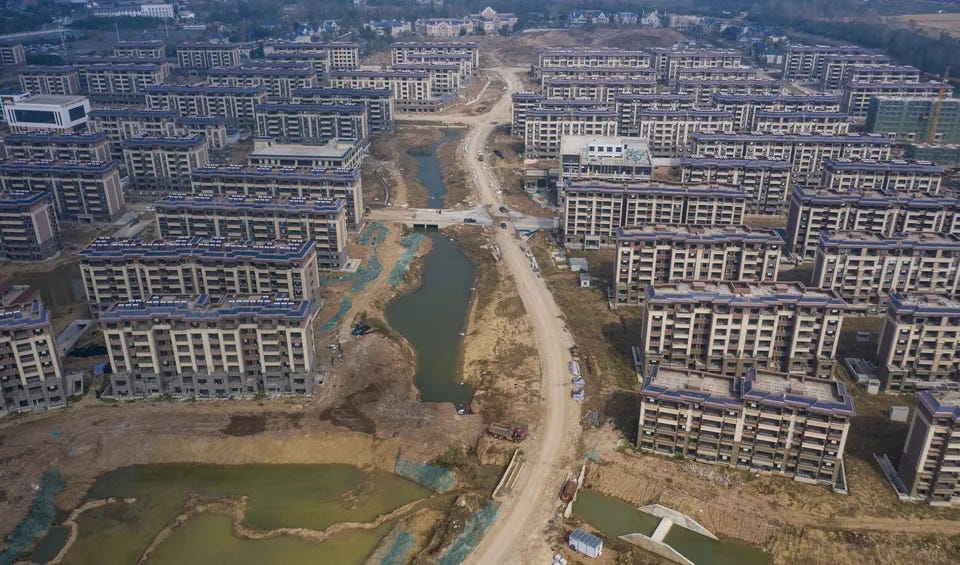
Hui Ka Yan faces time in a Chinese prison, after pleading guilty to fraud, embezzlement and bribery in relation to his company China Evergrande Group, which has descended from being China’s biggest property developer to the world’s most indebted real estate firm. He is also the biggest example of Beijing’s refusal, as it has in past crises, to launch a massive, central-government-funded bailout, instead pursuing a market-oriented redesign aimed at shifting the economy away from its decades-long reliance on property.
On April 14 at the Intermediate People’s Court of Shenzhen, Hui, also called Xu Jiayin, pleaded guilty to charges of embezzling public funds, fraudulently raising funds, fraudulently issuing bonds and securities, illegally using funds, failure to disclose material information, abuse of position and bribery, reported state news agency Xinhua. Hui and Evergrande faced similar charges in this Chinese court on April 13 and 14. The court will render judgement at a later date.
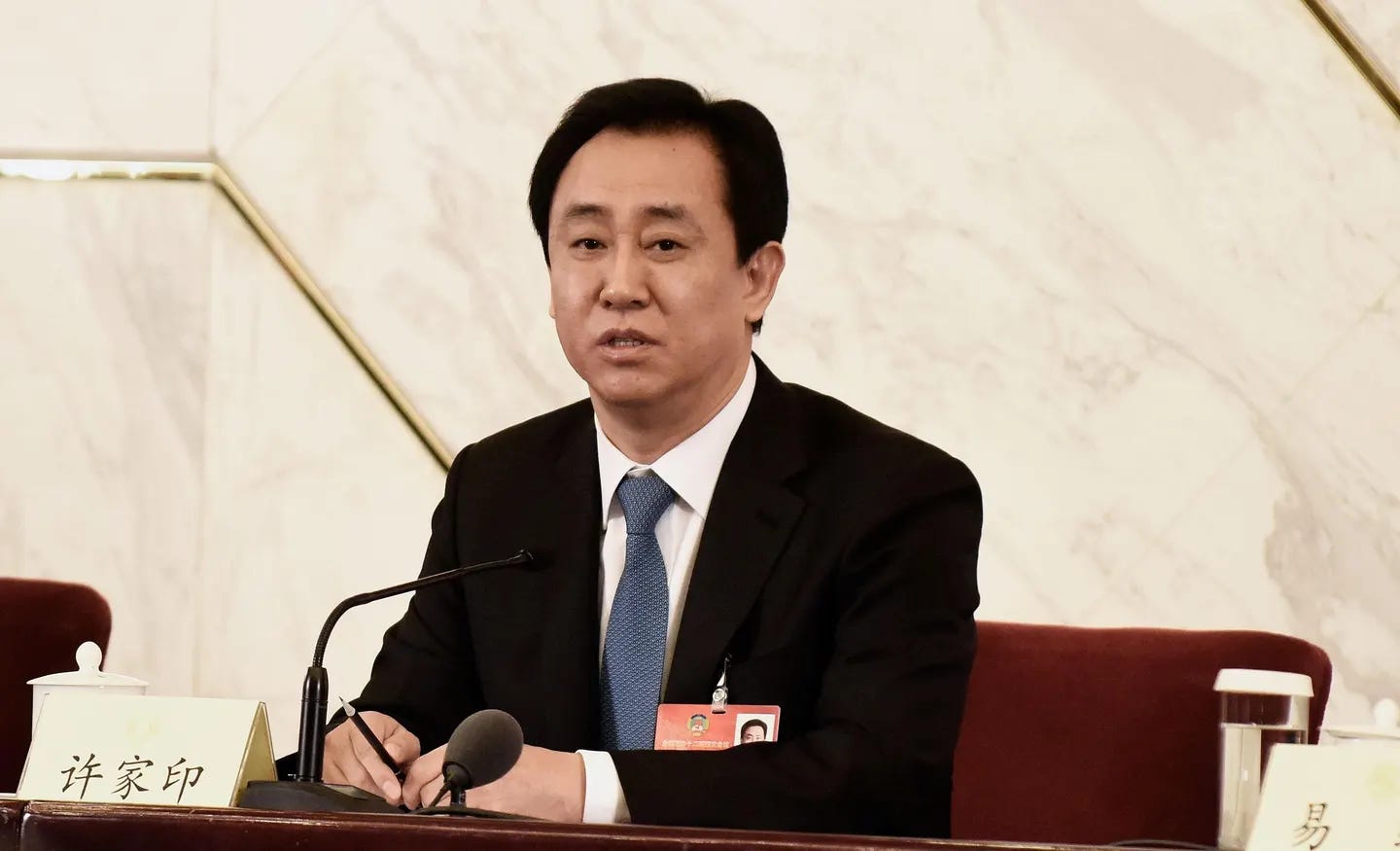
This is a steep comedown for Hui, ranked by Forbes as China’s richest person with a net worth of US$42.5 billion in 2017 and who once employed a cast of nubile young Chinese women, the Evergrande Song and Dance Troupe, to entertain rich and powerful men and to win business and corrupt Chinese officials. Born into a humble family in a Henan village in 1958, Hui founded Evergrande in 1997, which grew to be China’s largest property firm by sales, with annual sales at one time exceeding US$100 billion. The company, which at its peak had a market capitalization of more than US$50 billion, delisted from the Hong Kong Stock Exchange last August.
Hui, a Hong Kong resident, was arrested in mainland China in September 2023. The company defaulted in December with more than US$300 billion in debt, leaving an estimated 20 million units across China and rendering it the world’s most indebted property firm. That was substantially more than Argentina’s entire external debt, tweeted Michael Pettis, a senior fellow of the Carnegie Endowment for International Peace, a US think tank, on October 9, 2023.
A lawsuit by Evergrande’s liquidators, Alvarez & Marsal, to claw back funds from the property developer’s auditor, PwC, is scheduled for its first public hearing at the Hong Kong High Court on May 18.
Last November, a Hong Kong court expanded an asset freeze against Hui’s ex-wife Ding Yumei, including more than US$300 million of her assets in Canada, Gibraltar, Jersey and Singapore in the injunction, to give liquidators greater space to recover US$6 billion owed to creditors, according to media reports. Ding obtained Canadian citizenship in August 2023.
In May 2024, the China Securities Regulatory Commission (CSRC) fined Evergrande and Hui RMB4.2 billion (US$615 million) and RMB47 million respectively, for fraud in issuing bonds and violating Chinese rules on disclosure. The CSRC also permanently banned Hui from involvement in China’s securities markets. On May 21, 2024, the CSRC accused Evergrande of inflating revenue by RMB214 billion (US$31 billion) and profit by RMB173 billion in 2019, and inflating revenue by RMB350 billion and its profit by RMB299 billion in 2020.
On September 13, 2024, China’s Ministry of Finance and the CSRC fined PwC Zhong Tian, the mainland Chinese subsidiary of the Big Four accounting firm, RMB444 million for its audit of Hengda Real Estate Group Company Limited, Evergrande’s main subsidiary, from 2018 to 2019, and suspended PwC Zhong Tian’s operations for six months. This is the biggest fine imposed on a Chinese subsidiary of a Big Four accounting firm. In 2024, the Hong Kong Accounting and Financial Reporting Council launched an investigation of PwC’s audit of Evergrande.
Friends in high places
“Xi Jinping could also have decided to detain Hui Ka Yan now as part of a broader effort to root out his remaining factional enemies,” said a report of SinoInsider, a China-focused risk consultancy based in New York, on October 13, 2023.
Hui has long been known to have close associations with Zeng Qinghong, the de facto head of the Jiang Zemin faction after the passing of the former Chinese president in late 2022, explained the SinoInsider report. “Hui is also likely to have connections with former Politburo Standing Committee member, ex-Guangdong Party Secretary, and Jiang faction member Zhang Dejiang. Without the powerful political backing of Zhang, Zeng, and the Jiang faction, it seems unlikely that Evergrande would have been able to expand nationally in the 2000s and eventually make the Fortune 500 list in 2016.”
In November 2014, Hui paid more than US$30 million for a mansion in the exclusive Point Piper district of Sydney, Australia using a string of shell companies to conceal his involvement, according to media reports. His mansion was a stone’s throw away from one once inhabited by Zeng Wei, a son of former Chinese Vice President Zeng Qinghong, and his wife. The Australian government in March 2015 ordered Hui to sell the mansion after finding the purchase violated Australian foreign investment rules.
Hui was close to a fallen Politburo member, Ma Xingrui. Earlier in April, the Chinese government announced Ma was placed under investigation for corruption, the third Chinese Politburo member investigated for graft. In Shenzhen on November 4, 2015, Ma, then Deputy Secretary of Guangdong Provincial Party Committee and Party Secretary of Shenzhen, met Hui and his delegation, where Ma expressed the hope that Evergrande would increase its investment in Shenzhen, according to Evergrande’s website.
While Ma was party secretary of Shenzhen from 2015 to 2016, Ma reportedly had close interactions with Hui, said a report on April 6 of SinoInsider. After a meeting between Ma and Hui, Evergrande relocated its headquarters from Guangzhou, the provincial capital of Guangdong, to Shenzhen during Ma’s tenure in Shenzhen, said the SinoInsider report. “There were also allegations that Ma strongly backed Evergrande’s acquisition of key land development rights in Shenzhen, as well as its involvement in urban redevelopment projects.”
Desmond Shum, a Hong Kong businessman living in the UK, in his book Red Roulette recounted that he went shopping with Hui for a yacht off France’s southern coast. Hui envisioned a “floating palace to wine and dine officials off China’s coast, away from the prying eyes of China’s anti-corruption cops and its nascent paparazzi,” Shum wrote.
When Evergrande’s debt difficulties surfaced in late 2021, there were fears that the developer’s woes would precipitate a global financial crisis. In October 2021, then US Secretary of State Antony Blinken urged the Chinese government to behave responsibly in handling the Evergrande crisis. But with the shrinking importance of China’s property sector, Evergrande’s collapse hasn’t sparked a financial crisis in China, let alone the world.
In recent years, senior Chinese policymakers reduced the importance of rapid GDP growth as a policy objective, putting more emphasis on the quality of growth, which has reduced use of property-oriented stimulus, said an S&P Global report on February 8. “In addition, policymakers have viewed China’s economic growth in recent years as sufficient, we believe. Strong exports have supported GDP growth despite subdued domestic demand amid the property market stress.”
Toh Han Shih is a Singaporean writer in Hong Kong and a regular contributor to Asia Sentinel.