

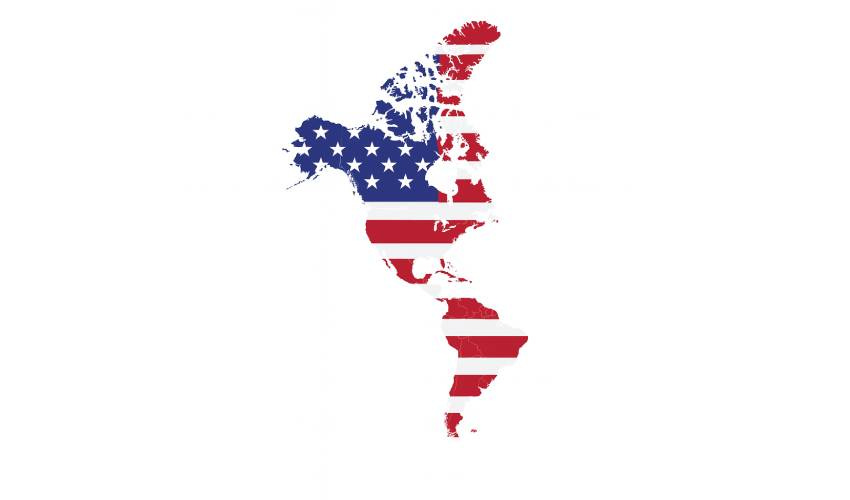
The latest view from the kaleidoscope through which to observe US President Donald Trump’s worldview and foreign policy appears to show a focus wholly on the western hemisphere, leaving less focus on China as well as Europe, Russia, and the Middle East. The whole hemisphere is regarded as a US bastion which needs to be protected from outsiders.
The US will dominate the Americas while China controls East Asia and Europe, Russia, India, and oil-rich Arabs + Israel can divide up the rest. However, in the wider scheme of things, the US belief that its might and the Monroe doctrine made it dominant has been, and remains, an exaggeration and is likely to be more of one given increasing Chinese investment and trade, historic European ties, and growing EU access through the Mercosur trade pact.
Nonetheless, the range of Trump’s hemispheric ambitions has stirred unease in capitals from north to south. He has demanded, however fancifully, that Canada be absorbed into the US and the Gulf of Mexico be renamed the Gulf of America. Talks also have been going on in the Greenland capital Nuuk between the US and a nervous Greenland and Denmark in the wake of statements Trump made earlier about America’s need to take control of the autonomous Danish territory “one way or the other” for what he called national security reasons. US forces have now seized an oil tanker near the Venezuelan coastline, significantly escalating pressure to oust President Nicolás Maduro and change the regime.
Whatever the merits of aspects of such a US policy, if so it can be described, it is founded on a grand illusion which may be traced back to the so-called 1823 Monroe Doctrine pronounced by President James Monroe, originally a simple statement aimed at preventing further colonies or interference by European powers in the Americas and promising to keep the US out of European affairs including the Greek war of independence then in progress. Most of Latin America was already independent of its former European rulers, with Argentina independent in 1816, Mexico in 1821, and Brazil in 1822 with only Cuba and small European colonies in South America surviving. The US wanted to be alone as top dog among American states.

The doctrine, at least as interpreted by later presidents such as Theodore Roosevelt, gave the US the right and obligation to manage change in the region and approve or otherwise of its leaders. This may have seemed a viable goal at a time when the American states to its south were all quite newly independent and mostly subject to political stability. It also provided a backdrop to US ideas of its “Manifest Destiny” at a time when much of America’s west had yet to be conquered by white settlers. It was two decades before Mexico, after defeat in the war of 1846-48, was forced to cede about half of its territory to the US, including California and Texas. In 1898, Cuba was to become the cause of the Spanish-American war which saw the US usurp Philippine independence.
Despite a background rooted in its own expansion, the Monroe Doctrine has remained an article of faith in Washington. It explains its repeated and ultimately disastrous efforts to control events in Cuba, and at various times nominally covert interventions on behalf of the United Fruit Company and such as the murderous military overthrow of President Allende in Chile in 1973 and support for the military coup in Brazil in 1964. It has also, on more than one occasion, intervened directly in Panama and the Dominican Republic and in 1983 on the island of Grenada.
Despite these interventions, the Monroe Doctrine did seem to have passed into history given the US involvement in two 20th-century wars in Europe, and its until-now dominant role in the NATO (North Atlantic Treaty Organization). However, with the recently enunciated US National Security policy implying a gradual exit from Europe, accommodation with Russia and possibly even China, the words Monroe Doctrine have gained renewed attention in the US.
It is often assumed that Latin America has long been part of the US domain. However, in the wider scheme of things, the US belief that its might and the Monroe doctrine made it dominant has been, and remains, an exaggeration. Since it was declared, the major states of the region, and Argentina and Brazil in particular, have seen massive immigration from Europe, notably Italy, Germany, Portugal, and Spain (other than the UK which had options in Australia and Canada) which ensured their social and economic links with Europe. The US capital was a later arrival, with Argentina in particular benefiting from an influx of British capital which for a while made the country richer than Australia. British capital was also important in developing the Mexican oil industry.
Naturally, since 1945, US capital has been more important throughout the region, yet the European presence is very strong in areas such as banking and telecoms. Spain is the largest single foreign investor in Argentina, followed by the US and with other EU nations also heavily invested. Argentina is the third most populous but second largest economy in the region. The US heads the list of foreign investors in Brazil, but Europeans are close behind. China is a noisy newcomer but started late compared with others and anyway does not have an inexhaustible demand for raw materials.
The underlying situation is that though US links are dominant in Mexico and throughout Central America, South America is a very different story. The dramatic growth of China trade and investment interest is the new factor which unnerves the US and has revived the Monroe Doctrine talk. China now accounts for more than 30 percent of Brazil’s exports and imports. Given the composition of this trade, with China buying massive amounts of iron ore and soybeans and supply consumer goods, it is hard to imagine the US regaining a dominant role. Overall, the EU has overtaken the US and is now Brazil’s second-largest trading partner.
The importance of Brazil is hard to overstate given that its population is 213 million, two thirds that of the US, and equal to the whole of the rest of South America and income per head similar to the regional average.
Argentina’s trade is more evenly spread, with China marginally overtaking the US and the EU not far behind and other countries, notably India, rising in trade importance.
Often missed in discussions about regional trade is the importance of links to Europe because data is mostly provided by individual countries, not the EU. The UK and Switzerland also add to European connections. Yet while the US has chosen to upset its trade relations with its immediate neighbors Mexico and Canada, and has paid scant attention to the large South American economies where protectionism was long the norm, the EU appears to have seen new opportunities in a region which is mostly geographically as close or closer to Europe than to the US. Opposition in Europe, notably by farmers, to a free trade treaty with the Mercosur block has largely been removed by Europe’s need for new friends in the wake of the Trump administration's contempt for Europe.
The treaty now looks to pass final hurdles in 2026, giving better EU access to Argentina, Bolivia, Paraguay, and Uruguay, as well as Brazil. In addition to the Mercosur deal with the EU, Brazil and Japan have also recently signed a closer cooperation agreement as both seek to diversify away from China and the US. (Brazil has long had a large community of Japanese origin).
For sure, the US is (most of the time) and will surely remain the main trading partner of the northern states of the South, oil (and drug) exporting Colombia and Venezuela, but taking the region as a whole, there is little to justify any American assumptions of its economic weight. The same applies politically. In World War II, Argentina remained neutral despite US pressure, finally declaring war on Germany a few days before its surrender. Brazil had joined the allied side in 1942. But both resumed neutrality afterwards. Argentina’s domestic politics as well as geography have long precluded significant participation in international affairs (the Falkland/Malvinas conflict apart). The US was admired and feared but seldom loved.
Now, Brazil at least hankers for a greater global recognition for its size and (unevenly distributed) wealth. President Lula has been seen in forums such as BRICS, the G20, and the Climate Change Conference. He has attacked Israeli alleged genocide in Palestine and generally aligned with the Global South. Like India, it hankers for a Security Council seat.
None of that is in the spirit of recognizing the Monroe Doctrine of the pre-eminence of the US throughout the Americas. The mostly democratic, if unstable, political systems in the region oscillate between left and right in both domestic politics and attitudes to the US. Yet Trump-era notions of white Christian civilization find few sympathizers to the south where the cultural background is Latin, not Anglo-Saxon. The legacy of slaves from Africa is a visible, notably in Brazil, if not always acknowledged, common denominator with the US. Peru and Bolivia have complex mixed/ indigenous demographics. But, with varying additions, the Latin base is everywhere secure.
Taken as a whole, Latin-speaking South America is as close to Europe as it is to the US. China’s economic power in the region may seem a challenge when seen from Washington but less so seen from Sao Paulo or Lima. Trump’s team may like to think of dividing the world into blocks, with the US being master of all the Americas. The Monroe Doctrine is a broken mirror.
Excellent article. The fact it riles up the MAGA-turds is just an bonus ;-)
sorry, i just cannot get past that the moron groks monroe.
at least not past some low risk but divine power grab , all other details frankly uninteresting and bothersome to trump.