
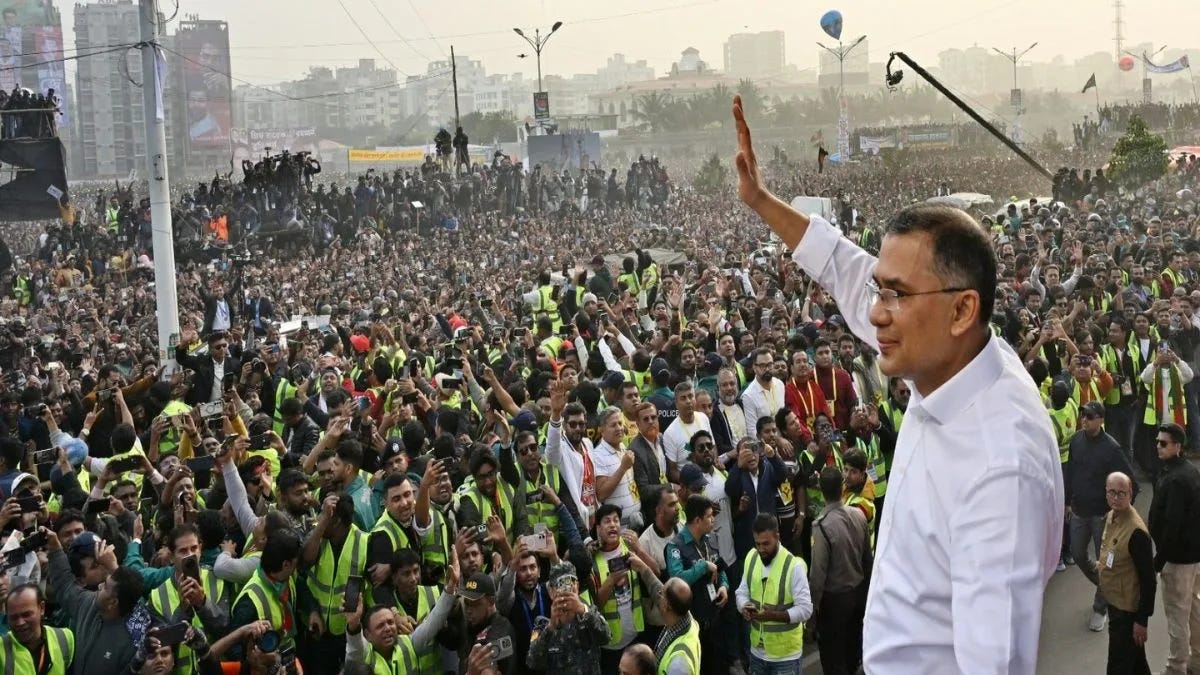
The Bangladesh Nationalist Party appears to have won a landslide in February 12 national polls according to local media, winning 209 seats, a two-thirds majority in the 300-member National Assembly the Jatiya Sansad. It must be counted as a triumph for the caretaker government of Muhammad Yunus, the octogenarian “banker to the poor” who took over to steer the country for a year and a half after the student-led ouster by outraged crowds of Sheikh Hasinah, who was forced to flee to refuge in India in August 2024.
The election was regarded by observers – and 300 international poll-watchers – as Bangladesh’s first truly competitive vote in years, with turnout predicted to reach 60 percent, exceeding the 42 percent recorded in 2024 when the BNP boycotted the polls, regarded as rigged to keep Sheikh Hasina in power. More than 2,000 candidates including many independents were on the ballot, and at least 50 parties contested seats, a national record.
India, hosting the defenestrated Sheikh Hasina, declined to send observers. But, in a gesture of goodwill designed to ease tensions between the Hindu-majority India and its Muslim-majority neighbor, Indian Prime Minister Narendra Modi became the first leader to congratulate the BNP’s leader, Tarique Rahman, for his victory and expressed interest in working with him to strengthen relations. The BNP leaders immediately reciprocated Modi’s gesture.
Significantly, the election seems to have come off with a minimum of violence, previously a serious concern with Hasinah’s nominally sectarian Awami League barred from participation, disenfranchising an estimated 20 to 30 million people. There had been persistent violence in the run-up to the polls with nearly 200 deaths over the past year, some of it gory including lynchings, and a sharp spike in incidents targeting religious minorities amid unremitting hostility against Hindus, Christians and Buddhists at the hands of extremists. It was said to be the first election in 35 years in which no one was killed on election day. The BNP, in an apparent gesture toward the possibility of violence, decreed no celebratory procession or rally and urged people to pray at mosques, temples, churches and pagodas.
Jamaat-e-Islami says it’s positive
Fortunately, the leader Shafiqur Rahman of the Islamist Jamaat-e-Islami’s party-led alliance, which won just 68 seats, told local media that Jamaat wouldn’t engage in the “politics of opposition” for the sake of it. “We will do positive politics,” he told reporters. The party has a long and controversial record of violence, its history marked by being banned due to its alleged role in mass atrocities and militant activities. The National Citizen Party, led by student activists instrumental in toppling Hasina and which was a part of the Jamaat-led alliance, won just five of the 30 seats it contested as it collapsed into disorganization and infighting.
A referendum on a new National Charter, personally overseen by Yunus and held simultaneously with the polls, was ratified by more than 70 percent of the voters to add a 100-member upper house to the Parliament, guarantee representation for women, restrict a premier’s consecutive tenure to 10 years, restore the pre-election neutral caretaker government system and restore independence to the judiciary and electoral system.
Future not bright
The question is where Bangladesh goes from here. There is the threat of sectarian violence, with Muslims making up 91 percent of the country’s 177 million people, followed by 8 percent Hindus and a smattering of Buddhists and Christians. Following the August 2024 upheaval, independent sources recorded nearly 200 deaths in mob violence. There was a sharp spike in incidents targeting minorities, mostly Hindus, with more than 2,900 attacks on religious minorities amid unremitting hostility against Hindus, Christians and Buddhists at the hands of extremists. The statement by Shafiqur Rahman of Jamaat-e-Islami’s commitment to positive politics, if it holds, is a welcome harbinger.
Beyond that, Tarique Rahman, the BNP chief who spent 17 years in exile in London before returning in December to fight the election, faces a critical, multi-faceted crisis in a country fortuitously no longer classified among the absolute top-tier poorest nations, but still ranking 64th of 154 countries in global poverty databases by dint of a booming ready-made garments industry that makes up 80 percent of exports and employs 4.4 million people, making it the country’s largest industrial employer.
The garment industry is both a blessing and a curse, with overreliance rendering it vulnerable to global vagaries. The Trump administration first hit Dhaka with a 37 percent reciprocal tariff but officially reduced it to 19 percent with carve-outs for apparel exports made with US-sourced materials, such as cotton and man-made fibers, a relief for a country whose apparel exports to the US reached approximately US$7.6 billion in 2024, third in the world after China and Vietnam.
Poverty, corruption
Some 24 percent of the population fall under the poverty line, with significant disparities existing in accessing education, healthcare, and employment, especially for women and marginalized communities. GDP growth, which had averaged 6 percent over the past two decades, has fallen below expectations, with projections of 3.8 percent for 2026. Transparency International’s annual Corruption Perceptions Index for 2025 scores Bangladesh 24 out of 100, the 13th lowest in the world, a step lower from 2024. Tax collection accounts for only 7.7 percent of GDP.
One of the world’s biggest diasporas, estimated at up to 13 million, is a source of foreign exchange reserves of US$14.1 billion in a single recent year, representing more than 12 percent of GDP.
By 2050 – just two and a half decades – Bangladesh is expected be one of the countries hardest hit by global warming, permanently losing 17 percent of its territory due to rising sea levels, including 30 percent of its agricultural land. As it is, a quarter to a third is routinely inundated. During peak monsoon seasons, up to 75 percent can experience flooding. In one of the world’s most overcrowded countries, according to the Multiple Indicator Cluster Survey 2025 released last November, the total fertility rate (TFR) has risen to 2.4 children per woman, above the replacement at 2.1 and marking a reversal in what had been a long-term decline, indicating a potential stalling in family planning efforts.
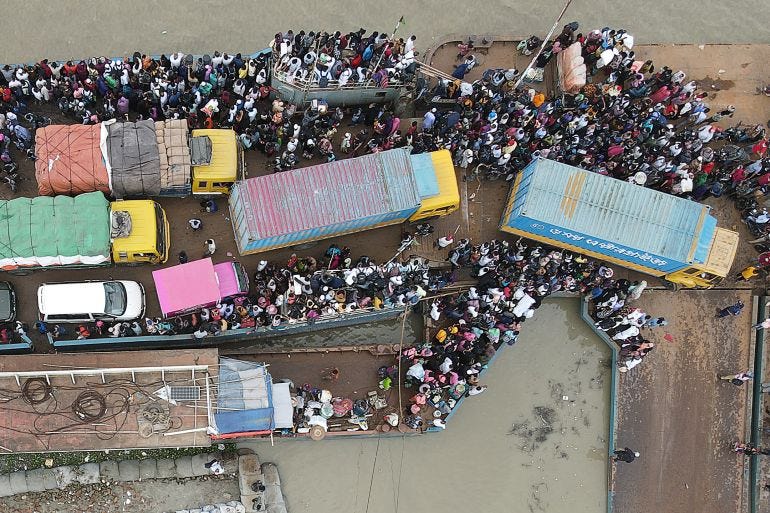
Other problems include inflation at 8.58 percent in January, driven by higher food and utility prices, with monthly consumer prices increasing by 0.23 percent amid a major financial crisis featuring currency devaluation, high rates of non-performing loans projected to reach 15 percent of GDP, and a severe dollar crunch. The banking sector is considered weak, according to the Asian Development Bank.
It is the unwilling host to more than 1.1 million Rohingya refugees who fled persecution in Myanmar’s Rakhine State. They are primarily located in crowded camps in Cox’s Bazar on the southeastern coastal region along the Bay of Bengal, creating immense pressure on local resources, the infrastructure and the economy.
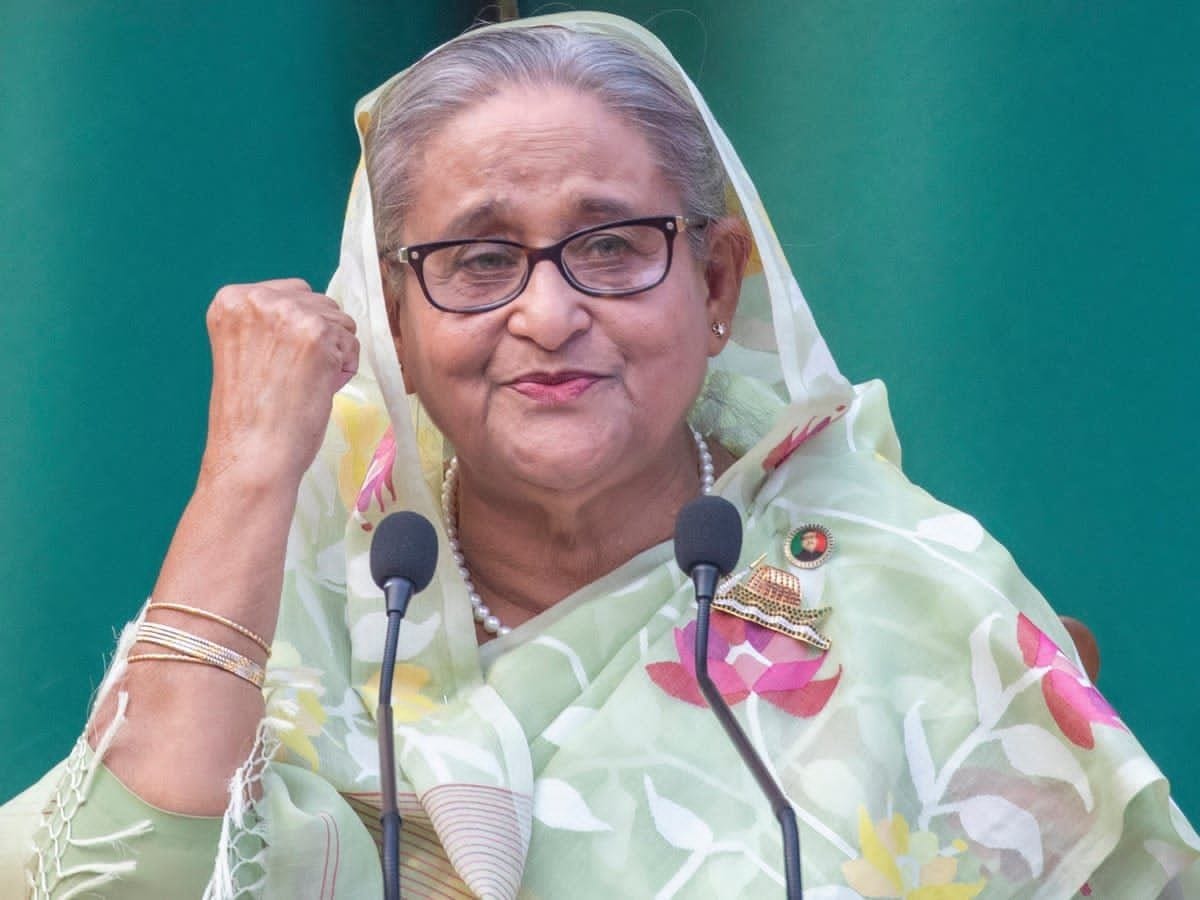
Then there is the specter of the 78-year-old Sheikh Hasina, in exile in a suspicious New Delhi, who has called the Nobel Peace Prize-winning Yunus a “murderous fascist” presiding over a “foreign-serving puppet regime,” claimed that the elections in Bangladesh would be neither free nor fair and who has pledged to overthrow the new government. Bangladesh is demanding her return to be put on trial for the thousands of deaths that allegedly occurred during her reign.
This is what the 60-year-old softspoken Tarique Rahman, the son of Presidents and Prime Ministers Ziaur Rahman and Begum Khaleda Zia, the grand dame of BNP politics and the mortal foe of Sheikh Hasina, faces if, as expected, he takes over the reins of the BNP and the country. Khaleda died just five days after he returned. If the events of the past week – a reasonably fair and free election despite the Awami League ban, and a new democratic constitution willed to him by Yunus – are any herald, he may have a chance.
Nava Thakuria contributed to this report