
By: Michael Vatikiotis
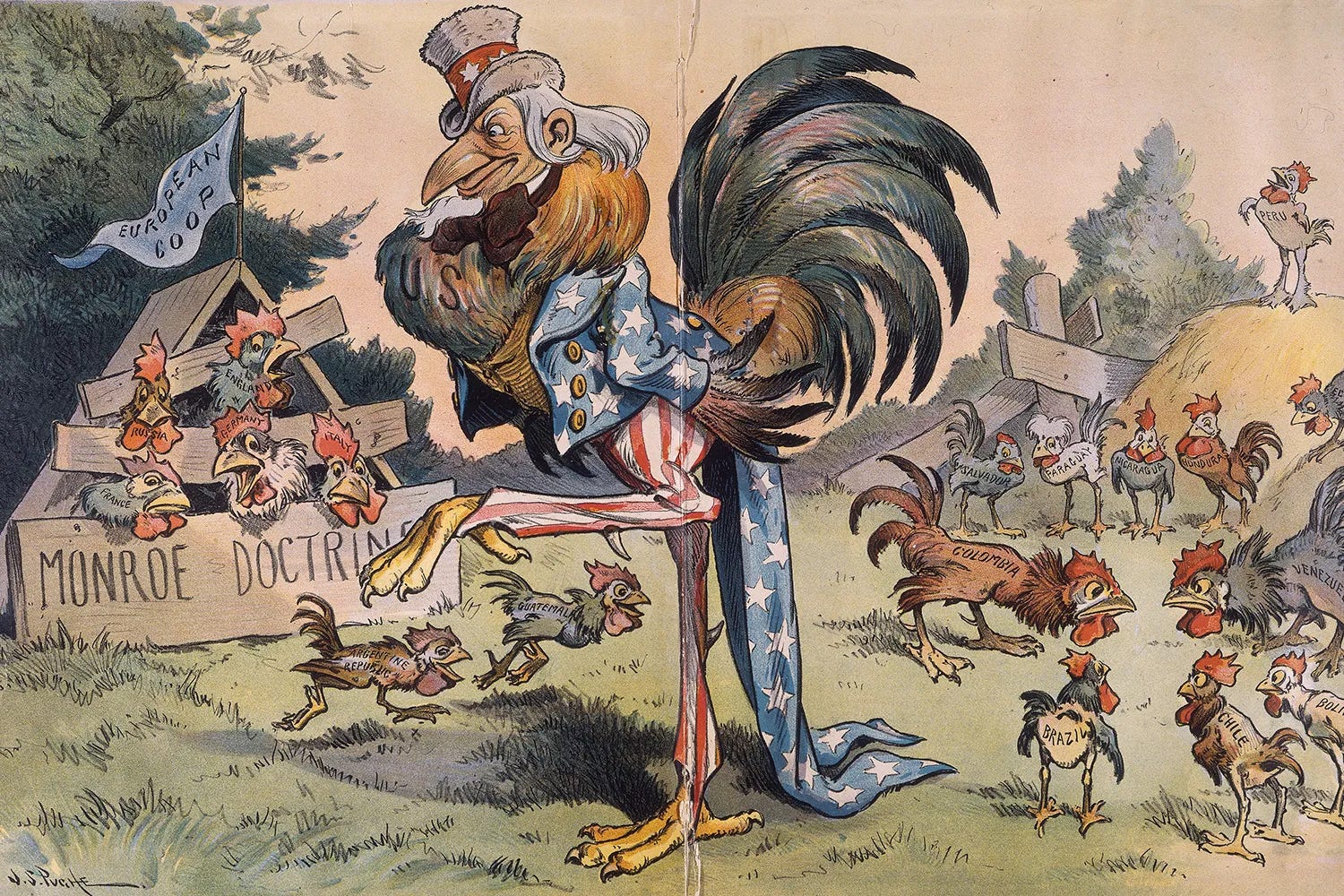
Lost in the shock and awe of President Trump’s audacious snatching of Venezuelan strongman Nicolas Maduro in the early hours of January 3 is the fact that America has a long history of orchestrating the departure of government leaders. Ngo Dinh Diem of South Vietnam in 1963, Salvador Allende of Chile in 1973, and then Ferdinand Marcos of the Philippines in 1986, to name but three. One might also throw in Indonesia’s President Sukarno after a CIA-supported coup in 1965.
More recently, in concert with the EU, the US poured money and intelligence resources into popular protests that brought down the government of President Victor Yanukovych in February 2014.
Clearly, the use of either force or indirect and covert means by the US to enact regime change is not new. Other great powers, notably Russia, have also exercised regime change as a tool of foreign policy - in Czechoslovakia in 1968, then Afghanistan in 1979.
Often, what followed was messy. As many as a million people died in the post-1965 coup witch hunt against Communists in Indonesia. Saddam Hussein’s downfall at the hands of the US resulted in a civil war that cost the lives of up to three million Iraqis. The 2014 Maidan protests set the stage for Russia to occupy Crimea and eventually invade Ukraine – Moscow describing the events in Kyiv as a coup to justify its actions.
Yet, just as often, much of the world, especially the Western non-communist world, quietly cheered US efforts to keep authoritarianism, communism, or extremism at bay. No one much believed the allegation that Iraqi President Saddam Hussein had WMD, but European states were fixated on the fear of Islamic extremism in the wake of 9/11. Saddam, although no Islamic extremist, was a convenient fall guy.
With very few exceptions, what followed these interventions was bad for the affected countries. South Vietnam fell to Communist North Vietnam a decade after Diem’s downfall; Chile endured decades of right-wing violence and repression; Indonesia under Suharto’s New Order endured military rule and repression, even as the economy prospered and grew.
Yet there were also moments of high-minded idealism. After Ferdinand Marcos fled into exile in Hawaii, courtesy of the US, the Philippines underwent a process of democratic reform and change led by President Corazon Aquino, the widow of assassinated opposition figure Ninoy Aquino. Her address to the US Congress in 1986 marked the high-water mark of a more benign US foreign policy rooted in the promotion of democratic change. Five years later, when President George Bush ordered US troops into Kuwait to counter an Iraqi invasion, the US was similarly praised.
What is new, and shocking to many today, is the absence of the old fig leaf, often used in these mostly covert operations, that the US was motivated by a desire to promote freedom and democracy. Let’s be clear: It almost always was a fig leaf. Usually, what followed was government led by a more pliant client of the US, which helped preserve vital strategic and economic interests of the US. “He’s a son of a bitch, but he’s our son of a bitch,” Franklin Roosevelt is alleged to have said about the Nicaraguan Dictator Anastasia Somoza in 1939.
Today, Trump’s ‘America First’ agenda eschews the idea that the US is in the business of forging change in the image of itself. ‘Far too many American presidents have been afflicted with the notion that it’s our job to look into the souls of foreign leaders and use US policy to dispense justice for their sins,’ Trump told an audience in Saudi Arabia last May. He slammed ‘so-called nation-builders’ who he said ‘wrecked far more nations than they built.’
Yet since making that speech, Trump has acquired a taste for military intervention. Barely a month later, he sent B2 bombers to attack Iran’s nuclear installations; in the months since, he has launched attacks on alleged drug smuggling boats in the Caribbean, and on Islamic extremists in Nigeria and Syria. He has also threatened to use force to crack down on drug cartels in Colombia and Mexico, and even acquire Greenland.
Like Presidents before him, some see a correlation between Trump’s declining popularity at home and increasing military adventurism abroad. In tandem, Trump seems to enjoy the situation room drama of overseeing military ops and has just announced a further increase in US defence spending.
Again, there’s nothing much new there. Only the mask of morality has slipped. So much, therefore, for Trump as “the President of Peace”.
Rather, what many now fear is that the US is forging a new brand of imperialism, one that harks back to the days of former US President Theodore Roosevelt who as Secretary of the Navy in the late 19th century initiated America’s colonial expansion into the former Spanish colonies of Cuba and the Philippines, arguing that it was a ‘step toward the complete freeing of America from European dominion.’ Interestingly, the counter argument was idealism: the US had no need to obtain colonies because the very notion of its democracy and freedom endowed it with the power of persuasion that would help open markets and boost trade.
Similarly today, Trump administration officials argue the need to impose control on states and territory in the Western hemisphere – defined as stretching from Latin America to Greenland – to secure control over resources because this is America’s backyard. Notions of America’s greatness being built on the idea of democracy and free trade are clearly no longer operative.
It is this new imperialism, rather than military intervention, that threatens global order. Just as Great Britain’s colonial neuralgia in the early 20th century set the stage for a devastating world war, so we should all be worried about what demons Trump has unleashed by declaring America First!
Michael Vatikiotis is a writer and private diplomat who has lived and worked in Southeast Asia for four decades. He is the author of seven books and was the managing editor of the now-defunct Far East Asian Review.
A Special Message to the Editorial Board of the Washington Post and other MSM lackies
You stood and clapped like a trained seal when the administration staged its gangster kidnapping of Maduro, a grotesque little coup dressed up as “justice.” Trump himself told the world, in his usual incoherent way, that this was about oil — about seizing Venezuela’s reserves and handing them to American companies.
Now, with the blood still warm and the smoke still rising from Caracas, you pretend that the oil never mattered, that this was all some noble, disinterested act of humanitarianism. Spare us the pantomime.
You’ve cheered an act of imperial piracy and called it policy; now you’d like to pretend that the loot was never the point. Your moral vision isn’t merely short-sighted; it’s willfully blind, a self-serving fog that descends whenever empire and oil are on the table.
Try, if only for the sake of your own dignity, to rip the cataracts of hypocrisy from your eyes before you lecture the rest of us about principle.
Thankfully, Asia Sentinel fulfills its namesake in reporting the truth without fear or favor.
God bless uncle sam for making the world safe for democracy. 🤮