
By: Nava Thakuria
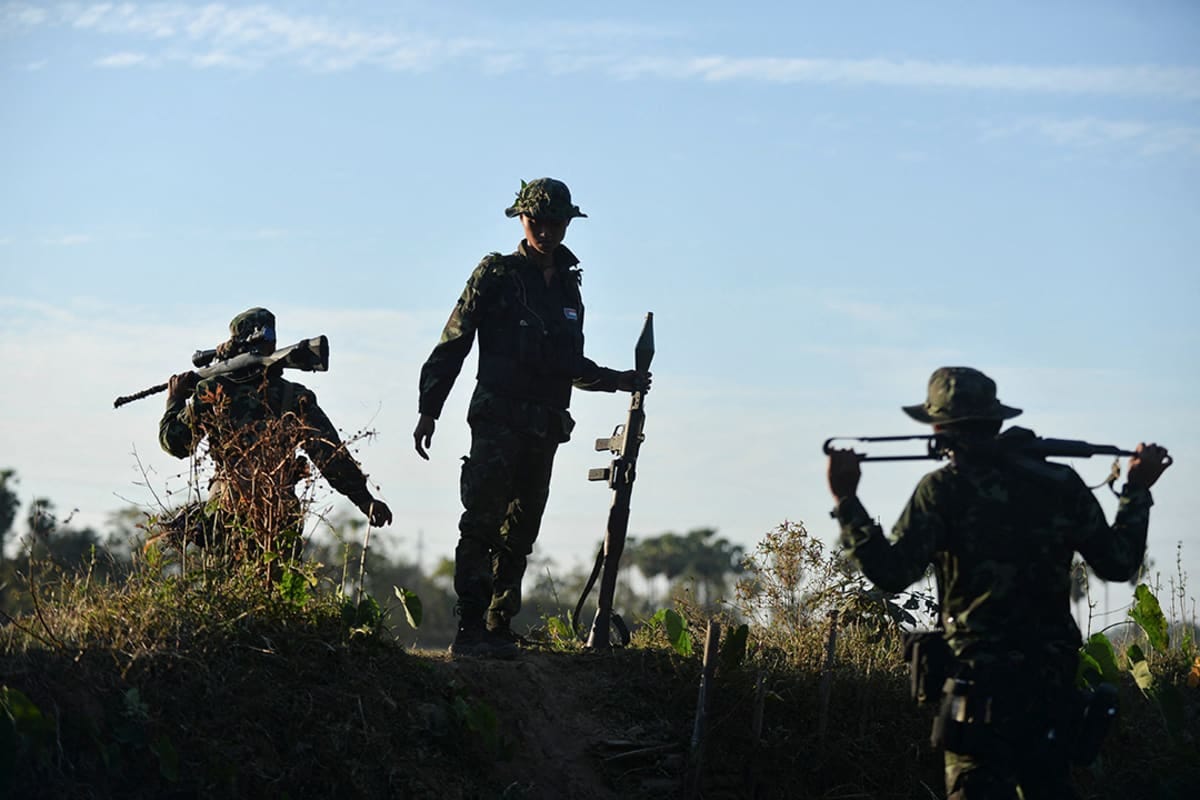
Myanmar’s civil war has settled into a pulverizing, multi-front stalemate in which neither side appears capable of a military victory with the Tatmadaw, as the junta’s military are known, seemingly having halted prior territorial losses and stabilized their position. Armed resistance groups, however, are said to control or contest up to 80 percent of the country of 55 million people, while the Tatmadaw control most of the cities and the sinews of commerce.
While tens of thousands have died on both sides in the conflict, it is a war that has been forgotten by the outside world, receiving a fraction of the news coverage or international aid afforded to other global crises. The brutal reality of the war—now well into its sixth year—is thus that it is largely unfolding in the dark.
More than two years ago, anti-junta forces launched a combined offensive that put the country in a severe political, economic and humanitarian crisis. One of the powerful resistance groups, the Arakan Army (AA), occupies and rules over 70 percent of the landmass of Rakhine State, with AA fighters continuing to target junta forces to take control over the state capital city of Sittwe. But the rebels received a rude shock in early June when the junta’s military leader Min Aung Hlaing, bolstered by the fig leaf of a sham January election, paid a five-day state visit to India, his first since leading the 2021 military coup that ousted the democratically led government headed by Aung San Suu Kyi. Discussions with Delhi are said to have ranged over trade, defense, security cooperation, border management, and “bilateral, regional and global issues of mutual interest.”
India’s interests are both strategic – countering China’s regional dominance – and commercial. New Delhi anticipates benefits from the ambitious Kaladan multi-modal transit-transport project it has sponsored on Myanmar’s western border, which would connect India’s landlocked north-eastern region with western Myanmar’s Sittwe port in the Bay of Bengal. An India-Myanmar-Thailand highway spanning over 1,360 km is expected to enhance regional connectivity and trading activities. The riverine project was supposed to be operational 10 years ago, but it continues to face difficulties primarily due to political turmoil in Rakhine and Chin States of Myanmar.
Both China and Russia have already taken sides, providing diplomatic, economic and military support to the junta, formally known as the State Security and Peace Commission. Lacking an international sponsor, the rebels are forced to source their weapons through a combination of domestic production, black-market purchases, battlefield captures and alliances with longtime ethnic rebel groups. But if the rebels are in stalemate, it is worth remembering that minorities have been carrying on civil wars in Burma and Myanmar for over 78 years, making it the longest ongoing civil war in the world.
In the meantime, Myanmar is being cut to pieces by strife. Global aid organizations claim that more than 5.3 million Myanmarese people are now living in distress. The UN High Commissioner for Refugees recently revealed that 1.6 million had already fled to the neighboring countries. Around 3.7 million internally displaced residents continue to live in border areas with no regular access to food, healthcare or shelter. Chronic poverty now affects nearly 80 percent of the population. Refugees have sought shelters in neighboring countries such as Bangladesh, Thailand, and India, putting pressure on their border economies.
Min Aung Hlaing has positioned himself as the civilian head after the disputed national election, which took place without the participation of opposition parties including the National League for Democracy. His recently concluded official visits to India and China have earned some dubious respectability. Although both giant neighbors welcomed Hlaing with red carpets, the ground reality remains the same. It remains one of the world’s most discredited regimes.
The ongoing conflicts have resulted in heavy casualties, with the United Nations estimating that more than 75,000 people have died over the past five years. Other estimates range above 100,000. The Rakhine region and central Myanmar continue to face the brunt of military atrocities. The UNHCR recently stated that civilians in both regions face continuing brutality, with junta forces using fighter jets and drones to drop explosives on civilian areas, even targeting schools, hospitals and refugee camps.
Students remain silent sufferers, with more than six million children and young people staying out of school in the 2026-2027 academic year. Thus, almost half of the country’s children (around 13 million) are now deprived of formal education. The healthcare sector has also collapsed as many doctors and health workers have died in repeated aerial attacks on clinics. Private hospitals have also been shuttered by the administrations and large numbers of healthcare professionals who allied with the opposition leaders have been arrested and prosecuted.
The media face the most critical period since independence, with at least 215 journalists arrested in the last five years. Some 15 remain in detention. The Geneva-based global media rights body, Press Emblem Campaign recently demanded their urgent and unconditional release. PEC President Blaise Lempen told Asia Sentinel that 97 media outlets have been subjected to legal harassment. Lempen urged authorities to revoke all bans, restriction and de-licensing of news outlets. Lempen’s demand is likely to fall on deaf ears, as all other such demands have done since the junta took over the country.
Likewise, the Association of South-East Asian Nations (ASEAN) has been urged to demand the unconditional discharge of all political prisoners, said to number 31,100 people since the 2021 coup, with more than 22,000 detainees remaining in military custody. Rights groups also have repeatedly asked ASEAN to condemn the forceful conscription of young people to fight against the anti-junta forces on the frontline.
Suu Kyi’s son Kim Aris has appealed to international governments and organizations to seek the 81-year-old woman’s whereabouts and to confirm that she is receiving appropriate medical care. The European Union, Yangon-based foreign embassies and diplomatic missions belonging to Australia, Britain, Canada, France, Germany, Italy, Switzerland, Norway, the United Kingdom and Netherlands, the Assistance Association for Political Prisoners and the UN special envoy on Myanmar echoed concerns while calling for her urgent release along with other political prisoners. The rebel National Unity Government joined the chorus for the release of all political prisoners
During Hlaing’s recent visit, Indian Prime Minister Narendra Modi also raised the issue of Suu Kyi and democracy, saying he supports an initiative for resolving security concern in the entire 1,643 km Indo-Myanmar border areas. North-eastern separatist militants have engaged in disruptive activities in the eastern part of India and then run to the safe hideouts inside Myanmar.